Mixed-use buildings: only one energy certificate from 2027?

The ground floor houses the bakery or the dental practice, and four households live above. For such a building, many owners have so far expected two energy certificates, because § 106 provided for separate treatment of mixed-use buildings. The section number stays in the law, but from 1 January 2027 a different subject sits under it. For the whole building there will then be only one energy certificate.
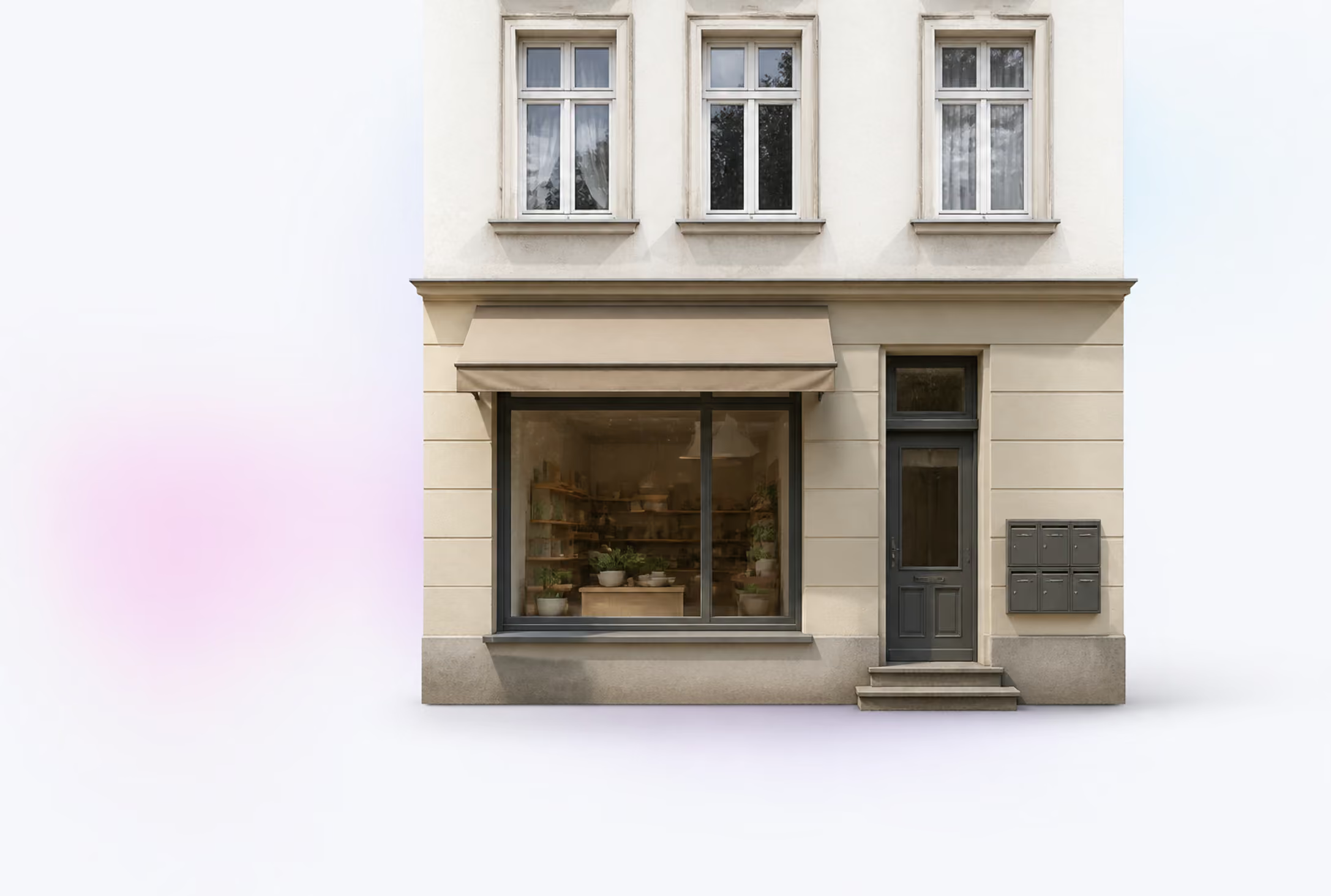
Mixed-use buildings: only one energy certificate from 2027? Yes. From 1 January 2027, one energy certificate is issued for the whole building. The separate treatment of building parts under § 106 in its former version no longer applies.
Whether a building is residential or non-residential depends on its predominant use. If the building is not used exclusively for living, a consumption-based certificate is no longer an option, and the issuer prepares a demand-based certificate.
The legal basis is Article 2 of the GModG from 1 January 2027. Until 31 December 2026, § 106 in its former version still applies.
Legal status / as of: 28 November 2026. GModG promulgated 28 July 2026 (BGBl. 2026 I No. 226). Article 2 from 1 January 2027.
In this article
- Until the end of 2026: building parts are treated separately under § 106
- From 1 January 2027: one certificate for the whole building
- Residential or non-residential building: predominant use decides
- Zoning under § 20(2): one certificate, several zones in the calculation
- What owners of a mixed-use building should check now
- Frequently asked questions
- Conclusion and outlook
Until the end of 2026: building parts are treated separately under § 106
Until 31 December 2026, the principle is that an energy certificate is issued for a building. An exception sits in § 79(2) sentence 2: a certificate is to be issued for parts of a building if those parts are to be treated separately under § 106. That section covers two cases. Parts of a residential building that differ substantially from living in their type of use and building services, and that make up a not insignificant share of the useful floor area, are treated separately as a non-residential building. Conversely, residential parts of a non-residential building that make up a not insignificant share of the net floor area are treated separately as a residential building.
The statute names no percentage threshold anywhere. It only requires that the part be “not insignificant”. Guides and official notes offer rules of thumb, but none of them appears in the law. Because of this dividing line, many owners of a building with commercial space still expect two certificates. The law as it stood until 2026 is explained in Energy certificate for a single flat and mixed-use buildings.
From 1 January 2027: one certificate for the whole building
Article 2 of the Building Modernisation Act (GModG) rewrites § 79(2). The sentence “An energy certificate is issued for a building.” stays. The following sentence on building parts under § 106 is repealed, as is the former § 106 “Mixed-use buildings”. The law therefore no longer provides for separate treatment of residential and non-residential parts. The BBSR sums up the consequence this way: there are no separate energy certificates for building parts any more, and there are only residential and non-residential buildings.
Watch the section number. From 2027, § 106 contains the requirements on solar energy in buildings, but no rule on mixed use. Older guides that cite § 106 for mixed-use buildings therefore describe the law as it stands until 31 December 2026.
| Question | Until 31.12.2026 | From 1.1.2027 |
|---|---|---|
| What is the certificate issued for? | For the building, and under § 106 also for building parts (§ 79(2)) | For the whole building (§ 79(2)) |
| Separate treatment of residential and commercial part | Separate if the share is not insignificant (§ 106) | No longer provided for |
| What does § 106 regulate? | Mixed-use buildings | Solar energy in buildings |
| Classification of the building | Residential and non-residential part separately where § 106 applies | As a whole by predominant use (§ 3(1) nos. 33 and 23) |
Residential or non-residential building: predominant use decides
Without § 106, the building is classified only as a whole. The criteria for this are set out in the definitions. A residential building is a building that, by its intended purpose, predominantly serves living (§ 3(1) no. 33). A non-residential building is every building that does not fall under that definition (no. 23). If flats predominate, the whole building is a residential building, even with a shop on the ground floor. If the business predominates, the whole building is a non-residential building, even with flats above. The law leaves open what “predominantly” means in figures.
For the certificate type, however, the classification makes little difference in a mixed-use building, because both routes lead to the demand-based certificate. For a non-residential building, a certificate based on an energy balance calculation must be issued for a sale, letting, lease, leasing or contract extension (§ 80(3) sentence 2). § 82(1) permits the consumption-based certificate only for buildings used exclusively for residential purposes. A residential building with a shop or practice is, as a rule, not used exclusively for residential purposes. The Gebäudeforum klimaneutral of dena takes the same view.
Both routes lead to the demand-based certificate for the whole building
What remains open is how large a secondary use must be before a building is no longer used exclusively for residential purposes. For a very small practice or office in the building, clarify the classification with the issuer before ordering. For which buildings owners may choose a consumption-based certificate from 2027 is explained in Will consumption certificates become the bestseller?
Zoning under § 20(2): one certificate, several zones in the calculation
The single certificate does not erase the differences between flat and shop. They enter the calculation as separate zones. Under § 20(2), a residential building is divided into zones if not insignificant parts of the useful floor area serve purposes substantially different from living and their building services differ substantially from residential use. The standard is DIN/TS 18599 in the 2025-10 edition. For the demand-based certificate of an existing building, § 81(2) and § 38(3) refer to these calculation rules. For a non-residential building, § 21(2) provides for zoning anyway.
The issuer then accounts for shop and flats separately and combines the result in one joint balance. Zones therefore do not mean several certificates. There is still one joint balance and one document. How the zones are delimited in detail follows the standard and is the issuer's task.
One joint balance, one document
What owners of a mixed-use building should check now
This gives you a short preparation before you order the certificate.
Preparing the energy certificate for a mixed-use building from 2027
Frequently asked questions
Do I need two energy certificates from 2027 for a building with a shop or practice?
No. From 1 January 2027, one energy certificate is issued for the whole building. The separate treatment of building parts under § 106 in its former version no longer applies.
What does § 106 regulate from 2027?
From 1 January 2027, § 106 regulates solar energy in buildings and no longer mixed-use buildings. Texts that cite § 106 for mixed-use buildings describe the law as it stands until 31 December 2026.
How is a building with a practice on the ground floor and flats above classified?
What counts is the predominant use of the whole building. A residential building is a building that, by its intended purpose, predominantly serves living, and every other building is a non-residential building. The law names no percentage threshold. The building is classified as a whole and not in parts.
Can I choose a consumption-based certificate for a building with a shop or practice?
No. From 2027, a consumption-based certificate is permitted only for buildings used exclusively for residential purposes (§ 82(1)). For a non-residential building, a certificate based on an energy balance calculation is required in any case (§ 80(3) sentence 2). For a mixed-use building the issuer therefore prepares a demand-based certificate. For a very small secondary use, the issuer clarifies the classification.
Does zoning mean that several certificates are still issued?
No. Zoning under § 20(2) concerns the calculation. Residential and commercial use are accounted for separately in the balance, and the result appears in one certificate.
Do my existing two certificates for the residential and commercial part remain valid?
An energy certificate is valid for ten years (§ 79(3)). The transitional provisions in § 112 contain no separate rule for certificates already issued for individual building parts. Whether such certificates still suffice from 2027 as a valid certificate for the building under § 80(3) is therefore not expressly regulated. Clarify this with the issuer before a sale or letting. With a new demand-based certificate for the whole building, the question no longer arises.
Can I get an energy certificate just for my flat in the building?
No. Even for a mixed-use building the certificate is issued for the building, not for a single flat or a single shop. The principle is explained in the article Can I get an energy certificate for my flat?
Conclusion and outlook
For a building with a flat and commercial space, a simple rule applies from 2027. The energy certificate is issued for the whole building, and because the building is not used exclusively for living, it is a demand-based certificate. How the issuer separates shop and flats in the balance is the issuer's task. Your task is to keep use and documents complete. You can order the demand-based certificate through the guide Order a demand-based energy certificate online. If the classification of your building stays unclear, the certificate check helps.