Energy certificate answers
Frequently asked questions (FAQ)
Answers to frequently asked questions for owners, landlords, property managers, estate agents and partners — with a clear focus on GModG changes from 1 January 2027.
Four steps to a valid energy performance certificate
- Check whether a certificate is required. Confirm whether sale, re-letting, leasing or a similar trigger applies. From 1 January 2027 the listed-building exemption ends; buildings under 50 m² useful floor area remain exempt.
- Choose the certificate type. Decide between demand-based and consumption-based certificates. Until end-2026 special rules apply to small older buildings; from 2027 pure residential buildings with valid consumption data have a free choice.
- Order the certificate online. Gather documents and building data and commission a qualified issuer — e.g. self-service at energyausweis.de. Property managers should prepare annual consumption data over two years from 2027 onwards.
- Prepare the listing and handover. Present the certificate at the latest during a viewing and hand it over after contract conclusion. From 2027 listings require primary energy demand and issue date; existing certificates keep final-energy disclosures until expiry.
All questions at a glance
Almost every heated or cooled building needs a certificate when you sell, re-let, lease or create a hereditary building right. New builds receive a demand-based certificate. Exceptions remain narrow: buildings under 50 m² useful floor area and buildings that cannot be heated or cooled with energy.
Important from 1 January 2027: Article 2 of the GModG ends the listed-building exemption. Heritage protection no longer removes the duty to hold a certificate on sale or letting — see listed buildings and EPCs from 2027.
Certificates are usually valid for ten years. A new one is due earlier if you substantially change or extend the building envelope and the whole-building proof must be renewed. Until expiry you may reuse the same certificate for further lettings and sales — but listing disclosures must match the applicable legal regime (see the GModG transition for existing certificates).
Budget from about €50 upwards. Price depends on certificate type, building complexity and self-service versus on-site survey. Rough guide for dwellings up to about five units:
Certificate type Service Price per certificate Consumption Self-service €50–80 Demand Self-service €100–200 Consumption On-site service €200–400 Demand On-site service €300–500 Current energyausweis.de prices are on the price list. More context: EPC cost comparison.
Usually the seller, landlord or property management — whoever must ensure interested parties can see a valid certificate. Owners and agents may agree who pays; many agents order certificates for their clients.
Yes — if a qualified issuer produces it and the data are correct. Lower online prices mainly reflect self-service data collection by owners or managers, not weaker legal effect. The DIBt registration number on the certificate documents the issuer’s registration.
From 1 January 2027 (GModG Article 2): That special rule ends. Buildings used exclusively for residential purposes that meet the consumption-certificate data rules have a free choice — including older small buildings. Mixed use usually means a demand-based certificate. Details: consumption-certificate choice from 2027.
Until 31 Dec 2026: Existing buildings often have a choice. Exception: small residential buildings with a building application before 1 Nov 1977 and fewer than five dwellings that do not meet the 1977 thermal standard — there a demand-based certificate is often mandatory. New builds and cases without consumption data need a demand-based certificate.
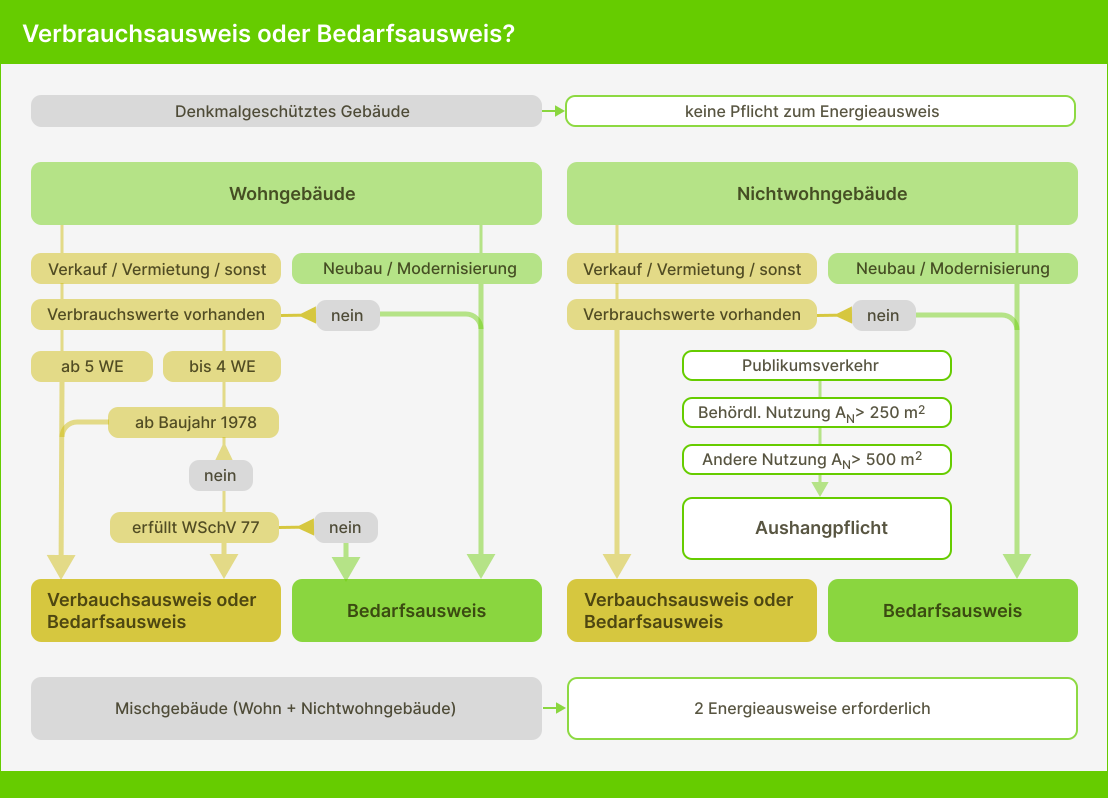
A demand-based certificate rates building quality independent of occupant behaviour. A consumption-based certificate reflects measured use over recent billing periods — thrifty users may look better than demand, intensive users worse.
There is no legal ranking that “demand is always better”. What matters is data quality, use type and — from 2027 — whether a consumption-based certificate is allowed. With Energyausweis Smart™ we calculate both paths internally and issue the more favourable lawful option.
Core fields are certificate type, final energy in kWh/(m²·a), energy carrier, year of construction and efficiency class. For residential buildings the A+ to H scale remains final-energy-based (§ 86(2) GModG). Primary energy figures and modernisation recommendations are also included.
Certificates issued after Article 2 takes effect also add absolute annual amounts in megawatt-hours. Listings from 2027 follow a separate mandatory set (primary energy + issue date) — see the agent questions below.
Metric Unit / form Where to find it Building Year, useful floor area, etc. Page 1 top Energy carrier Oil, gas, etc. Page 1 top Renewables PV, etc. Page 1 middle Ventilation / cooling Window ventilation, etc. Page 1 middle Certificate type Consumption / demand Page 1 bottom Final energy value kWh/(m²a) Page 2 or 3 Energy efficiency class A+ to H (residential) Page 2 or 3 Primary energy demand kWh/(m²a) Page 2 or 3 Modernisation recommendations Individual measures Page 4 At energyausweis.de owners, landlords, property managers and agents order online. Partners can refer via the partner programme (affiliate) or embed certificates with the Energyausweis API™.
Self-service online certificates are often ready within a few hours if the data are complete and plausible. Follow-up questions on missing data delay the process. On-site surveys usually take several weeks.
New builds should sit in the green range (roughly class B or better). For buildings under about ten years old, at least class D is a realistic guide. Unrefurbished older stock often sits at F, G or H — not a purchase blocker, but a signal for heating costs and retrofit need. The residential A+ to H scale remains final-energy-based under the GModG; see the GModG scale fact-check.
Plan for higher heating costs and possible retrofit spend — and use the class in price negotiations. The modernisation recommendations on the certificate are a starting point, not a full renovation plan.
You mainly cut heat and cooling losses via the envelope and plant:
- Insulate the roof.
- Insulate the façade.
- Insulate the basement ceiling.
- Replace windows and doors.
- Renew the heating system.
PV or solar thermal do not always cut envelope final energy, but often improve the primary-energy balance. Listed buildings face additional heritage constraints — the 2027 certificate duty does not relax monument consent for works.
The EPBD certificate reform sits in Article 2 of the GModG and takes effect on 1 January 2027 — not with Article 1 (heating reform / renaming since 29 July 2026). For certificates, that includes among other things:
- Updated rules on issue, presentation and listing disclosures (§§ 79–88).
- Digital certificate: machine-readable new issues (§ 79(2)); paper only on request.
- Choice of consumption-based certificates for pure residential buildings (old small-building special rule removed).
- End of the listed-building exemption from the certificate duty.
- New trigger: lease, tenancy or leasing renewals also require a certificate (§ 80(3)).
- Stricter consumption-data requirements (annual periods over two years).
- Certificate content: absolute annual primary and final energy in megawatt-hours (§ 85).
- Quantified modernisation recommendations as mandatory content (§ 84).
- Listings: primary energy demand and issue date instead of final energy as the mandatory metric (§ 87).
- § 112(3) transition: certificates issued before the reform keep final-energy listing disclosures until expiry.
- Fines up to €10,000 per offence (§ 108) — including presentation, handover and listing breaches.
From 1 January 2027 a newly issued energy certificate must be issued digitally in a machine-readable format (§ 79(2) GModG). Paper is available only on request from the client or owner. Certificates already issued remain valid until expiry — including paper copies.
For you the main change is delivery: you usually receive a digital file to store and forward. The presentation duty at viewings remains; a screen/PDF, printout or visible display is enough if the content can be read. Details: digital energy certificates in practice.
Yes, on sale, letting and the other trigger cases. Until end-2026 the listed-building exemption still applies; from 1 January 2027 Article 2 removes it from § 79. Heritage status no longer removes the certificate duty — though it still constrains retrofit works. More: tens of thousands of listed buildings need a certificate from 2027.
Yes — if the building is used exclusively for residential purposes and meets the new § 82 consumption-data rules (including annual periods over two years). The link to a pre-1977 building application / 1977 thermal ordinance ends. Any commercial share typically forces a demand-based certificate. Details: choice for all residential buildings.
Keep a valid certificate ready before you advertise or show the property. Check expiry and certificate type; for listed buildings and small older stock, plan for the 1 Jan 2027 cut-over. For consumption-based certificates from 2027, secure annual consumption data early. Order at create an EPC online.
From 1 January 2027 consumption-based certificates need annual consumption data over two years per energy carrier (latest period no more than 18 months old). That hits day-to-day rental and condominium management — heating-cost routines often supply the raw data. Modernisation recommendations and owners’ meetings move closer together. Depth: GModG for property managers.
Yes. At the latest during the viewing the certificate must be available (visible display or inspection). After contract conclusion it must be handed over promptly as original or copy. If there is no viewing, present it without delay — at the latest on request. The structure remains under the GModG; the wording becomes more precise (§ 80). More for agents: GModG for estate agents.
From 1 January 2027 § 87 GModG replaces the final-energy figure in the ad with annual primary energy demand and adds the issue date, plus certificate type, efficiency class, year of construction and main heating energy carriers. The residential class remains final-energy-based — so the ad metric and the colour scale can diverge.
Transition: Certificates issued before entry into force keep today’s final-energy listing duties under § 112(3) GModG until they expire. Portals and CRMs need both paths.
§ 108 GModG provides fines up to €10,000 per offence. In practice UWG cease-and-desist letters (competitors, associations) are often the larger commercial risk — listing disclosures are market-conduct rules. Typical costs: association warnings in the low hundreds of euros, lawyer fees and contractual-penalty threats in four to five figures.
Offence Liability Fine (framework) Mandatory details missing or wrong in property ads Agent / advertiser up to €10,000 Certificate not presented or handed over on sale or re-letting Agent / seller / landlord up to €10,000 False or missing data supplied for the certificate Owner up to €10,000 Certificate or data not sent to the authority for inspection Issuer up to €5,000 With affiliate you refer customers to energyausweis.de and earn a commission; we own checkout, payment and issuance. With the API you embed the certificate in your software, serve the end customer under your brand and set your own price — we issue and invoice you. Overview: partner programme.
In the partner portal you get link and embed assets pointing to our sales pages. Standard commission is 20% of list price; with higher monthly volume up to 30%. Best for sites, blogs and agencies without their own integration. Start at the partner programme or partner login.
Portals, agent and property-management software, and PropTech products that need certificates inside their own UX. API usage is free; issued certificates are billed. You may sell above our list price — margin often beats affiliate commission. Product page: Energyausweis API™, try-out: API try-out.