The digital energy certificate from 2027 – what will it look like?

From January 2027 the energy certificate must be issued digitally in a machine-readable format. Paper is only required when the client or owner requests it.
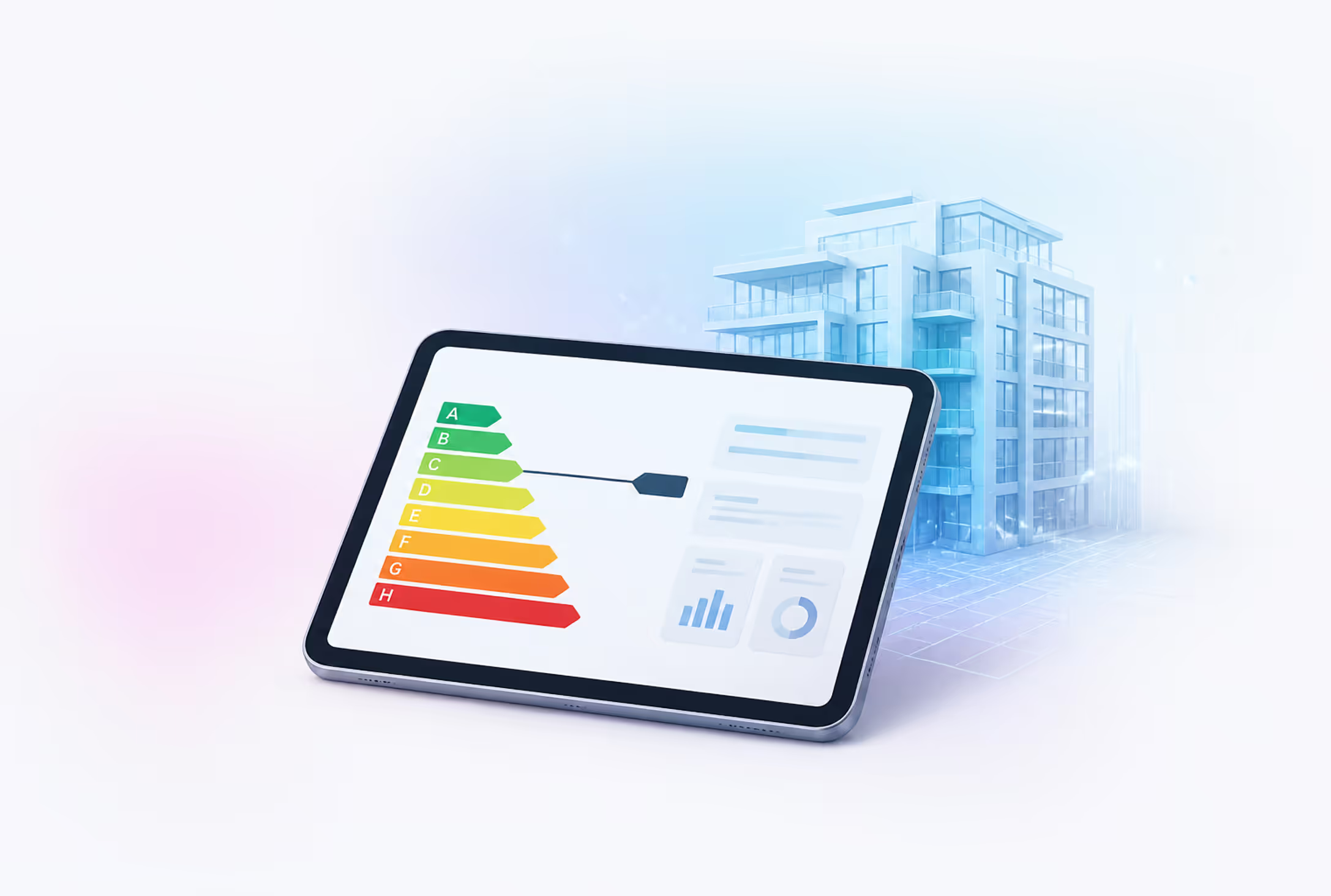
As of September 2026, however, new templates under § 85(8) GModG in the Federal Gazette and a finally published delivery format are still missing, even though the duty is already set in Article 2 of the promulgated amending act ( BGBl. 2026 I No. 226).
In this article
- What applies from January 2027
- What is still missing: templates and data format
- DIBt control XML as an orientation example
- PDF, pure digital file and viewer
- Result data, input data and retrievability
- Authenticity and integrity
- New business models become conceivable
- How to classify the digital duty and format questions
- Frequently asked questions
- Summary and outlook
Legal status: Promulgated on 28 July 2026 (BGBl. 2026 I No. 226). Article 2 (EPBD energy certificates, including § 79(2) digital) from January 2027. DIBt status on templates and schema: research September 2026. Hypotheses and market expectations are labelled below.
What applies from January 2027
Once Article 2 applies, digital issuance is the default. Paper remains the exception on request. The promulgated wording of § 79(2) states: the energy certificate must be simple and understandable. It must be issued digitally in a machine-readable format. On request of the client or owner it must also be issued on paper.
That does not change the duty to produce on sale and letting. Under § 80(4), the seller or estate agent must produce the energy certificate or a copy for the prospective buyer at the latest at the viewing. A clearly visible display or laying out also meets the duty. Digital therefore does not replace the duty to produce, but it does change the issuance standard. Anyone who only has the file in storage but shows no accessible proof at the viewing fails the duty to produce.
A good overview of the timeline is in GModG enacted: The new energy certificate arrives on 1 January 2027. The decision history is under GModG adopted.
| Layer | Status | Applies from |
|---|---|---|
| Digital, machine-readable issuance (§ 79(2)) | Law (Art. 2) | 01.01.2027 |
| Paper form | Only on request of client/owner | 01.01.2027 |
| Duty to produce at viewing (§ 80(4)) | Remains | 01.01.2027 (Art. 2 version) |
| New template / final delivery format | Not yet finally published (DIBt status) | open |
What is still missing: templates and data format
The duty is in the statute, while templates and schema still follow the GEG-2024 interim status at
the time of research. The German Institute for Construction Technology (DIBt) writes in its FAQ on
the XML control file: so far no new energy-certificate templates under § 85(8) GModG have been
published in the Federal Gazette. The existing GEG-2024 templates and schema
Kontrollsystem-GEG-2024_V1_0 continue to apply. Changes to disclosures and calculation bases take
effect only on January 2027. A technical adaptation of the registration system is therefore
planned for January 2027
(DIBt FAQ).
The law therefore sets “digital and machine-readable”. Official practice as of September 2026 still lags behind that: templates and schema for the new certificate type are not yet final. The technical switch is planned for the cut-off. Software vendors and issuers therefore plan with a tight window between publication and go-live.
DIBt control XML as an orientation example
It is plausible that the digital energy certificate will take its cue from today’s control file. Today issuer software produces, alongside the visible certificate, an XML control file under the DIBt schema and uploads it to the registration body on request. That file is machine-readable and control-capable because it follows the prescribed data schema.
Orientation example: a future delivery format could build on this schema, possibly slimmed of fields that serve only official control.
In favour is the existing software chain. Issuer tools already produce the control file. DIBt sets the data schema and already plans a technical adaptation of the registration system for January 2027. That would save issuers a lot of effort, because delivery format and control file would stay related rather than introducing an entirely new schema.
Against is the difference in purpose. The control file serves official sample checks and typically carries more than the indicators on the visible certificate. Owners, agents and banks need a delivery format for proof and onward transfer, not necessarily the same control scope. So a leaner result-data schema, a two-track path (control and delivery separate) or an entirely different official format remain possible.
Until templates and schema are published, alignment with the control file stays a reasoned orientation example for planning, not an official requirement.
PDF, pure digital file and viewer
Alongside the digital duty, market practice still needs human-readable proof, so PDF and viewers remain likely companions. § 79(2) does not ban PDF. Market expectation: estate agents, portals and banks will still need a human-readable representation, often as PDF beside or rendered from the digital file. That matches estate-agent practice on presentation and listing (GModG for estate agents).
A second scenario is the pure digital file plus viewer. The machine-readable file is the original. Online issuers are likely to ship a viewer as a component that shows indicators clearly and supports authenticity checks, for example via the registration number. Screen, browser viewer or display extract meet inspection at the viewing. Anyone who builds processes only on “we keep emailing a PDF” ignores the digital duty. Anyone who only stores an opaque file ignores viewing practice.
| Delivery path | Character | Status in this article |
|---|---|---|
| Machine-readable digital file | Statutory issuance duty | Law from 01.01.2027 |
| Paper | On request | Law |
| Human-readable, often a workflow standard | Market expectation (not banned) | |
| Viewer on the digital file | Inspection without a paper stack | Market expectation |
Result data, input data and retrievability
Machine-readable does not yet say which fields the delivery file carries or whether owners can retrieve centrally. Whether the delivery file to owners, agents and banks carries mainly result data (classes, indicators, registration number) or also input/calculation data is an open technical question. It is not one already decided in the Act.
Likewise, as of this research there is no evidence of a public central owner retrieval database from which anyone could download their certificate. Registration and control at DIBt are different from a citizen portal.
For property-management and PropTech platforms the interface question therefore stays central: accept the file, store it, pass it to clients and portals. See GModG for property-management platforms. Without a clear field model, integrations stay provisional and must be able to follow schema updates.
Authenticity and integrity
Without reliable authenticity checks the digital file becomes a risk in estate-agent and bank processes. That is why common industry mechanisms matter. GModG § 79(2) does not prescribe a concrete signature technology. In practice and for comparable digital documents, the following mechanisms are among those commonly used, without § 79(2) making them a statutory duty:
- registration number of the energy-certificate registration body
- cryptographic signature or hash of the file
- QR code or deep link for verification
- known issuer or software chains
While official templates and schemas are still pending, portals and banks should at least check registration number and issuance data against the visible content and avoid post-handover file changes. A forged PDF copy without a verifiable digital file remains a market problem, regardless of whether the delivery format becomes XML, a container or something else.
New business models become conceivable
If the digital file carries input data of the calculation as well as result data, new business fields open up beyond mere issuance. Certificate production could then also be checked by another issuer or by agents and banks with access to verification software. That does not replace DIBt control; it can extend due diligence in the market.
Beyond that, applications become conceivable that today fail on PDF and manual retyping: portal prefill for listings, portfolio and ESG analysis, renovation scenarios from envelope and plant data, software switches without resurvey, and anomaly checks across many certificates. Software for verification, display and analysis would specialise the market further. While the field model remains open, this stays a market expectation.
How to classify the digital duty and format questions
Digital duty and format questions: short check
Frequently asked questions
What applies from January 2027 for digital issuance?
The energy certificate must be issued digitally in a machine-readable format. On request of the client or owner it must also be issued on paper (§ 79(2) GModG, Art. 2 from 01.01.2027).
Is PDF banned from 2027?
No. The law requires a digital machine-readable format and regulates paper on request. PDF is not banned. Many workflows are likely to keep using PDF (market expectation).
Is the official delivery format already final?
No. As of September 2026, new templates under § 85(8) and a published delivery format are still
missing. GEG-2024 templates and schema Kontrollsystem-GEG-2024_V1_0 still apply. DIBt plans a
technical adaptation of the registration system for January 2027.
Does DIBt control XML automatically mean the 2027 delivery format?
No. In favour: the existing software chain and the planned registration-system update. Against: the purpose difference (control vs delivery), the missing publication status and possible new mandatory fields. Alignment remains an orientation example, not an official requirement.
Is there a central public retrieval database for owners?
As of this research there is no evidence of such a public retrieval DB. Registration and control are separate.
What is a viewer for the digital file?
A viewer makes the machine-readable certificate file readable and checkable. Online issuers are likely to offer it as a component so owners, agents and banks can present the file and verify authenticity without necessarily requiring paper.
Summary and outlook
The essentials at a glance:
- Law from January 2027: Digital, machine-readable issuance (§ 79(2)). Paper only on request. Duty to produce at viewings remains (§ 80).
- Still open: Official templates and final delivery format; as of September 2026 still GEG-2024
templates and schema
Kontrollsystem-GEG-2024_V1_0. - Market paths: PDF and viewers as readable companions (market expectation); DIBt control XML as an orientation example, not a 1:1 rule.
- Field scope: Result vs input data shapes prefill, portfolio analysis and third-party checks (scenario). No evidenced public retrieval DB.
- Integrity: Common industry checks are practice, not a duty under § 79(2).
What comes next depends mainly on notices on templates and data schema. Until then, owners, agents, banks and portals can already clarify how they store the digital file, make it inspectable at viewings and pass it on.
The statutory frame from January 2027 is fixed. The technical design remains open. Keeping those apart lets you plan storage and presentation without waiting for finished templates. When a new certificate is due, order early via energyausweis.de once it is clear when the certificate must be available.