Energy certificate in Munich: order from the online test winner

Munich is one of Germany’s strongest economic centres and a highly sought-after property location. With around 1.5 million inhabitants, high prices and scarce housing, the city places particular demands on owners, investors and managers.
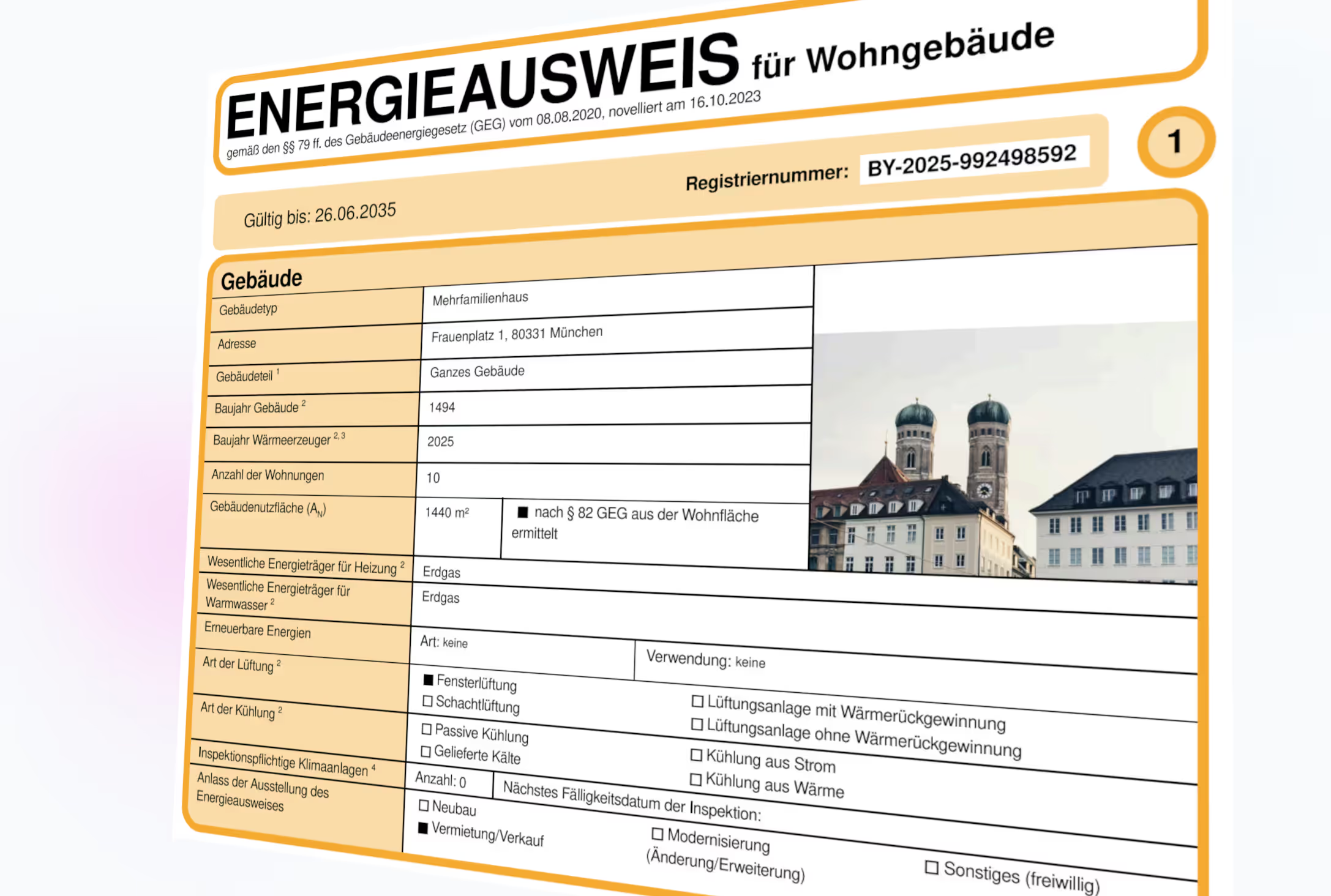
In this context the energy certificate matters more and more: it is not only legally required but also central for sale value, lettability and energy refurbishment.
What you need to know
- … the link between building age classes and energy certificates
- … how refurbishment status affects certificates in Munich
- … current figures and trends 2025 for certificates in Munich
- … ordering your energy certificate in Munich online
- … dominant energy sources in Munich 2025
- … top energy measures for Munich properties
- … solar potential in Munich
Energy efficiency in Munich: building age and certificates
A building’s energy quality depends strongly on year of construction and any refurbishment. In Munich, different building ages shape the city — from unrefurbished period buildings in Maxvorstadt to modern housing in Freiham. These differences are reflected directly in the certificate.
Typical building age classes and energy profile
The chart below shows the distribution of residential buildings in Munich by construction year, which gives an idea of likely efficiency classes:
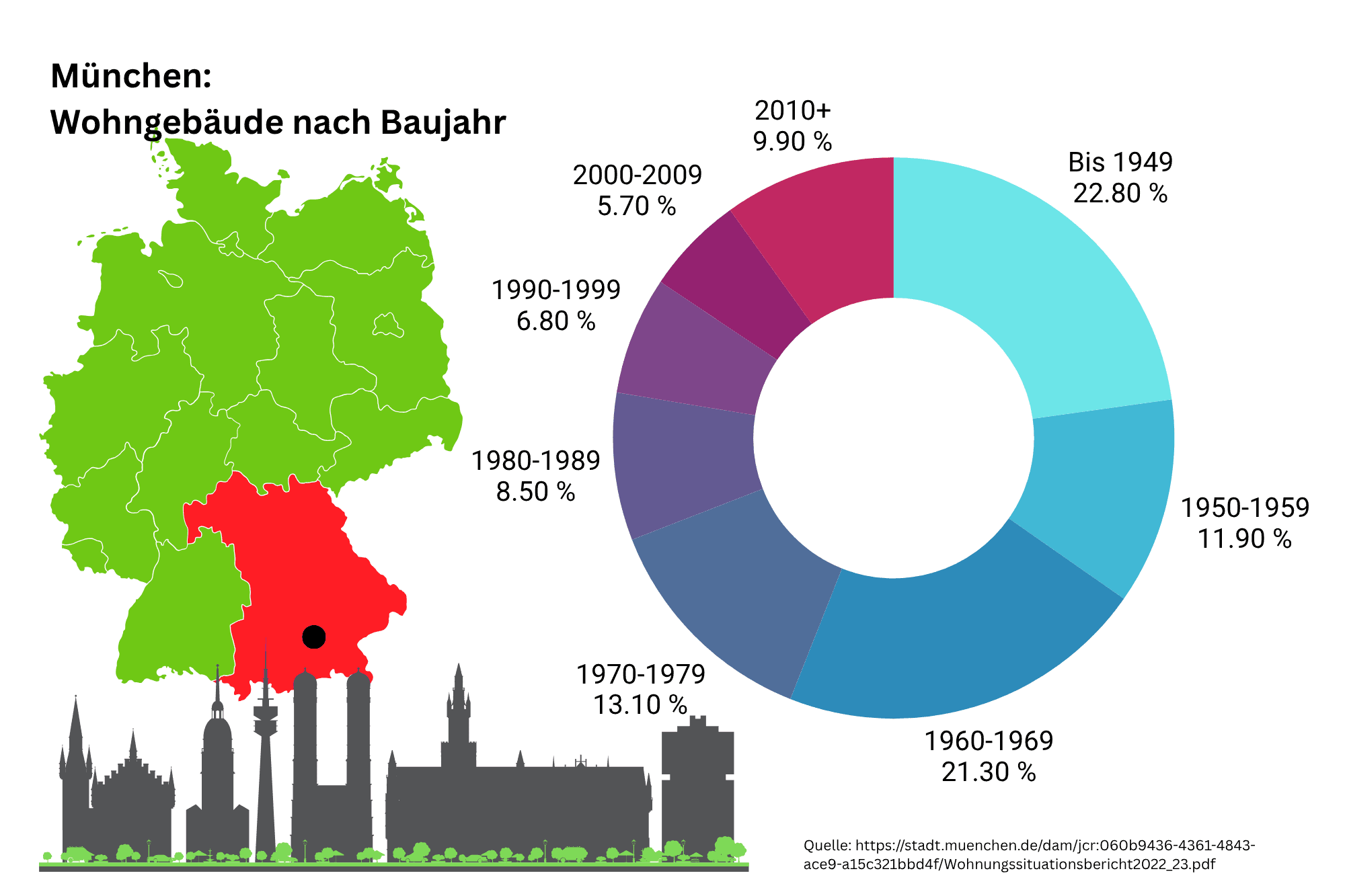
Typical efficiency classes by age (without refurbishment): pre-war F–H; post-war E–F; 1979–1999 C–D; from 2000 A–B.
Refurbishment status and certificates in Munich
Whether a building has been refurbished strongly affects its certificate. In Munich, status varies by area, building type and ownership. New-build areas often have modern insulation and heat pumps; in parts of Haidhausen, Schwabing or Sendling many unrefurbished buildings still have high energy demand.
Typical refurbishment measures and their effect
| Measure | Typical improvement | Effect on certificate |
|---|---|---|
| Facade insulation | up to 30% less heat loss | Improvement by 1–2 efficiency classes |
| Heating modernisation (e.g. heat pump) | up to 50% primary energy saving | Improvement by 2–3 classes |
| Window replacement (triple glazing) | up to 20% less heat loss | Improvement by 1 class |
For the demand-based certificate, the building is assessed objectively regardless of user behaviour; refurbishment leads to clear improvements. The consumption-based certificate can also be influenced by how occupants behave.
Energy certificates for residential buildings in Munich: figures and trends 2025
An estimated 30,000–40,000 certificates for residential buildings are issued in Munich each year, especially when properties are sold, let or refurbished. Since the 2024 GEG amendment, CO₂ emissions per m² must also be stated. Many certificates from 2015–2016 expire in 2025, so new certificates are needed. Smart certificates (combining consumption-based and demand-based and showing the better class) are increasingly used, especially for multi-family buildings.
Energy certificate in Munich online
You can order a certificate easily online via certified platforms such as energyausweis.de. Process: (1) Fill in the form with property details, year built, floor area, heating, etc. (2) Choose certificate type: consumption-based, demand-based or Energyausweis Smart™. (3) Receive the certificate within a few days. Benefits: often cheaper than on-site, fast processing, certified consultants check the data.
Energy sources in Munich: what dominates the market 2025
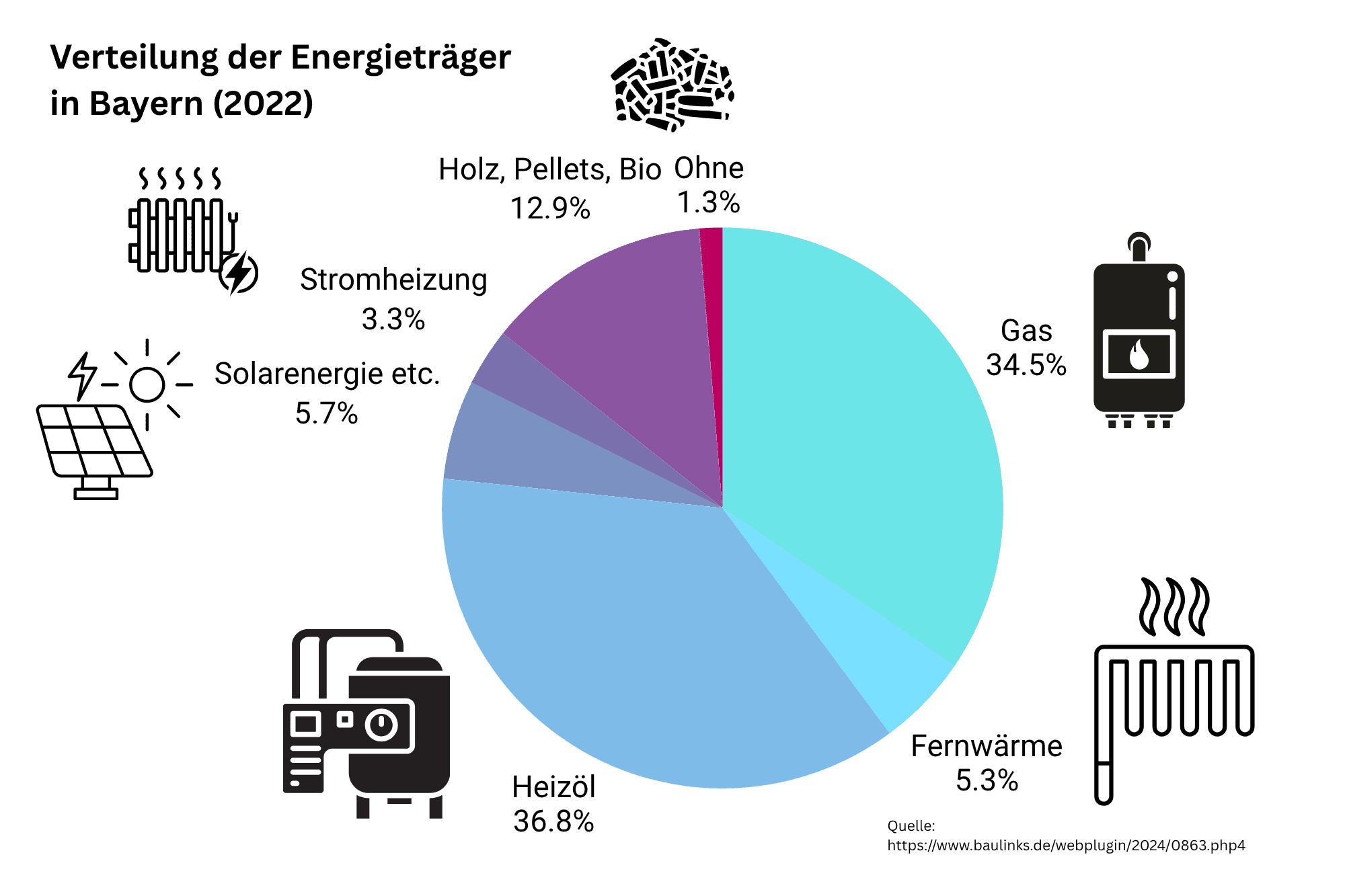
Heating oil (36.71%) and gas (34.43%) together account for over 70%. Wood/pellets 12.97%, solar/heat pumps 5.73%, district heating 5.34%. The mix is diversifying.
| Energy source in Bavaria | Share (%) |
|---|---|
| Gas | 34.43 |
| Heating oil | 36.71 |
| Wood, pellets | 12.97 |
| Biomass (excl. wood), biogas | 0.11 |
| Solar/geothermal, heat pumps | 5.73 |
| Electricity (excl. heat pump) | 3.36 |
| Coal | 0.05 |
| District heating | 5.34 |
| No heating | 1.30 |
Top energy measures for Munich properties
Effective measures: facade and roof insulation, heating modernisation (e.g. heat pump), triple-glazed windows, solar thermal and PV, digital heating control. These improve the certificate and long-term value. Munich has good solar potential; PV and solar thermal can reduce costs and improve primary energy figures in the demand-based certificate.