Tens of thousands of listed buildings will need an energy certificate from 2027

When you list a protected building, the property portal still does not require an energy rating today. That is because until 31 December 2026 you may still omit that proof for a listed building. But that will change shortly!
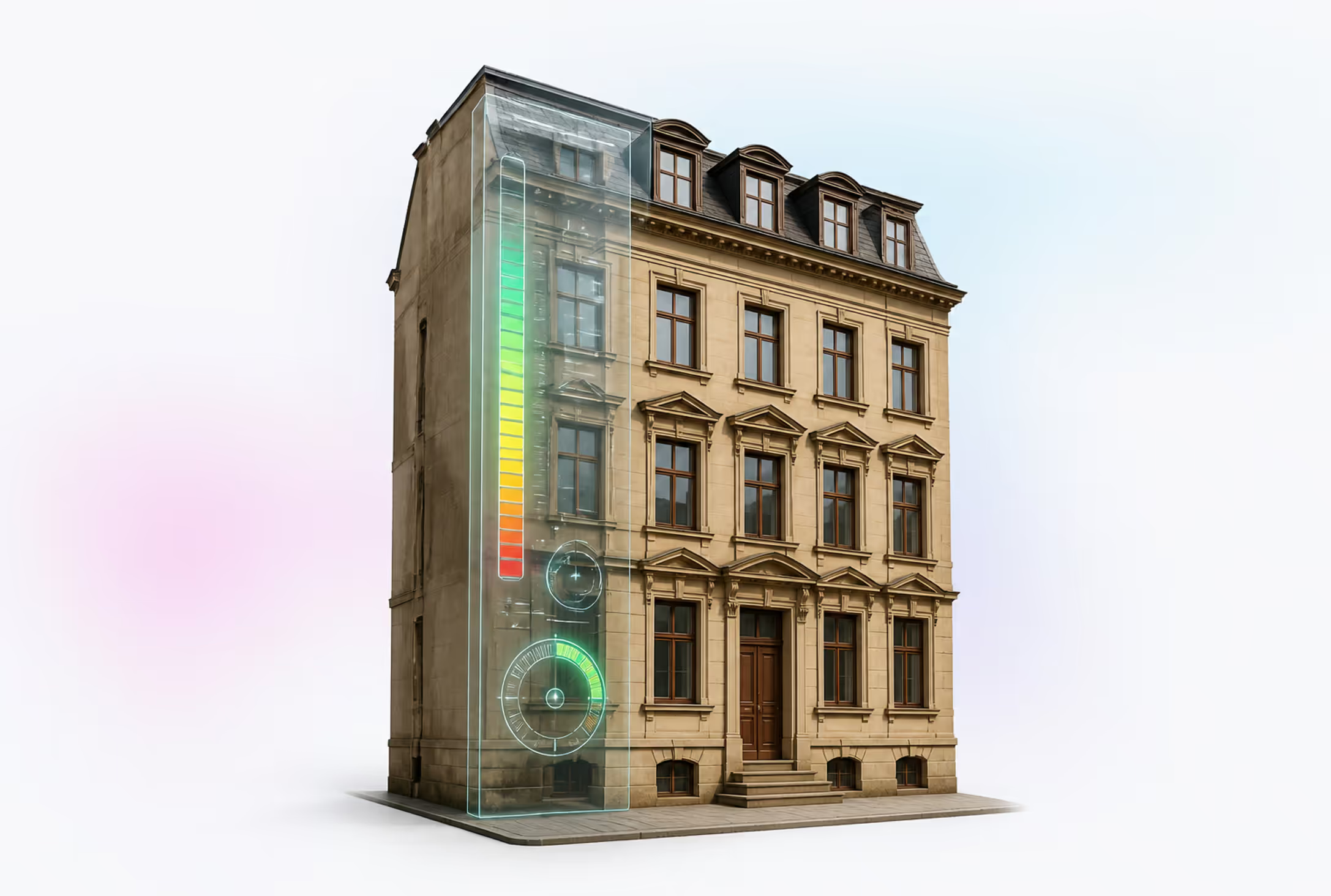
From 1 January 2027 that exact exception ends — and with it the habit of publishing the advert without an energy certificate. Article 2 of the same Act strikes the listed-building exception, so estate agents, buyers and prospective tenants demand the same certificate as for all other buildings.
In this article
- The exemption ends on 1 January 2027
- Why listed buildings went so long without a certificate
- What sale, letting and lease mean in 2027
- Tens of thousands of energy certificates: how the figure was determined
- Consumption or demand on a listed building
- What the authority often allows and what it frequently forbids
- How to proceed
- Frequently asked questions
Legal status: Promulgated on 28.07.2026 ( BGBl. 2026 I No. 226). Article 1 in force since 29.07.2026. Article 2 (EPBD energy certificates; listed-building exception removed) from 1 January 2027. Interim status until 31.12.2026: § 79 GModG.
The exemption ends on 1 January 2027
Until the end of the year the old Act still applies: § 80(3) to (7) shall not apply to a listed building. Anyone who sells or lets in that period needs no energy certificate for the monument, even if the Act on gesetze-im-internet.de is already called the Building Modernisation Act.
Although the Act was already promulgated on 28 July 2026 and Article 1 has applied since 29 July, the new energy-certificate provisions in Article 2 only take effect on 1 January 2027. Then § 79(4) reads differently: remaining exceptions are buildings owned by the Federation, allied forces or a company with federal participation that serve national and alliance defence, and small buildings with no more than 50 square metres of useful floor area. The listed building is no longer in that sentence.
Certificates issued from the cut-off therefore follow the EPBD rules, as the article on GModG promulgation sets out. An energy certificate that was not required in 2026 because of the exception must be issued for the first time on the first sale, letting or lease in 2027 — unless a valid certificate has already been obtained voluntarily.
Why listed buildings went so long without a certificate
Because the German exception felt so self-evident, many owners read it as an EU exemption from the energy certificate: listed buildings may stay inefficient, so the market needs no certificate. Directive (EU) 2024/1275 allows Member States to adapt external-insulation requirements for protected buildings. A listed sandstone façade therefore need not be insulated from the outside, but the building’s energy properties still matter. An energy certificate thus becomes mandatory for this class of buildings too.
Article 20 of the Directive requires a digital certificate on sale, letting to a new tenant and on renewal of the tenancy. Member States may exempt places of worship, certain temporary, industrial and agricultural buildings and detached buildings under 50 square metres. Listed buildings are not on this list: an EPC exemption was never an EU duty. The predecessor Directive 2010/31/EU still allowed Member States to exclude listed buildings from the certificate — as an option. Germany took that choice; Article 2 takes it back.
What remains is substance protection: § 105 GModG allows deviations from the Act’s requirements where substance or appearance would be impaired or other measures would be disproportionately costly. For offices, shops and other non-residential buildings, listed monuments with especially protected fabric remain expressly outside the legal energy-efficiency minimums under § 40 — that is not an exemption from the certificate duty: on sale and letting a demand-based certificate under § 81 must still be issued.
What sale, letting and lease mean in 2027
Whether a building is listed no longer changes the certificate duty from 2027. What counts is the occasion: If a built plot or apartment or partial ownership is to be sold, a heritable building right granted or transferred, or a building, dwelling or unit let, leased or financed by leasing or such a contract extended, an energy certificate must be issued if a valid one is not already in place.
Presentation and handover then apply as for any other property. The seller or the estate agent presents the certificate at the latest at the viewing and hands it over after the contract is concluded; the same applies mutatis mutandis to letting, lease and leasing. If the certificate is missing at the viewing, the statutory presentation duty has not been met. The document should therefore be available before the appointment. What must go into the advert is bundled in the article on the estate-agent listing duty.
Ensemble buildings need the certificate too, even if they have no house number of their own on the monument list. A building that Land law treats as part of a protected group of buildings remains a listed building within the meaning of § 3(1) no. 3. Until 31 December 2026 they therefore share the same statutory exemption as the individually listed building — that is also how the federal explanation still reads it. From 1 January 2027 the exemption also ends for these buildings because the exception in § 79(4) is removed.
Who stays exempt
That the listed-building exemption disappears does not mean every old building has the same duty. Small buildings of at most 50 square metres of useful floor area and the named defence buildings remain exempt under the new § 79(4). Anyone who neither sells nor lets, leases or subjects a listed building to a leasing contract does not trigger the transaction duty — the cut-off date alone does not force a certificate.
Tens of thousands of energy certificates: how the figure was determined
The estimate starts with about one million monuments listed by the Länder in November 2017. 63 percent were built heritage and 37 percent archaeological monuments (Destatis PM No. 208/2018).
63
37
The 2018 Baukultur sector report derives about 660,000 built-heritage entries from that total. They equal 2.9 percent of the then building stock of 22.1 million. These 660,000 list entries are the starting point for our calculation.
2.9 %
97.1 %
Next we narrow down how many list entries describe heated buildings that require a certificate. We use two scenarios: 20 percent and 50 percent of the 660,000 entries. There is no nationwide statistic on the use or heating of listed buildings. The broad range therefore represents a conservative lower bound and a scenario with a larger share of occupied individual and ensemble buildings.
For annual turnover we apply 2.5 percent sales and 5 percent lettings. The sale rate comes from the 507,000 residential property purchases counted by the BBSR relative to the 20.0 million buildings with living space in Census 2022. For lettings we use a higher working rate because dwellings are relet more often than buildings are sold; the GdW reports turnover of 6.5 to 6.6 percent for rented dwellings held by its member companies.
The energy certificate applies to the building. We therefore count no more than one first certificate per multi-family building, even if several dwellings are newly let. After allowing for overlap between sales and lettings, we use a combined rate of about 7 percent of certificate-relevant buildings.
The calculation is summarised below:
| Step | Assumption | Basis |
|---|---|---|
| Starting point | about 660,000 built-heritage entries | 63 % of about 1 million monument entries |
| Certificate-relevant buildings | 20–50 % of list entries | Two scenarios for heated buildings |
| Sales | 2.5 % per year | 507,000 purchases across 20.0 million buildings |
| Lettings | 5 % at building level | Working rate based on higher rental turnover |
| Sales and lettings | about 7 % of relevant buildings | After overlap: one building, one first certificate |
| Result for 2027 | about 9,200 to 23,100 first certificates | Order of magnitude: tens of thousands |
The 20-percent scenario produces about 9,200 first certificates; the 50-percent scenario about 23,100. The following graphic shows this path from the monument list to the 2027 order of magnitude:
The estimate therefore runs from around ten thousand into the low tens of thousands. Tens of thousands of first certificates describes that order of magnitude for 2027.
Consumption or demand on a listed building
When tens of thousands of energy certificates are ordered for the first time, the first question is which certificate type fits. For a building used exclusively for residential purposes, the choice stays open: consumption-based certificate under § 82 or demand-based certificate under § 81. Listed status does not change that.
If annual consumption data, split by energy carrier, exist over two years, a consumption-based certificate can often be produced more quickly. If those data are missing, demand must be calculated from the building envelope. If the building is not used exclusively for residential purposes, that choice ends: for non-residential buildings and mixed-use properties that do not fall under § 82, only a demand-based certificate is available on the same occasions. Choice in the residential stock therefore applies to the listed building just as it does to the unrefurbished estate house — but only while use is exclusively residential.
Because demand then remains the only option, historic materials often have to be assessed without known characteristic values. That makes the assessment harder, but it does not make the demand-based certificate unlawful. For existing buildings § 81(2) refers to § 38(3) and (4): if characteristic values are missing, secured experience values of comparable age classes may be used. In practice, conservative experience values are often applied. The same Gründerzeit building may therefore receive a poorer rating on a demand-based certificate than on a consumption-based certificate. Method basics are in the article on the demand-based certificate for residential buildings.
Why the class can come out poorly
On the first certificate for a listed building, the envelope is usually older than the average of the stock — Census 2022 reports construction years before 1919 as a separate class, but publishes no national percentage for listed buildings. Unrefurbished historic buildings typically receive poorer efficiency ratings.
Then a poor result sits in the certificate, without you simply being allowed to insulate the envelope. The certificate still does not force you into external insulation, because § 105 GModG allows deviations where substance or appearance would be impaired, and because listed buildings in the non-residential stock are expressly exempt from the legal energy-efficiency minimums. A modernisation recommendation in the document remains non-binding and creates no duty to insulate the façade.
A poor efficiency class and a protected façade do not rule each other out. Buyers and prospective tenants receive comparable information about the building’s energy performance, while the heritage authority continues to decide on changes to its fabric and appearance. A poor rating requires neither demolition nor external insulation.
What the authority often allows and what it frequently forbids
Even a poor class is no reason to bury your head in the sand. The certificate makes consumption visible; the lower heritage authority still decides which energy measures are permissible for the building. This tension arises from Land heritage law: changes to fabric or appearance need a permit, while § 105 allows deviations from energy requirements where protected fabric or appearance would be impaired. There is no nationwide statistic of how often authorities grant consent. The overview below is therefore an estimate of typical practice from authority guidance.
Measures with little or no visible impact are more often approved; changes to the show façade or street scene are often refused. The overview below shows how the reviewed guidance applies these principles to individual measures. It is not a federal statistic.
| Measure | Typical practice | What the authority looks at |
|---|---|---|
| External insulation of the show façade (ETICS) | Almost always refused | Stucco, brick, timber framing and window reveals would disappear from view |
| Split air-conditioning unit on the street façade | Usually refused | Outdoor unit, bracket and wall penetration permanently change the appearance |
| Heat pump in front of the show façade / street-facing front garden | Rare, case by case | Visibility from public space; courtyard, rear or screening often required |
| Replacing historic windows with a different division | Usually refused | Profile, glazing bars and glazed share are often part of the fabric |
| Internal insulation, window upgrading, roof and cellar-ceiling insulation | Often granted a permit | Little visibility, but still subject to building-physics and heritage consent |
| Central heating / boiler replacement indoors | Usually unproblematic | No intervention in the external appearance |
Facade, windows and roof
The show façade is the hardest case. Heritage offices almost always refuse external insulation with an ETICS on stucco, facing masonry or timber framing — in Hamburg office practice expressly as practically ruled out — because the articulation, render and window reveals would shift in plain sight. The Hamburg Monument Protection Office practice guide and the Berlin State Monument Office therefore require an individual, heritage-compatible concept for the envelope instead of the standard solution from new-build. Measures inside the building are therefore more likely to be appropriate: internal insulation to WTA guideline 6-4 remains established professional practice, but it is demanding in building physics and needs a permit. Working aids are collected by, among others, the Lower Saxony State Office for Monument Preservation. Internal insulation installed without prior agreement can damage plaster, timber framing or the indoor climate.
Windows and doors are often part of the protected fabric. Disposing of historic frames and replacing them with plastic of a different division usually fails; additional seals, insulating glass in existing frames, secondary glazing or box windows are more often accepted if profile, glazing bars and glazed share remain. The roof often offers greater energy savings: insulation between the rafters and of the top floor ceiling is often invisible from the street and therefore more likely to receive permission — as soon as insulation above the rafters lifts eaves and verge, it becomes a façade problem again. Cologne heritage conservation expressly lists cellar ceiling, top floor ceiling and replacement of the heating system as possible energy-saving measures.
Heating, photovoltaics and outdoor units
Where façade and windows may hardly be altered, a modern heating system can still cut consumption without touching the protected surface. Replacing a boiler or installing central heating indoors usually does not disturb the appearance; in the stepped sequence explained by the Hamburg Monument Protection Office — reproduced in a Haspa overview — swapping heating and domestic hot water is generally unproblematic, while heat pumps are treated as a special topic. An air-to-water heat pump changes the picture because the outdoor unit stands in front of the house. In front of the show façade or in the street-facing front garden it often fails on appearance; in the courtyard, at the rear or behind screening, permission is more likely to be considered on a case-by-case basis. Split air-conditioning units on the listed street façade are assessed even more restrictively: visible outdoor units, brackets and wall penetrations permanently change the building’s appearance, so authorities in practice often require the courtyard, a roof position behind the parapet, or doing without. Cologne therefore already asks in the application for alternative locations for technical equipment.
Photovoltaics are also possible in principle on a listed building, but they require heritage permission. The German Foundation for Monument Protection recommends solutions that are as unobtrusive, minimally invasive and reversible as possible. Depending on the individual case, suitable locations include restrained roof areas or unlisted ancillary and neighbouring buildings.
So you should ask the lower heritage authority before modernising, and have all measures approved. Where use is exclusively residential, Energyausweis Smart™ can determine the certificate with the better energy class. Especially on listed buildings it is not clear in advance whether the consumption-based or the demand-based certificate will yield the better rating.
How to proceed
The steps run from listed status to the advert.
- Confirm listed status. Check the list, ensemble and Land law; § 3(1) no. 3 also covers the protected group of buildings.
- Check the occasion and cut-off date. Sale, heritable building right, letting, lease, leasing or extension from 1 January 2027 need a valid certificate.
- Choose the method. Exclusive residential use: consumption or demand. Otherwise demand.
- Keep the papers ready. Two years of consumption data by energy carrier — or geometric and component data for the calculation, if necessary with experience values by age class.
- Order the certificate before the listing goes live. Present it at the viewing, put the rating in the advert.
Checklist: listed building and energy certificate from 2027
Frequently asked questions
Do I need an energy certificate in 2027 if I am neither selling nor letting?
The cut-off date alone does not force a certificate. Article 2 ties issuance to construction, certain alterations and to sale, letting, lease, leasing or the extension of such contracts, if no valid certificate already exists.
May a listed residential building get a consumption-based certificate?
Yes, if the building is used exclusively for residential purposes and the consumption data under § 82 are available. No special restriction applies to listed buildings. Non-residential buildings need a demand-based certificate under § 81 in the same transaction cases.
Does a poor efficiency class force façade insulation?
No. The certificate informs. § 105 allows deviations where substance or appearance would be impaired. The fact that listed buildings in the non-residential stock are exempt from the legal energy-efficiency minimums does not turn the certificate into a renovation order.
Do ensemble buildings also need an energy certificate in 2027?
Yes. The definition continues to cover buildings and groups of buildings under Land law. The previous exemption depended on § 79(4) sentence 2 and falls away with Article 2. From 1 January 2027 ensemble buildings also need a certificate on the named occasions.
Is internal insulation banned on listed buildings?
No. It is established professional practice (including WTA 6-4) and usually requires a permit. Without coordinating with the heritage authority you risk building damage and an unlawful intervention.
May a heat pump stand in front of the listed building?
The technology is not banned across the board. The outdoor unit usually needs a heritage permit because it changes the appearance. In front of the show façade or in the street-facing front garden the chance is low; courtyard, rear or screening are discussed more often. Split air-conditioning units on the street façade often fail on the same test.
Why does the title say tens of thousands when there are a million monuments?
From about one million monument entries, the sector report derives roughly 660,000 built-heritage entries. We use two scenarios of 20 and 50 percent for certificate-relevant buildings. At a combined turnover rate of about 7 percent for sales and lettings, this produces about 9,200 to 23,100 first certificates in 2027 — an order of magnitude in the tens of thousands.
Conclusion and outlook
Until 31 December 2026 you may still offer a listed building for sale or letting without an energy certificate. From 1 January 2027 that exemption falls away: Article 2 requires the same proof as for other heated buildings. As set out in the article, we estimate that in 2027 tens of thousands of energy certificates will have to be issued for the first time. For buildings used exclusively for residential purposes, the choice between consumption and demand remains; a poor class does not force external insulation.
The energy certificate is a disclosure duty on sale and letting. It does not order demolition or external insulation, and it does not require you to give up the protected façade or the window division. So you order the certificate before the listing and clarify with the heritage authority which measures are permissible for the building.
Anyone who wants to sell or let in 2027 should check now whether a valid certificate already exists, and assemble the papers. Many energy measures remain possible on listed buildings too, for example internal insulation, a heat pump and photovoltaics. After 1 January 2027 the certificate exemption is history in Germany; Land heritage law, by contrast, remains.
Citation guidance
A standard dofollow link is all you need
No separate permission is required when referring to statements or the estimate in this article. Credit Energyausweis.de as the source and link to this page.