The Energyausweis Smart™: how to increase your property’s value

The energy certificate is an important part of property valuation and can have a significant impact on your property’s value. This article explains how the Energyausweis Smart™ from energyausweis.de can help you increase that value without extra investment.
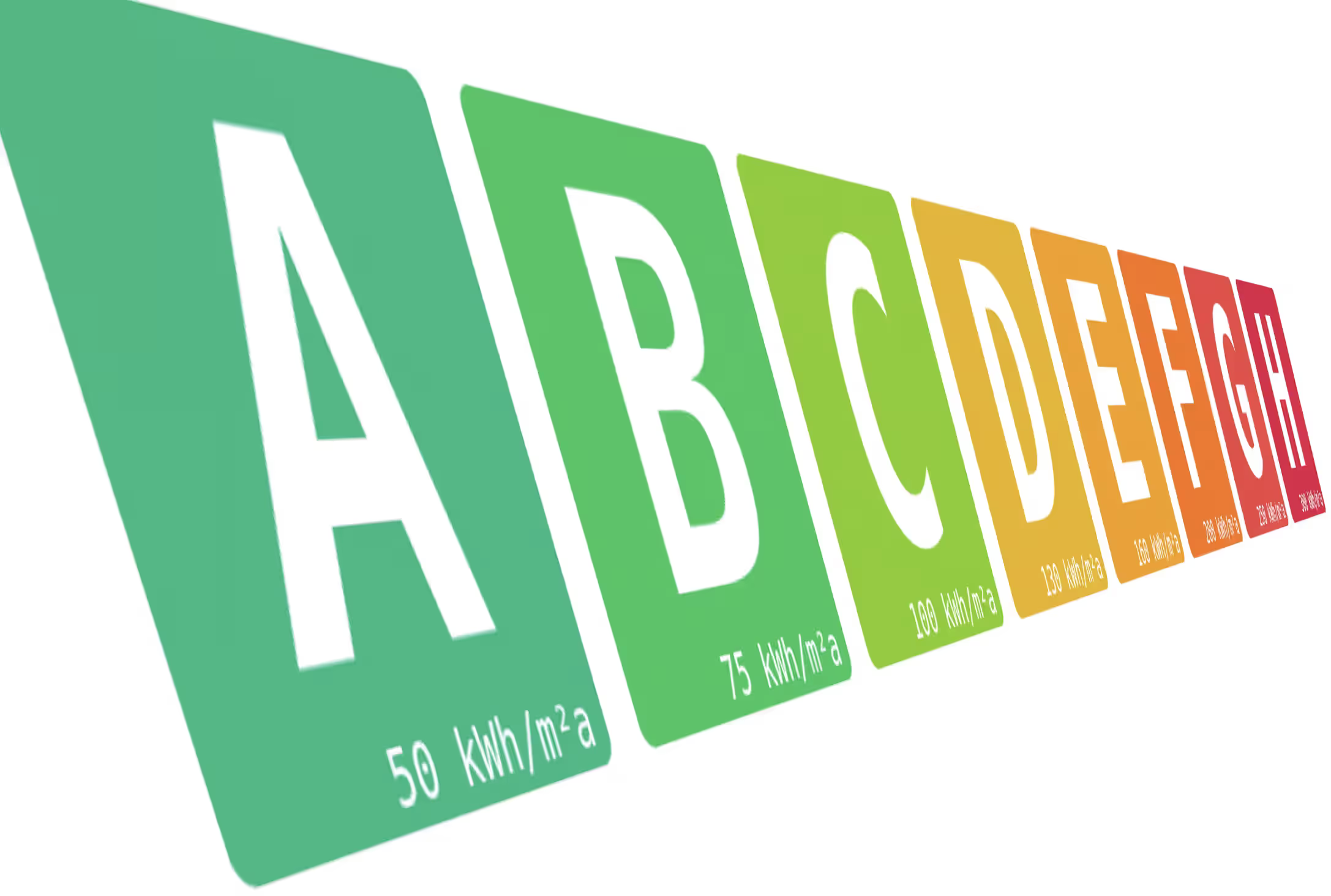
Too good to be true? When something is free you should be sceptical. Among financial investors there is a saying: There is no free lunch. But in this case it really is true: because the law provides for two different types of energy certificate, with the Energyausweis Smart™ you can have the more favourable of the two determined.
What you need to know
The energy certificate adventure
An energy certificate can be a real challenge for property owners, full of new terms and figures that are hard to understand at first. So we have written a guide to help you get oriented quickly: Understanding the energy certificate: a complete guide.
Although that guide explains the differences between the two certificate types in detail, we answer the practical questions here: How can I use the differences to my advantage? When is the consumption-based certificate better for me and when the demand-based? And how can the Energyausweis Smart™ help me get the best result?
You might ask: Why are there two types at all, and isn’t the certificate there to assess a building’s energy efficiency objectively? How can two different certificates for the same building give two different results? Why does the law allow that? We answer all of that in this article. Spoiler: there are good reasons for the two types.
So join us for the energy certificate adventure and see how you can benefit.
Consumption-based and demand-based certificate: the differences
The consumption-based and the demand-based certificate are two different types, each with advantages. The consumption-based certificate is based on actual energy consumption; the demand-based certificate calculates demand from the building envelope and technical systems.
The two types reflect the tension between a purely calculation-based standard (demand-based) and a practical measurement (consumption-based). The demand-based certificate can score where the consumption-based one reaches its limits, and vice versa.
The consumption-based certificate uses real, measured consumption. So it implicitly reflects building geometry, actual insulation, system efficiency and weaknesses such as thermal bridges, leaky windows or poor roof insulation. It is therefore a good indicator of actual consumption and heating and hot water costs.
For it to be meaningful, consumption must be measured over a longer period, there must be no excessive vacancies or change of use, and values must be weather-adjusted for nationwide comparison. So the consumption-based certificate’s strength is a realistic assessment of energy efficiency when use is typical for the building class – an assumption that does not always hold and is its main weakness.
For new builds, after refurbishment or with long vacancies, consumption data is often missing or not meaningful. There the demand-based certificate comes in: it is based on the building’s physical properties and technical systems, which can usually be determined from plans and technical data. Even though standard values by building age are set by law, obviously such defaults rarely reflect the actual building. So the demand-based calculation involves many assumptions that can strongly affect the result.
Why both certificate types have their place
Despite the pros and cons of each, both types are valid and can be the right choice in different situations. The consumption-based certificate is useful when consumption data over a longer period exists and use is typical. The demand-based certificate is useful when no consumption data exists or it is not meaningful – e.g. new builds, after refurbishment or with long vacancies.
So it should not surprise you that the two certificates often give different results. At the same time it is clear that the many differences make it hard to predict which will be better for a given building. That is where the Energyausweis Smart™ comes in.
You don’t always have a choice
In many cases you can choose which certificate to have prepared, but not always. For new builds and major refurbishment the demand-based certificate is mandatory. For existing buildings you can choose, provided the building at least meets the 1977 thermal protection rules. For multi-family buildings with five or more units you always have the choice.
The Energyausweis Smart™ only makes sense when you do have a choice. It determines the more favourable of the two for you, so you can always present the certificate with the better efficiency class. That improves your market position and can significantly increase your property’s value.
Property manager on the Energyausweis Smart
We regularly receive positive feedback at energyausweis.de. Here is one that refers to the Energyausweis Smart™:
After an old energy certificate for one of our properties expired, the owners’ meeting debated intensely whether to have a consumption-based or demand-based certificate prepared. We then chose the Energyausweis Smart™ from energyausweis.de. We were delighted: it easily settled the debate and we can always present the more favourable certificate. The new certificate presents our property in a better light and one owner has already reported achieving a higher rent. We will continue to use the Energyausweis Smart™ for all properties we manage.
— Property management, Frankfurt am Main
In practice: More documented feedback and typical switch scenarios from sales and rentals — including when the premium pays off and where Smart™ does not apply — are covered in Energy Certificate Smart™ experiences and on the customer reviews page.
So the Smart certificate solves the problem that as an owner you often don’t know which certificate is more favourable. You could of course have both prepared and use the better one – but that costs more and means entering data twice. With the Energyausweis Smart™, input for both types is merged into one simpler process.
Another decisive advantage: by combining both we can spot inconsistencies and errors more easily, run better plausibility checks and thus improve certificate quality. So you get not only the more favourable but also a higher-quality certificate.
Why you can’t know in advance which type is more favourable
Which certificate is more favourable for a given building cannot be answered seriously without a detailed calculation. The two types use so different methods that sometimes the consumption-based and sometimes the demand-based certificate is better. It is above all the very different assumptions that make the results differ. So don’t rely on general advice – have the results calculated, checked and compared objectively.
With GEG 2025, which requires demand-based certificates to be calculated according to DIN V 18599, quantifying the differences is becoming more important. The DIN V 18599 calculation is much more complex than the previous DIN V 4108 and uses more than 300 parameters, so the two certificate types can diverge even more than before.
Certificate preview: an alternative to the Energyausweis Smart?
You might ask: why not use the certificate preview that some issuers offer? That is possible but time-consuming. A preview is nothing other than preparing two certificates and comparing them. Input options are often limited and you must enter data separately for both. There is no direct side-by-side result.
If you want to spend that time, we won’t stop you. But remember that besides double data entry, comparing the two takes time and you may miss inconsistencies. All of that is done for you by the certified energy consultants at energyausweis.de when you order the Energyausweis Smart™.
Cost of the Energyausweis Smart
In our detailed cost comparison of 10 energy certificate services we looked at prices across Germany for both certificate types. As the comparison shows, energyausweis.de is among the most affordable.
What about the Energyausweis Smart™? Is it cheaper than the two certificates combined? Yes. The Energyausweis Smart™ costs only €129 – significantly less than the average price for a demand-based certificate in Germany, which is currently around €200.
How much does the energy certificate affect your property’s value?
The property specialist Jones Lang LaSalle (JLL) analysed 5,000 listing data points for multi-family buildings in 2023 and concluded that a poor efficiency class can lead to price discounts of up to 30% at the top end. The study does not give an average or compare the effect to other factors such as building age, location or layout. But the main point is: the energy certificate has a measurable effect on property prices and in individual cases it can be up to 30%. If we assume an average effect of only about 10% for a better class, that is already €60,000 on a €600,000 property that the Energyausweis Smart™ can secure when you sell.
Conclusion
The Energyausweis Smart™ from energyausweis.de is a real innovation on the energy certificate market. With it you can always present the more favourable certificate and achieve higher sale prices or rents. The combination of input for both types and plausibility checks ensures high quality. All of that for a small premium compared to a standard demand-based certificate. We are convinced that the Energyausweis Smart™ can help you get the maximum out of your property.
For planned changes from 2026 (e.g. new A–G scale and extended requirements), see Energy certificate 2026: new A–G scale and extended requirements.