The registration number on energy certificates

A short code with big meaning. The registration number on an energy certificate is not just a string of characters. It stands for the quality, legal certainty and verifiability of your document. Why that is and how you benefit is explained here.
What you need to know
What is the registration number — and what is it for?
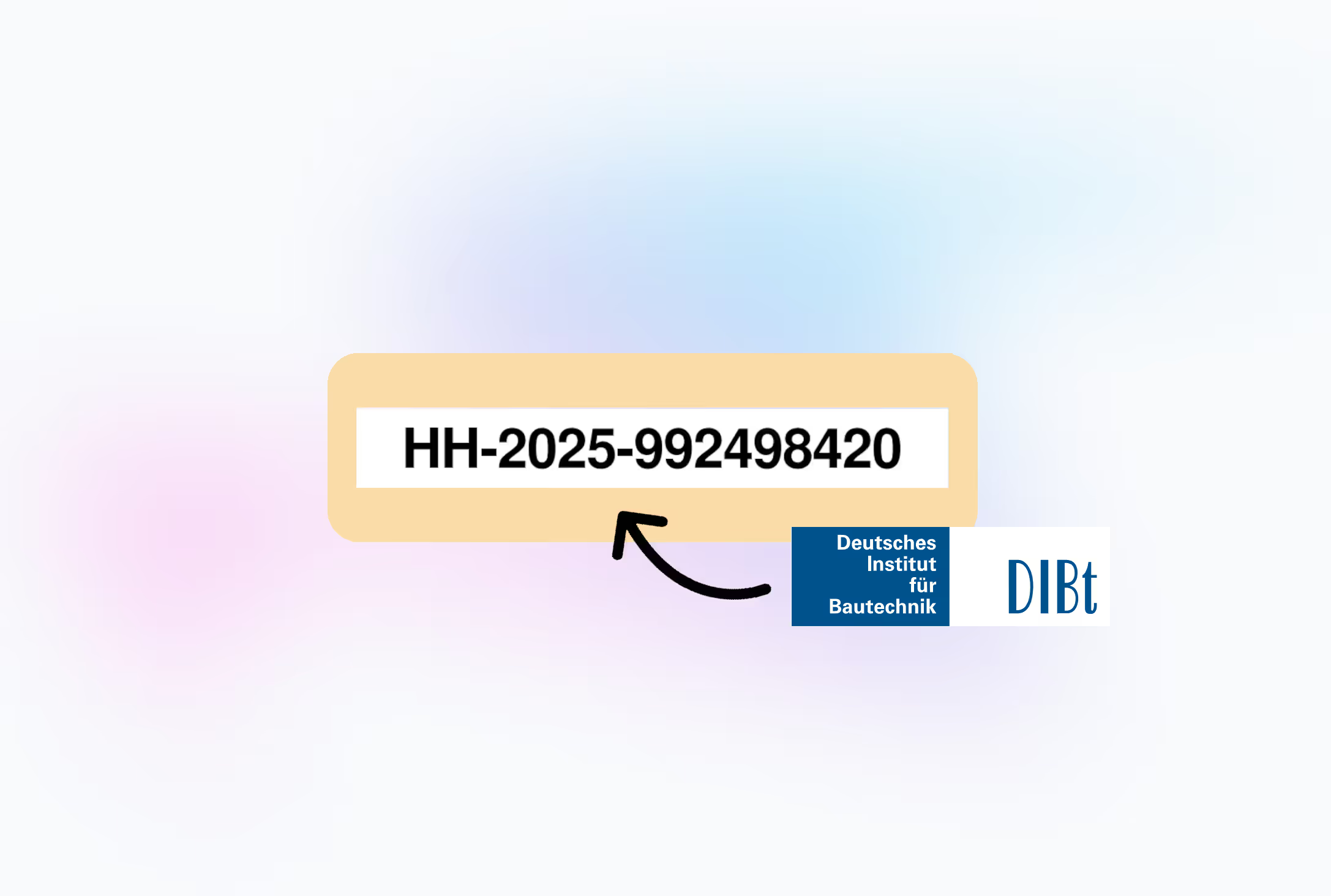
The registration number is issued by the German Institute for Building Technology (DIBt) via the GEG registration office. It has been legally required since 2014, first under the EnEV and now under the Building Energy Act (GEG) § 98.
This number is:
- A unique identifier for each energy certificate, like a serial number.
- A sign of state-recognised issuance by qualified energy consultants.
- A prerequisite for the document’s legality on sale, letting or refurbishment.
How is the registration number structured?
The registration number on an energy certificate in Germany follows a fixed scheme:
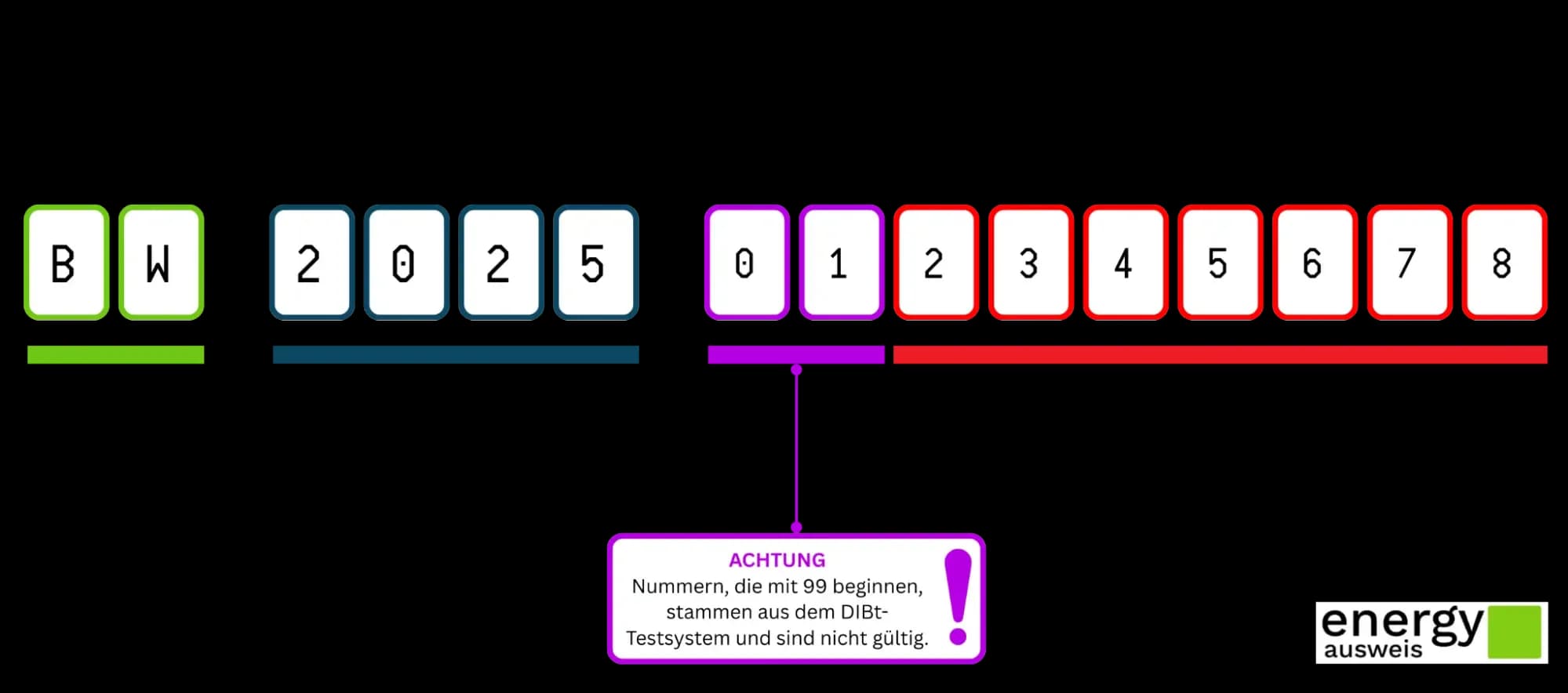
State code
Two letters indicate the federal state where the certificate was registered. Examples: BW = Baden-Württemberg, HE = Hessen, HH = Hamburg. All state codes are listed in the federal ministry’s data portal.
Year of registration
After a hyphen comes the four-digit year of registration, e.g. 2025.
Serial number
Another hyphen is followed by a nine-digit serial number. Numbers starting with 99 come from the DIBt test system and are not valid. As of 2025 the first two digits must be 00, as only seven-digit numbers have been issued so far. All nine digits form a unique number.
Issuing and process
The registration number is issued only by the GEG registration office at the DIBt, via an online portal accessible only to authorised issuers. Process: (1) Issuer logs in with their authorisation. (2) They request a unique number for each new certificate. (3) After entering basic details (e.g. building type, certificate type, postcode, date of issue) the number is generated automatically. (4) The number must then be clearly shown on the certificate. The number applies only to one specific building and is not transferable. Without it the certificate is not legally valid.
Value and meaning of the registration number
The number serves several key functions for owners, issuers and authorities: Consumer protection — it confirms that the certificate was properly registered and is not forged. Transparency — authorities can uniquely identify and trace details in sample checks. Protection against misuse — the same certificate cannot be used multiple times or for other buildings. Quality assurance — it is the basis for the DIBt’s electronic sample checks. For owners, an energy certificate with a valid registration number signals reliability and meets legal requirements — a plus for letting, sale or financing. For changes from 2026, see Energy certificate 2026: new A–G scale.
Quality control: How does sample checking work?
The registration number is at the centre of a three-stage control system run by the DIBt: Stage 1: Formal check — whether the certificate is complete and contains all mandatory details. Stage 2: Plausibility check — whether the data (e.g. energy demand) is internally consistent and fits the building. Stage 3: Detailed check — the issuer must disclose all calculation bases and data. If a certificate is rejected, it must be corrected or withdrawn within a short period. Repeated errors can lead to consequences for the issuer, including loss of licence.
Legal basis and registration with DIBt
The legal basis: since 1 May 2014 the GEG (§ 98) has required central registration. Every certificate must receive an individual registration number. The GEG registration office at the DIBt issues the numbers and carries out electronic sample checks. Only the necessary information is recorded (e.g. issuer, building type, postcode, date of issue, certificate type). Important data such as address or consumption values are not stored centrally. The system is not a public register.
- Number present? Every lawful energy certificate must show a registration number on the first page. Without it the certificate is invalid.
- Check with DIBt: There is currently no publicly available online tool to verify the number yourself. If you doubt the authenticity of a certificate, you can contact the DIBt or a consumer advice centre.
- Check plausibility: Does the date of issue match the number structure (year)? Do the details on the certificate seem realistic for the building?
Registration number — quality assurance of the energy certificate
The registration number ensures traceability, protects against forgery and is a central part of quality assurance in the energy certificate process. In short: it stands for trust, transparency and real consumer protection.
You can order a legally sound energy certificate with registration number here.