Energieausweis duty in Germany: what you must do and what it can cost if you do not

Selling or renting out a property in Germany? The Energieausweis (energy performance certificate) is not an optional document, but a legal obligation with clear timing: at listing stage, at the viewing, and, in a sale, immediately after the purchase contract.
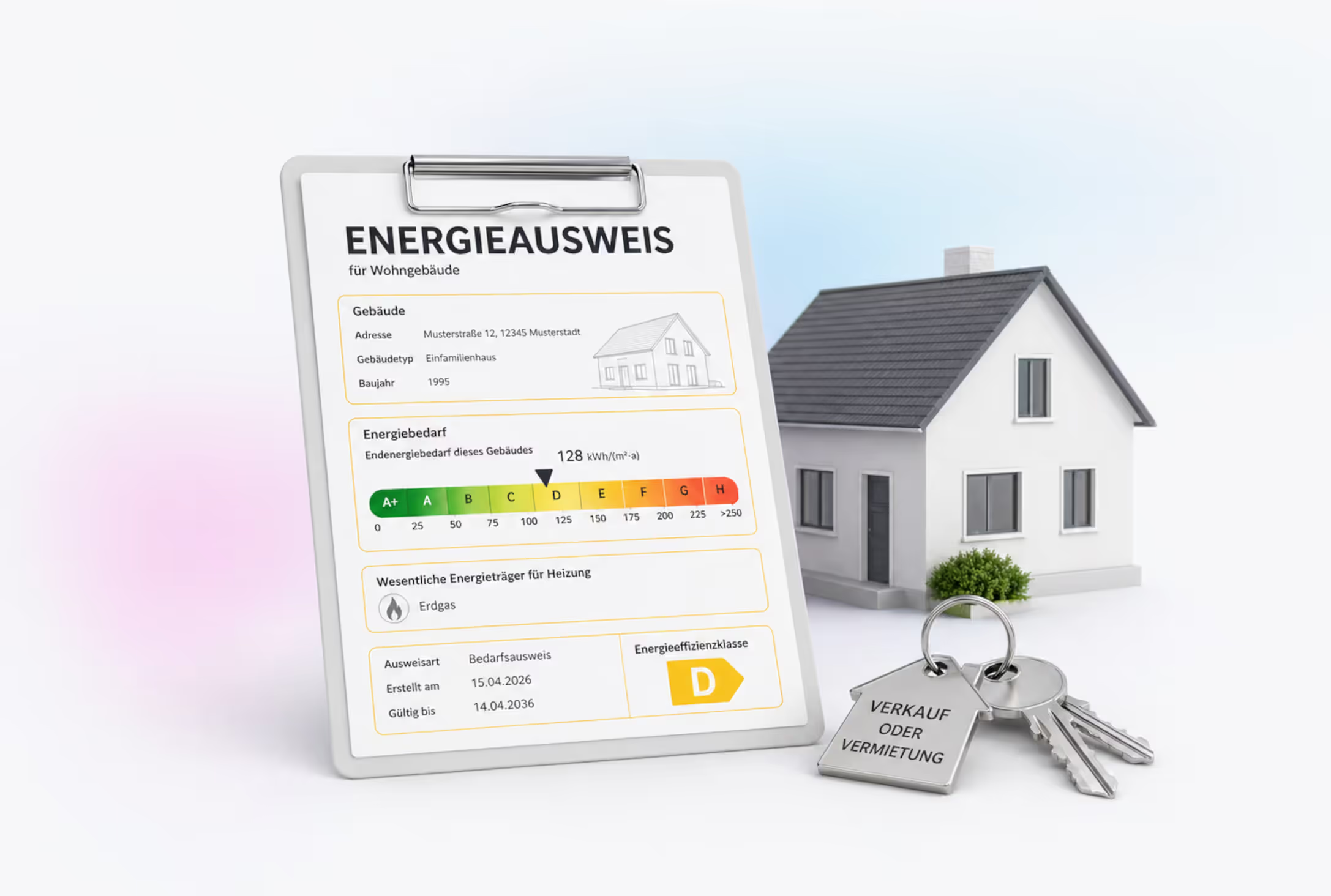
This article provides practical guidance. You get a clear timeline of obligations under the German Building Energy Act (GEG), especially § 80 GEG (presentation and handover duties), § 87 GEG (mandatory ad fields), § 88 GEG (who may issue an energy performance certificate (EPC)), and § 108 GEG (administrative offences / fines).
In this article
- The one-minute answer: when an energy performance certificate is required
- The decision guide: what you must do (and when)
- Stage 1: before you publish a listing (ads)
- Stage 2: at the latest at the viewing
- Stage 3: contract and handover (who gets what and when)
- What happens if you do not follow the rules (real risks)
- Validity and typical mistakes that cause short-term stress
- A simple way to stay legally compliant (without stress)
- Mini checklists you can copy
- Answers to frequently asked questions (FAQ)
The one-minute answer: when an energy performance certificate is required
In practice, this means: a valid EPC is required whenever you:
- sell (house, apartment, etc.), or
- rent out, lease or let (a building or a self-contained unit, e.g., an apartment).
The legal logic is clear:
- If you intend to sell or rent out, an EPC must exist unless a valid one already exists. See § 80(3) GEG.
- There is no fixed day-based deadline. Duties are tied to events: ad publication, viewing, and (for sales) handover after the purchase contract.
If you mainly want the sequence:
- Check whether a certificate exists and is valid.
- Copy the certificate values into the listing (if you advertise in commercial media).
- Keep the certificate or a copy ready for the viewing.
- In a sale, hand it over to the buyer without undue delay after signing the purchase contract.
Inherited a home? Inheritance alone does not trigger a certificate obligation — only sale or new letting. Separately, retrofit obligations with a two-year deadline may apply: Energy certificate for inherited property.
The decision guide: what you must do (and when)
Treat the following steps as a binding timeline. If you work through them systematically, you avoid time pressure and unnecessary rework.
Stage 1: before you publish a listing (ads)
If you publish a property ad in commercial media, and an EPC already exists at that time, the ad must contain
mandatory details from the certificate.
Source: § 87(1) GEG. For an official overview, see
BBSR - Details required in property listings.
Which details must the ad include? (residential buildings)
For residential buildings, the following information is mandatory (summarized from § 87(1) GEG):
- Certificate type: demand certificate or consumption certificate
- Final energy value: final energy demand or final energy consumption (as stated in the certificate)
- Main heating energy source (as stated in the certificate)
- Year of construction (as stated in the certificate)
- Energy efficiency class (as stated in the certificate)
Who is responsible? (owner vs. real estate agent)
The duty applies to the seller/landlord/lessor/leasing party, or to the real estate agent if they are responsible for publication (see § 87(1) GEG).
Practical tip: define who performs the final listing check and work from one central source document.
Important limitation: only if the certificate already exists
The mandatory listing fields apply if an EPC already exists at the time the ad is placed.
This is where many mistakes happen in practice:
- estimating the efficiency class,
- copying values from an outdated document,
- using values from a different unit or property.
If you remember one rule only: use values exclusively from the current document that you will later present.
Stage 2: at the latest at the viewing
For sales, the duty is explicit: present the EPC (or a copy) at the latest at the viewing. The duty can also be met by
clearly displaying it during the viewing.
Source: § 80(4) sentences 1–2 GEG.
If there is no viewing, it must be presented without undue delay (“unverzüglich”).
Source: § 80(4) sentence 3 GEG.
For rental, lease and letting situations, corresponding presentation duties apply via statutory cross-reference.
Source: § 80(5) GEG.
Stage 3: contract and handover (who gets what and when)
Sale: hand over without undue delay after the purchase contract
Without undue delay after the purchase contract is concluded, the seller or agent must hand over the EPC (or a copy) to
the buyer.
Source: § 80(4) sentence 6 GEG.
Special case (residential buildings with no more than two apartments):
- After handover, the buyer must have an informational consultation on the EPC, if such consultation is offered free
of charge as a separate service.
Source: § 80(4) sentence 7 GEG.
What happens if you do not follow the rules (real risks)
Breaches of presentation/handover duties (§ 80) and missing mandatory ad fields (§ 87) are administrative offences under § 108 GEG. For the relevant cases, fines of up to €10,000 are possible.
Validity and typical mistakes that cause short-term stress
How long is an EPC valid?
An EPC is issued for a validity period of 10 years.
Source: § 79(3) GEG.
It may also lose validity earlier if a new certificate becomes mandatory (also § 79(3) GEG). As a practical rule:
- an expired certificate is treated in practice as if no certificate existed (for listing, viewing and handover).
Typical mistakes and how to avoid them
A simple way to stay legally compliant (without stress)
If you want to keep the process simple and reliable:
- keep one up-to-date master document ready (optionally with a paper copy for in-person viewings),
- use this document as the binding source for listing and viewing,
- if an agent is involved, clearly define who performs the final check and who brings the certificate to viewings.
If you do not have a valid certificate yet, commission it early enough to cover listing and viewing timelines. Online services can be practical, but compliance still depends on issuance by an authorised person and complete, plausible input data (see § 88 GEG). For an official overview, see BBSR - Rules for EPCs.
Mini checklists you can copy
Quick checks for compliant action
- ☐Is an EPC available, and is it valid? (rule of thumb: 10 years)
- ☐
If the certificate already exists: does the listing contain all mandatory fields (type, final energy value, energy source, year of construction, efficiency class)?
- ☐Is responsibility for publication and final review clearly assigned?
- ☐Keep the EPC or a copy ready at the latest by the viewing.
- ☐Use the same version for all viewings (no outdated documents).
- ☐If an agent is involved, clarify who brings the certificate and how it is presented or displayed.
- ☐Prepare a copy for handover after signing the purchase contract.
- ☐Record internally: “certificate handed over” (date and version).
- ☐Special case up to two apartments: observe consultation duty where consultation is offered free of charge.
Answers to frequently asked questions (FAQ)
Do I need an EPC before I can list my property?
If you place an ad in commercial media and an EPC exists at that time, the ad must include mandatory fields from the certificate (GEG § 87). If no certificate exists yet, do not estimate values or copy them from outdated documents, as this often leads to corrections and additional risk later.
What must be included in the listing?
For residential buildings, listings must include certificate type, final energy value, heating energy source, year of construction and efficiency class (see GEG § 87(1)).
When must I show the EPC?
For sales: at the latest at the viewing (or without undue delay if there is no viewing).
See GEG § 80(4). For rental, lease and letting, the statutory cross-reference applies via
GEG § 80(5).
Do these duties also apply to real estate agents?
Yes. This applies both to presentation duties at the viewing (sale) and to mandatory listing details where the agent is responsible for publication (GEG § 87(1)).
Is an online EPC legal?
Yes, in principle. The requirement is that it is issued by a person authorised under the GEG and based on complete, plausible inputs (see GEG § 88). “Online” describes the process of collecting and transmitting data; it does not bypass legal requirements. Whether you may issue a certificate yourself — and what you can still prepare — is covered in Can you create an energy certificate yourself?.
How long is an EPC valid?
As a rule, 10 years (see GEG § 79(3)).