Property managers going digital: cloud, AI and the Energyausweis API

Property managers are caught between what clients call a digital service and what supervisors and rules require as an auditable file on each building. Clients expect portals, fast answers and smooth hand-offs; regulators and tightening duties expect evidence that sits in the master record, not in a private inbox. If you modernise only the front office and let certificates and invoices keep circulating as attachments, you do not replace the filing cabinet with a resilient data layer — you build an archive of forwards and loose ends in e-mail.
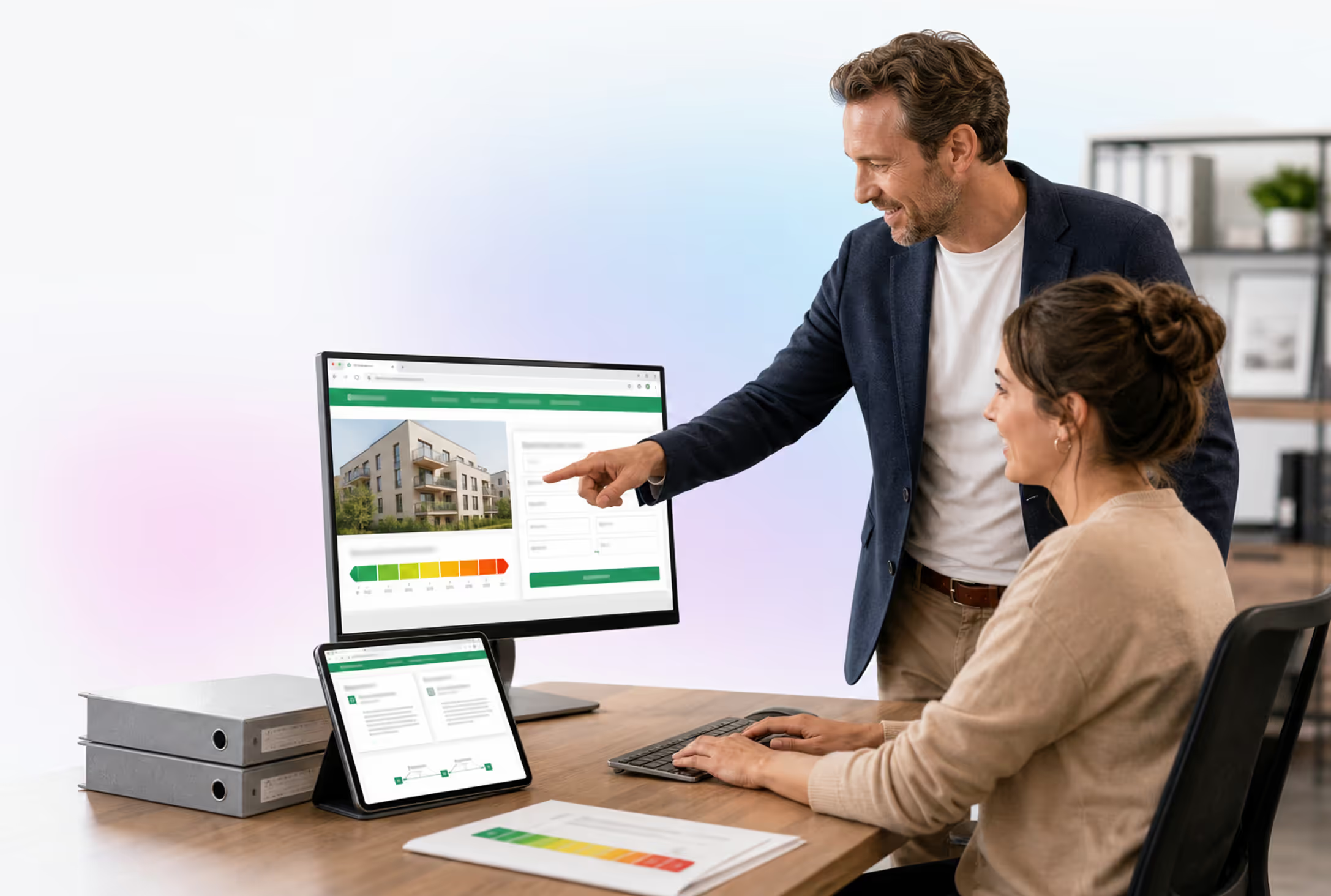
Whether digital workflows stay end-to-end or slide back into free-text e-mail depends on how ledger, customer communication, specialist tools and regulated APIs interlock. Small and large portfolios hit different bottlenecks — from a missing object master to governance at thousands of units. The Energyausweis API™ closes a typical break: issuance under § 88 GEG with structured fields alongside the PDF so the record, certificate and downstream steps share one source of truth — instead of the next break starting with another attachment.
In diesem Artikel erfahren Sie …
- Why property managers are starting the second digitisation phase now
- Four system layers instead of one app
- Ten units or a thousand: where it hurts first
- AI: triage and summaries yes — unsupervised decisions no
- Energyausweis API: evidence in the record instead of a link in e-mail
- Regulatory pressure stays: structured inbound invoicing
- FAQ on the digital toolchain
- Checklist: review the digital toolchain in five steps
- Conclusion and outlook
Context · energy certificate
The Building Modernisation Act was promulgated on 28 July 2026 (Federal Law Gazette 2026 I No. 226). Article 2 (energy certificate rules) applies from 1 January 2027. Timeline hub: New energy certificate from 2027. Operational duties for managers: GModG for property managers.
Why property managers are starting the second digitisation phase now
The first phase was availability: web access, PDF, e-mail, maybe ticketing. The second phase is end-to-end continuity: the same object ID from service-charge accounting to broker collateral — including legally required records and proofs that lawmakers now attach to those structures. If the energy certificate still lives only as a loose PDF outside your master record, you have no reliable revision trail for deadlines, certificate type and future listing fields — and you pay the media break twice because teams re-key metrics.
Rather than betting everything on a single app, a layer model is the stronger long-term strategy: it shows where ledger, comms, documents and specialist APIs must meet. The Energyausweis API hits the break between your record and the issuer — if metrics and status do not land with the PDF in your system, you pay for the same work twice later.
Four system layers instead of one app
Professional management rarely runs on “one app”. You typically combine ledger and dunning, customer comms, documents and specialist APIs — the interfaces inject regulated domain logic from specialists instead of building and maintaining it in-house. This overview summarises the usual split for property management, IT and integrations:
| Systemtyp | Typische Rolle im Betrieb | Was schiefläuft ohne saubere Grenze |
|---|---|---|
| Integriertes Verwaltungs-ERP (WEG/Miete) | Buchhaltung, Abrechnung, Bank, Objektstamm, oft Eigentümer- und Mieterportale. | Doppelbuch mit Excel, wenn Bestandsdaten nicht der einzige Anker bleiben. |
| Kommunikations- und Vorgangsschicht | Tickets, Begehungen, Handwerker, Dokumentenablage zum Objekt. | „Parallel-CRM“ in E-Mail, wenn Vorgänge nicht an den Objektstamm gebunden sind. |
| Spezial- und Compliance-Werkzeuge | DMS, elektronische Rechnung, Archiv, ggf. separates Facility-Tool. | Medienbruch bei Mandanten, wenn Belege nicht retour ins ERP verbucht werden. |
| Regulierte Fach-APIs | Ausweis-Erstellung, Bank/SEPA, Identität — Endpunkte mit klarer Verantwortlichkeit. | PDF-Friedhof, wenn Bestellung extern bleibt und Kennwerte nicht im Objekt landen. |
Consequence: If these layers are not split contractually and technically, work drifts into free-text e-mail — where audit and automation die.
Ten units or a thousand: where it hurts first
Small firm (roughly ten to a few dozen units): licence fees are rarely what hurts first — you more often lack time and clear priorities. Lock down first: an object master your tax adviser can use without constant clarification, and a document path that runs from inbound bill to posting. Without that foundation, AI inbox triage stays hit-and-miss — it cannot reliably tell which building belongs to which client.
Large firm (hundreds to thousands of units): the focus shifts to governance: who may change system IDs and master data, how trades tickets align with the lease and economic plan line, and where the API layer for regulated proofs sits. Early energy-certificate integration pays off — recurring issuance either scales cleanly or generates support tickets in an opaque process; see the partner article CRM and management software with the Energyausweis API.
AI: triage and summaries yes — unsupervised decisions no
Vendors sell percent savings and assistants; in operations only what you measure counts. This split separates measurable benefit from marketing claims in supplier talks and internal roadmaps:
| Hinweis | Eher tragfähig | Eher heiße Luft |
|---|---|---|
| Messgröße | Minuten je Vorgang, Quote erster Lösung, Rückfragenquote — Vorher/Nachher. | Prozent-Pitches ohne Stichprobe, Zeitraum und Definition. |
| Entscheidung | Sortieren, zusammenfassen, zuordnen — Mensch bestätigt bei Kündigung/Frist. | „Autonome“ Antworten zu Mietrecht ohne Freigabe. |
| Datenbasis | Ein Objektstamm, saubere Rollen, Revision bei Anpassungen. | KI oben drauf auf vier Excel-Versionen gleichzeitig. |
Short: AI is a tool where it relieves routing and documents, not where it answers on termination, deadlines or fine risk without human approval.
Energyausweis API: evidence in the record instead of a link in e-mail
The energy certificate is a regulated proof with issuance duties and metrics, and an increasingly digital return — see The digital energy certificate from 2027. For property managers and cloud-based property-management platforms, the key points are:
- Order and status live in your system — not as a forward to an anonymous third-party order portal.
- Alongside the PDF you receive structured metrics so portals, tickets and listing templates share the same fields — product overview Energy certificate API for portals.
- Issuance and review under § 88 GEG are delivered by energyausweis.de with certified assessors and a DIBt registration number; you remain responsible for complete inputs and your processes — liability picture as in Brokers and large managers + API.
Technical entry: API product page, try-out at /api/try-out, including a machine-readable specification in the OpenAPI 3.1.2 standard. API usage is free for partners; issued certificates are billed — see commercial terms in the partner programme.
Regulatory pressure stays: structured inbound invoicing
Besides the energy certificate, lawmakers pull a second thread through your software: structured B2B invoices. German businesses must be able to receive structured invoices under Federal Ministry of Finance rules, with staggered issuance duties — exact deadlines and formats are documented in the BMF e-invoicing guidance (BMF: e-Rechnung). Practically: receive — read — post must run without a parallel shadow spreadsheet, or the second phase collapses back into the first.
FAQ on the digital toolchain
Why is one “good cloud app” not enough?
Because object, contract and accounting data have different lifecycles. Without an authoritative source, the same metrics exist in three versions — and every media break becomes a support case later.
Is a certificate API worthwhile before 2027?
Yes, if you already feel media breaks between the object file and the issuer. The test environment is at /api/try-out; 2027 fields roll forward to Article 2 timing — integration still needs lead time (data model, approvals, monitoring).
What does the API cost?
No usage fee; you pay for issued certificates — affiliate (commission on list price) or white-label API with your end-customer price in the partner programme.
Where does AI realistically help in property management?
Where it ships metrics: routed documents, shorter handling time, fewer clarifications — not where a “chatbot” decides dunning stages without escalation.
Checklist: review the digital toolchain in five steps
- Lock the master record and roles — one source for buildings, units, contracts and bank accounts.
- Map four layers — ERP, communication, specialists, regulated APIs; ownership per interface.
- Test compliance paths — one inbound invoice path and one evidence path (e.g. energy certificate) without a shadow inbox.
- Pilot AI only with metrics — one case, before/after measurement, documented approval.
- Plan the Energyausweis API — where order, status and JSON live; exercise try-out with a test key.
1
2
3
Conclusion and outlook
The second digitisation phase is less about buying another app than about a fully digitised end-to-end process flow: one object master that ledger, communication and regulated proofs attach to — instead of attachments and forwards. If you map four layers, introduce AI only with metrics, and run inbound e-invoicing and energy certificates as continuous paths, you cut media breaks where they later become support queues and rework.
Looking ahead to 2027 and beyond: GModG Article 2 and tighter listing and evidence duties increase the pressure to keep metrics and deadlines on the object — the Energyausweis API returns structured fields and status with the PDF for that job. In parallel, B2B e-invoicing remains the test of whether your software can receive, read and post without the second phase sliding back into free-text e-mail.
Platform or SaaS property-management vendors must approach integration differently from a classic mid-market HOA firm. The article GModG for property-management platforms spells out how GModG from 1 January 2027 (Article 2) applies to tenant-capable property-management platforms and how to wire the energy certificate as a recurring platform feature via API — tenant roles, white-label and a clean hand-off to the issuer. For volume and white-label questions: Contact.