Energy Certificate API: Legally Compliant Certificates for Your Online Portal – Without In-House Experts

Portals and brokers need an energy certificate for every property listing – employing your own energy experts is expensive and hard to scale. The Energyausweis API covers the full process: legally compliant certificates via API, no in-house staff, with optional white-label for your portal.

In this article you will learn what the Energyausweis API brings to your online portal, how it differs from form-only solutions or fixed single integrations – and how to integrate in a few steps. For developers: full OpenAPI documentation, clear error handling, and a Try-it interface at energyausweis.de/api/try-out. Product overview: energyausweis.de/api.
In this article
- Why Portals and Brokers Need Energy Certificates
- Legal requirement: §87 GEG and property listings
- The Energyausweis API at a glance
- Advantages of this API compared to other solutions
- How integration works
- Quick start: Create certificate, submit data, order
- GEG 2026 and future readiness
- Conclusion and recommendations
Why Portals and Brokers Need Energy Certificates
Energy certificates matter for real estate, broker and bank portals in two ways: as a legal requirement in listings and as an opportunity for lead generation. Those who combine both stay the first point of contact for sellers and landlords – from certificate ordering to the published listing. In practice, the certificate is often requested before sellers or landlords contact a broker or portal. Offering it in your own customer journey – e.g. as energy certificate integration directly in the portal – helps you capture leads early.
Legal requirement: §87 GEG and property listings
The German Building Energy Act (GEG) requires §87 GEG for commercial property listings (sale, rental, lease) certain mandatory information from the energy certificate. These include: type of certificate (consumption- or demand-based), final energy demand or consumption, main heating energy sources, year of construction, and energy efficiency class. Sellers, landlords and brokers are responsible; the information must appear in the listing when a certificate exists (see §87 GEG, BBSR GEG portal).
Breaches of certificate and listing duties can lead to fines (§108 GEG). From May 2026, extended EU requirements apply: new A–G scale, presentation duties also for lease renewals, major renovations and public buildings. Those who map listings and processes via API in a legally sound way today are well set for GEG 2026.
The cost without an API: Forms, manual handling, in-house experts
Without API integration, users often leave your portal: they order the certificate from a third party, handling runs outside your platform – no seamless experience and no control over the touchpoint. Employing your own energy experts for issuance is expensive and does not scale. Portals and brokers instead want a seamless customer journey, legally compliant certificates without in-house staff, and optional own branding (white-label). That is what the Energyausweis API as product-as-a-service (PaaS) is designed for.
Example: A landlord wants to list their apartment – if you do not offer the certificate directly in your portal, they go to a third party for it. With the API they stay on your portal, order the certificate in one place, and you keep control of the lead.
The Energyausweis API at a glance
How can this be implemented technically? The Energyausweis API lets partners create and manage energy certificates for residential buildings in Germany via REST API. One API key, one end-to-end lifecycle – from creating the certificate to downloading the legally compliant PDF.
One API access for the full energy certificate lifecycle
The API supports all steps: create certificate → add contact, location, building, construction and heating data → upload documents via presigned URLs → place order → check status → download the finished PDF. All over HTTP with a bearer API key. The three product types at a glance:
| Product type | Basis | Note |
|---|---|---|
| Consumption-based certificate | Actual energy consumption (e.g. billing data) | Lower cost, practical; suitable when consumption data is sufficient. |
| Demand-based certificate | Calculated energy demand (building envelope, systems) | Independent of user behaviour; often required for new build or major renovation. |
| Smart energy certificate | Both variants are calculated | The certificate with the better efficiency class is issued. |
Legally compliant without in-house energy experts
energyausweis.de handles issuance and technical review – with certified energy experts and compliance with legal requirements (GEG 2026, DIBt registration). You as a partner do not need your own energy experts. Certificates are legally compliant and can be offered white-label under your branding.
Who the API is for
The Energyausweis API targets the energy certificate B2B market: real estate portals, broker portals, energy portals, bank and building society portals, larger brokerage firms, and property-management platforms (spin-off on the GModG pilot). API use is free for partners; tailored package solutions – e.g. for React or Next.js – enable faster integration in frontend and backend and are offered on request. Whether you refer as an affiliate or issue via API partnership: overview and entry points are on the partner programme page.
Advantages of this API compared to other solutions
Many providers only offer form extensions or fixed integrations into one product – without a public, full API to create and download the certificate yourself. The Energyausweis API sets a new standard here.
Modern design and documentation: Optional tailored package solutions with a modern stack (React, Next.js) are available for fast integration. The API is fully documented in OpenAPI format – machine-readable, single source of truth for client generation and documentation.
Full API instead of isolated solutions
A single REST API covers the entire energy certificate lifecycle: from creation through all data and documents to ordering and PDF download. Other solutions are often limited to one product (e.g. a CRM) or only add input fields in portals – without the ability to create and retrieve the certificate fully via API. With this API you stay independent and can connect any frontends and backends.
Developer-friendly: OpenAPI, clear errors, Try-it
The API is specified in OpenAPI 3.1.2. Clients, validation and documentation can be derived from the spec. Validation (including with Zod) is strict: for invalid requests you get 422 with structured, field-level error messages – ideal for frontends that show errors directly on the field. The Scalar interface at energyausweis.de/api/try-out lets you test the API directly and supports common client examples (cURL, fetch, axios).
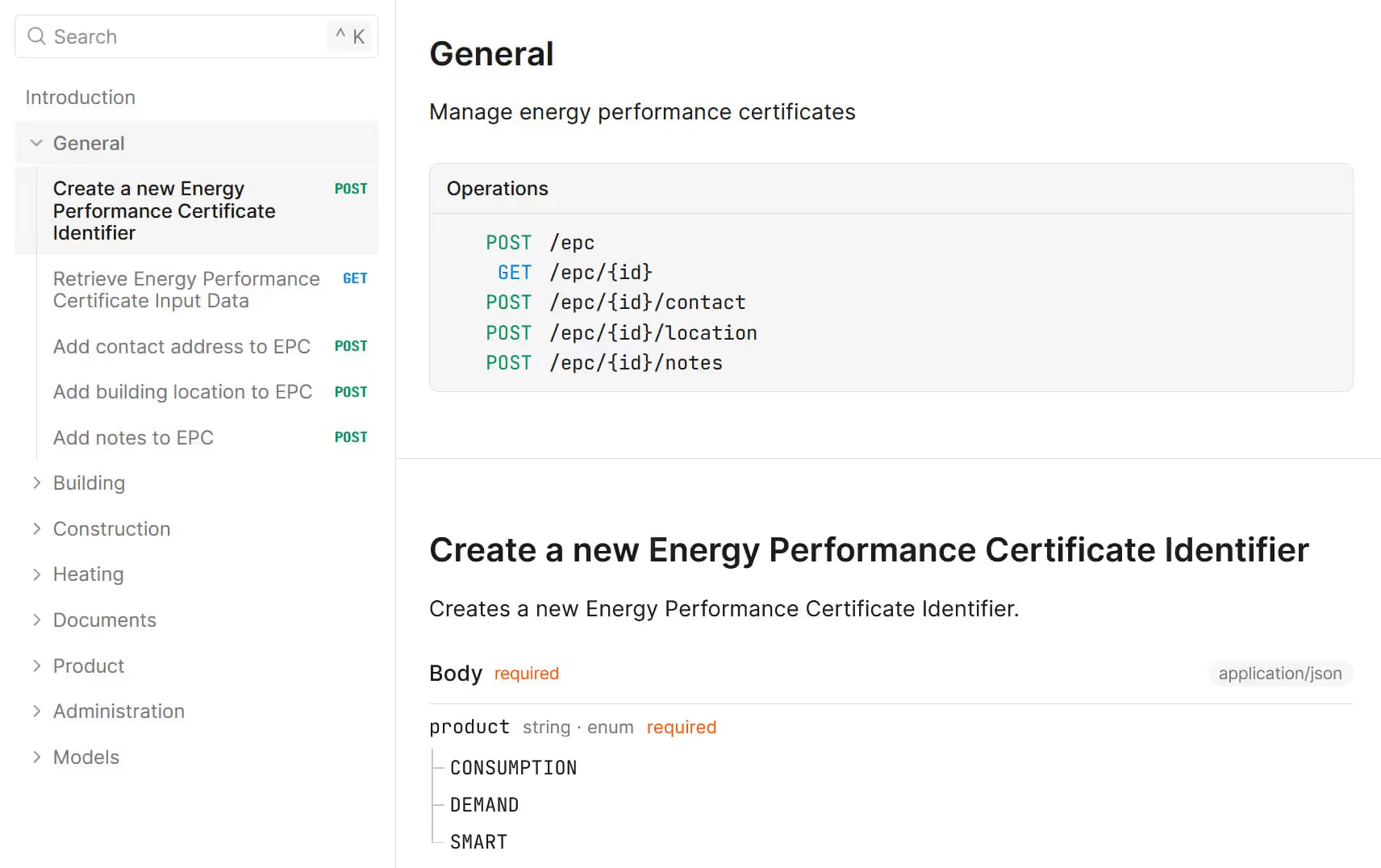
Document upload uses presigned URLs: the client requests a URL from the API, uploads the file via PUT, and confirms with POST – no multipart on the main API server, clear separation and scalable.
Operations and integration
Bearer authentication per partner, separate test and production environments (apitest.energyausweis.de and api.energyausweis.de). The API is designed to be called seamlessly from your portal or web app – even when users work in the browser. Leads (in-progress certificates), orders and payments are available via the API – no hidden per-call costs for partners.
New regulations covered automatically
New requirements – such as the upcoming EU changes (A–G scale, extended duties from 2026) – are implemented by energyausweis.de. As a specialist for certificate issuance and legal compliance, the service keeps the API and certificates up to date. You do not need to track legal updates yourself; your integration stays future-proof.
How integration works
Putting the theory into practice is kept simple with the Energyausweis API: a clear flow, documented endpoints and a Try-it interface reduce integration effort.
Quick start: Create certificate, submit data, order
The typical flow:
- 1POSTCreate energy certificate
POST /v1/epcwith product type (e.g. consumption-based) and occasion (e.g. SELL) – you receive a certificate ID (epcId). - 2POSTAdd data
Via
POST /v1/epc/{epcId}/contact,/location, and further endpoints for building, heating, documents – in the order that fits your workflow. - 3POSTPlace order
POST /v1/epc/{epcId}/orderwith the required confirmations (data verified, terms, privacy, purchase). - 4GETCheck status
GET /v1/epc/{epcId}/status– when complete, retrieve the PDF. - 5GETDownload PDF
GET /v1/epc/{epcId}/productreturns the legally compliant certificate as PDF.
Full OpenAPI documentation and the interactive Scalar interface to try it out are at energyausweis.de/api/try-out.
Uploading documents: Presigned URLs
For photos or other documents, the client requests a presigned URL from the API
(GET /epc/{id}/document), uploads the file via PUT to the returned URL, and confirms the upload
with POST (e.g. /epc/{id}/document/confirm) with filename, content type and optional metadata. The
main API stays lean; actual file handling runs via object storage – clean separation and scalable.
Next steps for your platform
- Request an API key (partner access).
- Use the OpenAPI spec to generate a client or implement calls with fetch/cURL.
- Run through the full flow in the test environment (apitest.energyausweis.de).
- For even faster integration – e.g. with ready-made modules for React or Next.js – you can ask the team about tailored package solutions.
GEG 2026 and future readiness
From May 2026 the new EU requirements apply: uniform A–G scale and extended presentation duties. The Energyausweis API is aligned with GEG 2026 standards and current legal requirements. For more on the legal framework, see: Energy certificate 2026: New A–G scale and extended duties and Will energy certificates be invalid from May 2026?.
Conclusion and recommendations
In short: The Energyausweis API brings legally compliant certificates to your online portal – without in-house energy experts, with one API for the full lifecycle from data capture to PDF. Developers benefit from OpenAPI, Scalar docs, clear error handling and presigned URL uploads; partners from white-label and free API use. New regulations are handled by energyausweis.de, so your integration stays future-proof.
Your next steps:
API documentation and Try-it
Use the docs and test your first requests. Product page: /api.
energyausweis.de/api/try-out →
2Tailored package solutions
React, Next.js or your platform – we support your integration.
Get in touch →
More on the topic
Basics, product types and provider comparison in our articles.
Whether you want to offer energy certificates as an extra service as a portal or simplify processes as a broker – the API scales with your business and stays up to date through energyausweis.de taking care of new regulations. We look forward to your enquiry.