Energy certificate with MWh per year: Are the cards being reshuffled?

The listing shows efficiency class A — yet the buyer is surprised by the high energy figure on the certificate. Two homes can share the same class; one uses far more energy per year than the other. That is rarely a calculation error. It is usually about which number you read: energy per square metre or for the whole building.
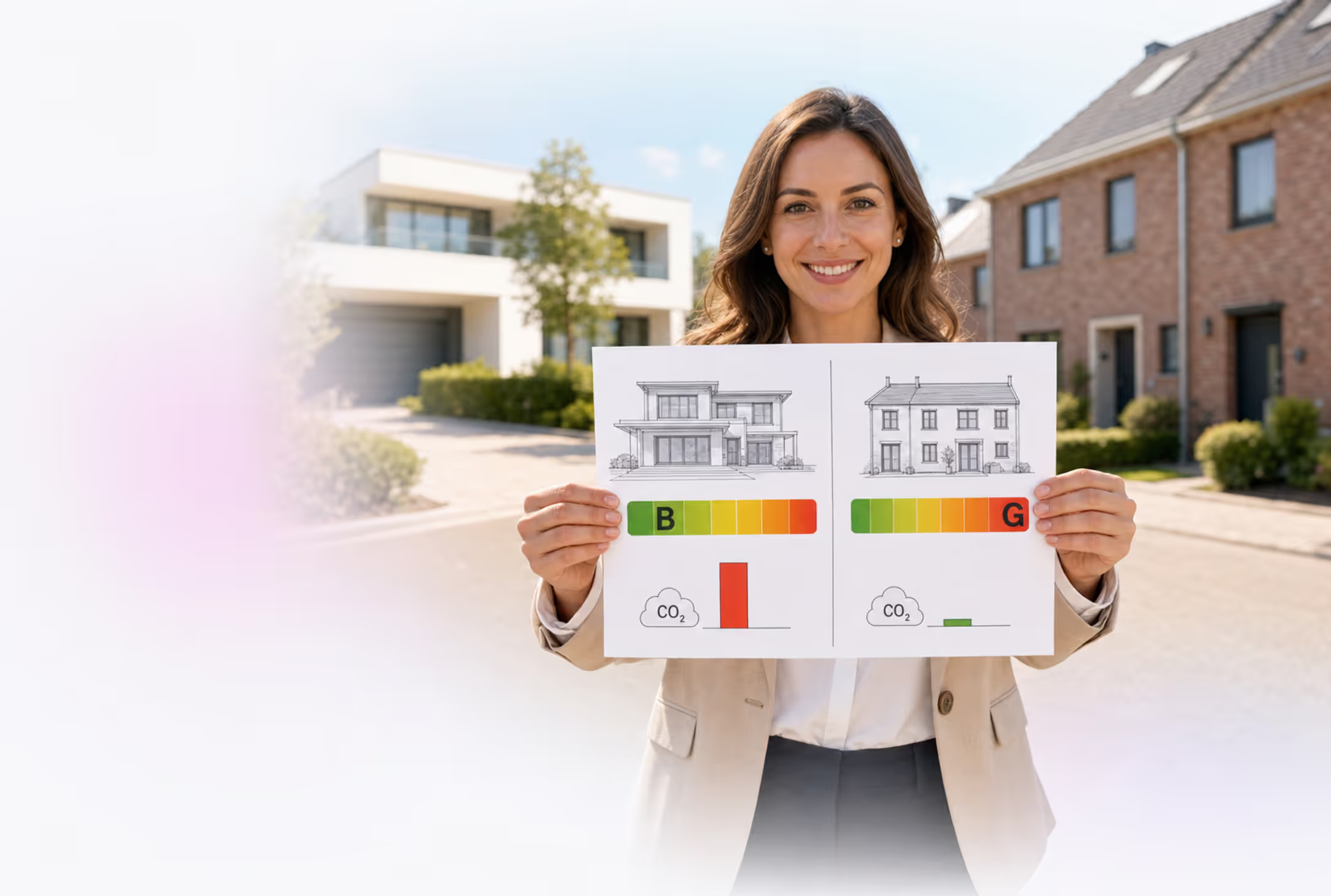
Much attention goes to the EU A to G scale — for homes, however, the GModG cabinet draft of 13 May 2026 is set to keep the familiar A+ to H scale and require primary and final energy in megawatt-hours per year as an additional line. For owners, sellers and landlords, what changes is mainly how you read the certificate — not how the class is calculated. We answer whether the “cards are being reshuffled” without scaremongering and without legal jargon.
In this article
- In brief: What changes on the energy certificate
- Specific vs. absolute: Two views of the same balance
- What the specific indicator means
- What the absolute indicator means
- Practical example: Luxury home vs. small terraced house
- Who performs well in absolute terms — who in relative terms?
- Environmental balance and costs: What matters more?
- What you can do now
- FAQ
- Conclusion
The Bundestag and Bundesrat passed the GModG on 10 July 2026 — promulgation is still pending; until then the GEG remains unchanged. Section references relate to the cabinet draft. What happens next for energy certificates?
In brief: What changes on the energy certificate
Today’s residential energy certificate focuses on the specific primary or final energy figure in kWh/(m²·a) and the efficiency class from A+ to H. Both are to remain for homes in the draft — unlike many non-residential buildings, where an EU-style A to G scale is planned (GModG fact-check, Annex 10a).
New under the GModG draft: absolute energy indicators in megawatt-hours per year. Draft § 85(1) no. 23 requires calculated primary energy in MWh and calculated annual final energy in MWh — in addition to the area-related values (nos. 10 and 11). No. 24 adds renewable generation in MWh; for most readers that is a supplement, not the core of this debate.
Important: there is no second building model. The absolute annual value follows the same energy assessment as today — roughly indicator × usable floor area. What changes is display on the certificate so buyers and tenants see the order of magnitude of total demand, not only efficiency per square metre. Anyone who today sees only the coloured scale in a listing will get a second anchor on the document itself — if the draft becomes law.
The rule implements the EU Buildings Directive (EU) 2024/1275 in Annex V (European Commission: EPBD). Full detail on all mandatory fields: GModG cabinet draft fact-check.
So: legally, the cards are not reshuffled for homes. In practice, you gain an extra perspective — and that is what matters day to day.
Specific vs. absolute: Two views of the same balance
What the specific indicator means
The specific energy indicator (often shown as consumption or demand in kWh/(m²·a)) answers: How much energy does the building use per square metre and year? It allows comparison of different-sized homes — similar to an appliance label independent of size.
For residential buildings, the efficiency class still follows final energy consumption or demand, classified under GEG Annex 10 and § 86 GEG (unchanged for homes in the draft). The class is a technical quality rating per area, not total household consumption. In a sale conversation, “we have class B” is no longer enough if the MWh line tells a different story — at latest after the draft enters force, when new certificates include the figure.
What the absolute indicator means
The absolute value in MWh per year answers: How much energy does this building need in total? It depends strongly on size (usable area, heated volume) — at equal efficiency per m², a large home almost always uses more than a small one.
This matters for three everyday questions:
- Energy costs: A rough order of magnitude if you multiply absolute demand by a price per kWh (use and tariffs vary widely).
- Grid and infrastructure: A building with high annual demand draws more from the system.
- Perception when buying: A “green” class and a high MWh figure can coexist.
Rule of thumb: Class = efficiency per m². MWh/a = energy demand of the whole building.
Practical example: Luxury home vs. small terraced house
The table below is a simplified calculation example, not measured buildings. Class letters are illustrative — the exact class depends on Annex 10 thresholds.
| Villa (example) | Terraced house (example) | |
|---|---|---|
| Usable area | 320 m² | 95 m² |
| Primary energy (specific) | 45 kWh/(m²·a) | 130 kWh/(m²·a) |
| Efficiency class (illustrative) | A | E to F |
| Primary energy (absolute) | ≈ 14.4 MWh/a | ≈ 12.4 MWh/a |
Message: Class A in a large home can use similar or more energy in absolute terms than a smaller building with a poorer class. Anyone who reads only the scale underestimates total demand for large floor area.
Rough cost illustration only: 14.4 MWh/a equals 14,400 kWh. At a notional 12 cents per kWh for heating, that is on the order of €1,700 per year — excluding hot water, household electricity and price changes. The terraced house would be around €1,500. The class alone does not show that.
Two everyday scenarios:
- Selling a large, well-insulated home: The class signals efficiency. The MWh line shows the building still carries weight in the system — relevant for buyers on a tight budget.
- Letting a small older flat: The class may be modest. Absolute demand can still be manageable — important for tenants who only see the scale on a portal.
Per person (not a mandatory certificate field): Dividing MWh roughly by occupants shifts the picture again — a large home with four people can look lower per head than a small one with two. That is not a legal criterion but helps in conversations with buyers or tenants.
Who performs well in absolute terms — who in relative terms?
On the specific view, new builds with insulated envelopes, modern heating and compliant design often score well — regardless of living area. Class A or B means energy is used sparingly per m².
On the absolute view, small buildings often show lower annual figures: little heated area, compact volume, sometimes less ancillary space. A refurbished older home with a modest class can show fewer MWh/a than a new build with a top class.
Large detached homes and large dwelling units on one certificate, by contrast, are often high in absolute terms even with a good class: the envelope is efficient, but total energy stays high because many square metres count.
On social framing, stated neutrally: a small older flat with a poor class looks “bad” on the certificate but may bind less energy in absolute terms than a large efficient new build with a climate-friendly image. Conversely, a large efficient home looks relatively good — the second look at MWh reveals total load. That is not moral judgement but more information for a factual debate.
This article covers additional mandatory fields, not changed primary energy factors or DIN methodology. If your class shifts on re-issue although nothing changed at the building, that reflects other calculation rules — not the new MWh line alone.
Environmental balance and costs: What matters more?
For climate and resources, not only how sparingly each square metre is used matters, but also how much energy and emissions the building causes in total. The new MWh figure makes that order of magnitude readable on the certificate. Operational greenhouse gas emissions remain per m² in the draft (no. 16) — absolute GHG is not the same as absolute energy.
For retrofit and technology, the specific indicator stays central: it shows remaining potential per area in envelope and plant, and drives the class.
For your budget, the absolute value helps as a rule of thumb for annual costs — with the usual caveat that actual use, behaviour and prices differ from the calculation. If you buy a large class A home, include the MWh line in financial planning, not only the colour of the scale. Over time, retrofit and heating replacement affect both figures — see Heating replacement: gas, oil, pellets or heat pump?.
Both perspectives complement each other: efficiency per m² and total demand answer different questions. Ignore one of them and you optimise the wrong thing — chasing the class when buying without checking running costs.
What you can do now
Read the certificate in three lines (on newly issued documents after reform):
- kWh/(m²·a) — how efficient is the building per area? (drives the class)
- Efficiency class A+ to H — quick comparison, still central
- MWh/a — how large is the calculated annual demand for the whole building?
Checklist for owners and sellers:
Stricter data rules for consumption-based certificates (24 months, monthly) are a separate topic — mainly whether such a certificate can still be issued, not the MWh line on a demand certificate: Order a consumption certificate before reform. The GModG draft also proposes removing the 1977 thermal insulation hurdle in Section 80(3), making the consumption certificate selectable for all homes — see the GModG fact check.
FAQ
Does the efficiency class change because of absolute values?
No. The class stays tied to specific figures and § 86 GEG. MWh is an additional field.
Do I need a new certificate immediately because of MWh/a?
No. Valid existing certificates keep their period of validity. After the draft enters force, newly issued certificates should include MWh — re-issue is still required only for sale, letting, renewal and similar triggers.
Why does the GModG draft add MWh to the energy certificate?
The draft transposes Annex V of EPBD (EU) 2024/1275 (see § 85 no. 23 in the fact-check). The aim is greater consumer understanding and transparency on total energy demand — in line with the EU Buildings Directive for clearer energy certificates.
Is an A+ home automatically environmentally friendly?
It is efficient per square metre. With very large area, absolute annual demand can still be high — relevant for costs and resource use.
Conclusion
Are the cards being reshuffled? Legally no: the A+ to H scale and its per-m² logic remain for homes. Perceptually, much can shift when annual MWh appears beside the class — large efficient homes look less “light”, small buildings with a poor class are not automatically the largest consumers in the system.
Three questions worth asking before you sign or list:
- What class does the certificate show — and what kWh/(m²·a) value sits behind it?
- How high is absolute annual demand in MWh — and does that fit my budget?
- Do I need a new certificate now — or is the valid one enough until expiry?
Read the certificate on those two levels — technical quality per area and order of magnitude of total demand — and you use it as intended. That is what the planned addition is for: not to downgrade your existing class overnight.
The full cabinet draft fact-check (scale, § 85, mandatory fields) is in the GModG pillar article.
You can obtain a certificate for your building under current law online — regardless of when the MWh mandatory fields apply after the draft enters force.