The A–G scale is coming — just not for your home: GModG fact check (originally cabinet draft)

Everything seemed lined up: a new, EU‑harmonised A to G scale for the energy certificate, ready for the transposition deadline on 29 May 2026. Yet the cabinet decision of 13 May 2026 delivers a twist — A to G is coming, but only for non‑residential buildings. For homes, A+ to H stays in place for now.
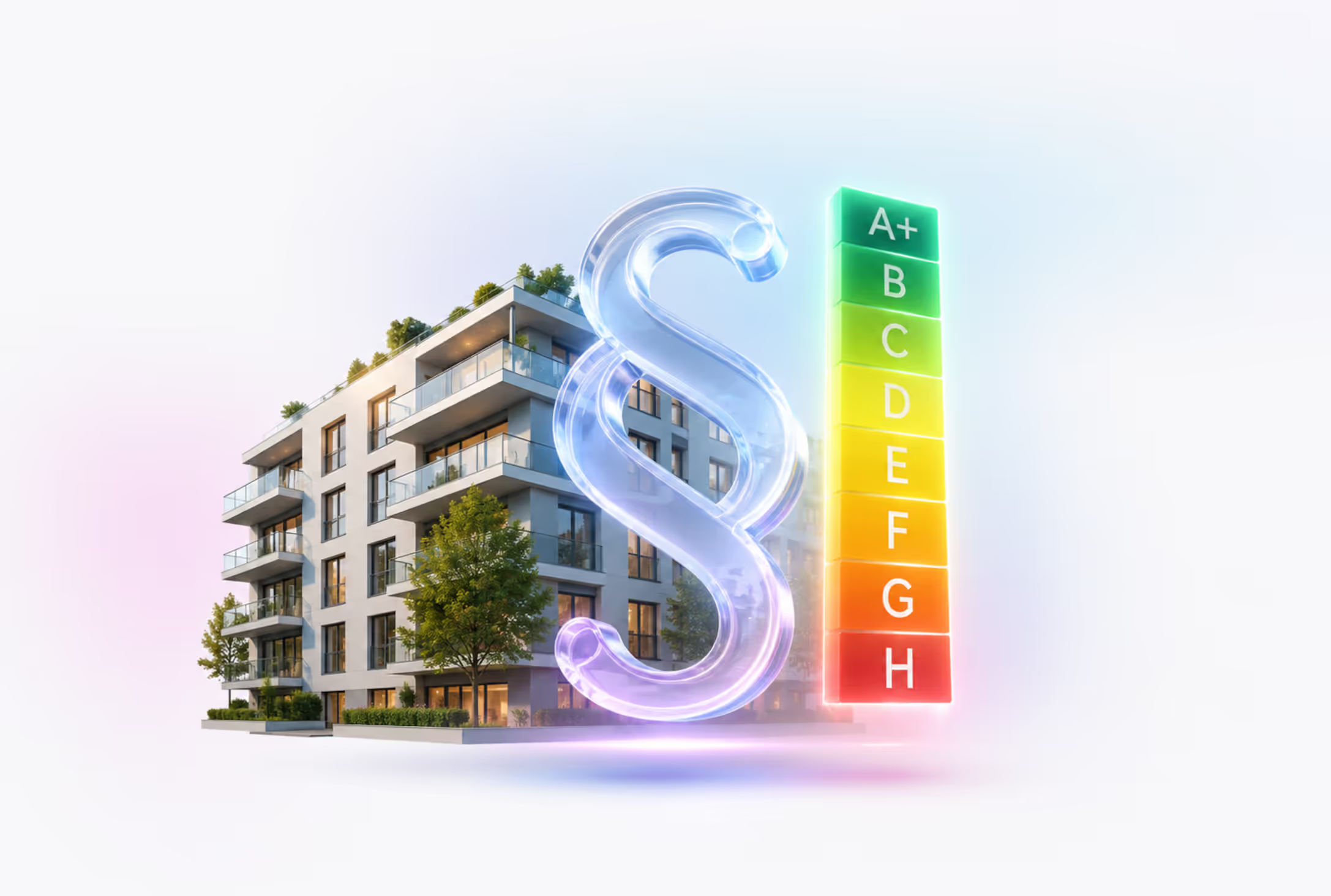
Fact‑checking what the cabinet draft of 13 May 2026 said about the scale, mandatory disclosures, display obligations, fines and entry into force — and what the promulgated Act (BGBl. 2026 I No. 226) now provides. A sober analysis for owners, property managers and estate agents; current overview in the hub GModG promulgated: the new energy certificate arrives on 1 January 2027.
This article began as a fact check of the cabinet draft of 13 May 2026 (see the joint press release by BMWE and BMWSB and the GEG information portal of the BBSR). The Act has since been promulgated (28 July 2026, BGBl. 2026 I No. 226); Article 1 has applied since 29 July 2026, Article 2 (EPBD energy certificates) from 1 January 2027. Section and process descriptions below remain historically draft‑based and are corrected where the final Act differs — especially on § 82.
In this article
- What's at stake: the cabinet draft in three sentences
- The central surprise: A+ to H stays for residential buildings
- What still changes for residential buildings
- Stricter display obligations for sale and letting
- Under the hood: revised annexes, revised indicators
- Fines up to €10,000 and sample inspections
- EU transposition: what arrives, what's missing
- Timeline: from cabinet decision to statute
- Practical FAQ on the residential building energy certificate under GModG
- Conclusion: reform with gaps – and outlook on the next amendment
The GModG is promulgated (28 July 2026, BGBl. 2026 I No. 226 ). Article 1 since 29 July 2026; Article 2 (EPBD energy certificates) from 1 January 2027 — no longer an open “+6 months after promulgation”.
This article started as a fact check of the cabinet draft of 13 May 2026. The core scale finding remains in the final Act: residential A+ to H, non‑residential A to G (Annex 10a).
Key draft→Act correction on § 82: instead of “24 monthly values”, the final text requires annual, energy‑carrier‑differentiated consumption data over two years; most recent period ≤ 18 months; consumption certificates only for exclusive residential use.
Current overview:
GModG promulgated: the new energy certificate arrives on 1 January 2027
What's at stake: the cabinet draft in three sentences
First: the federal government’s draft of 13 May 2026 replaced the Building Energy Act (GEG) with the new Building Modernisation Act (GModG) — the official long title is “Act on saving energy and modernising heat supply in buildings”. Sections 71, 71b to 71p and 72 GEG — in other words the entire block on the 65‑per‑cent renewable‑energy obligation when replacing heating systems — were deleted (BMWE/BMWSB press release of 13.05.2026). That line is implemented in the promulgated Act (Article 1 since 29 July 2026).
Second: at the same time, the draft largely transposed the new EU Building Directive (EU) 2024/1275 (“EPBD recast”) into German law almost one‑to‑one. The EU transposition deadline was 29 May 2026; the cabinet decision landed 16 days before that, while entry into force still required Bundestag, Bundesrat and promulgation (see Directive (EU) 2024/1275 on EUR‑Lex). A review of the central requirements in 2030 is already built into new § 9a: BMWE, BMWSB and BMU are to assess the climate impact of Parts 2, 3, 4 and 6 and, within six months, submit a proposal for further development.
Third: for the energy certificate, the draft — and the final Act — contain a whole cascade of new rules — new §§ 79 to 88c, a reworked fine provision in § 108 and a new Annex 10a with efficiency classes A to G for non‑residential buildings. Annex 10 for residential buildings, by contrast, remains unchanged in substance — and that point is the real surprise we start from.
The central surprise: A+ to H stays for residential buildings
Before the cabinet decision, there was widespread debate about whether Germany would align the longstanding A+ to H scale for homes with the EU‑typical A to G scale during EPBD transposition. The draft’s answer is sober: no — at least not now.
Annex 10 remains unchanged in substance
Article 1 item 54 of the draft changes Annex 10 GEG in exactly two respects: the heading is adjusted to “Annex 10 (to § 86(1))”, and in the second column the term “Gebäudenutzfläche” is replaced by “building useful floor area to DIN/TS 18599:2025‑10 that is heated or cooled”. The actual table of class boundaries for A+ to H is not touched. Classification for residential buildings therefore remains exactly as it stands today in Annex 10 GEG.
The decisive half‑sentence in the explanatory memorandum
The memorandum on item 55 letter b is unusually frank about the political reason for holding back:
The reference to building useful floor area continues to apply for Annex 10 only, even where the other GModG rules refer to net floor area. For Annex 10 the previous reference to building useful floor area is retained so that efficiency classes remain unchanged until Annex 10 is adjusted.
In plain terms: reform of the residential scale is not forgotten — it is deliberately postponed and will be added in a later amendment. Associations such as DENEFF and the GIH criticise precisely this omission — the EPBD requires a comparable scale, and a national special track of A+ to H is unsuitable for that purpose.
Contrast non‑residential buildings: new Annex 10a with A to G
The opposite happens for non‑residential buildings. Article 1 item 55 inserts a new Annex 10a (to § 86(3)):
| Energy efficiency class | Primary energy reference factor |
|---|---|
| A | 1.00 |
| B | 1.39 |
| C | 1.78 |
| D | 2.17 |
| E | 2.56 |
| F | 2.95 |
| G | 3.50 |
The class follows from the ratio of calculated primary energy demand to the primary energy demand of the reference building (new § 86(4)). For the reference calculation, deviating from Annex 2 item 4.1, a primary energy factor of 0.7 always applies.
A second, much‑noticed shift in the non‑residential field accompanies this: § 82 explicitly limits the consumption certificate to buildings that “serve exclusively residential purposes”. For non‑residential buildings only the demand certificate (§ 81) remains permitted. This asymmetry — new scale plus no consumption certificate for non‑residential buildings, while the consumption certificate becomes selectable for exclusive residential use (see below) — shapes the draft and the final Act together with the unchanged A+ to H scale.
What still changes for residential buildings
Anyone inferring from this asymmetry that nothing changes for homes is wrong. The class boundaries stay — but methodology, mandatory disclosures and the form of the certificate are tightened in several places. Below are the most important levers, ordered by practical relevance for owners, managers and agents.
Consumption certificate: selectable for exclusive residential use (§ 80(3) / § 82)
Under the cabinet draft — and so in the final Act — the consumption certificate becomes selectable for buildings with exclusive residential use once the WSchV‑1977 barrier in § 80(3) falls. When a certificate is required on sale, letting or contract renewal, choice rules therefore change compared with current GEG (interim rules until 31 December 2026).
Today, § 80(3) GEG requires a demand certificate for residential buildings with fewer than five dwellings where the building application was lodged before 1 November 1977. A consumption certificate is only possible if the house already met the Thermal Insulation Ordinance of 11 August 1977 at completion or was later upgraded to that level. Without that proof — for example an unsanitised older home, a terraced house or a small block of flats — the consumption certificate is ruled out; only the demand certificate remains.
In the draft and final Act (replacement of §§ 80–83), § 80(3) sentence 2 only states: for a non‑residential building, a certificate based on an energy balance under § 81 must be issued. The entire residential special rule with pre‑1977 applications and the 1977 ordinance is gone. For exclusive residential use, mandatory cases under sentence 1 therefore allow choice between § 81 (balance) and § 82 (recorded consumption) — provided § 82 is met. “Residential building” under § 3 (predominantly residential) is not enough for § 82: even a small commercial share rules out the consumption certificate.
| Situation | GEG until 31/12/2026 (§ 80(3)) | GModG from 01/01/2027 (§ 80(3)) |
|---|---|---|
| Sale, letting, contract renewal (general) | Energy certificate — demand or consumption | Choice for exclusive residential use (demand § 81 / consumption § 82); otherwise demand |
| Residential building with fewer than 5 units, building application before 1 Nov 1977 | As a rule, demand certificate only | No WSchV special rule — choice if § 82 (exclusive residential use) is met |
| Exception Thermal Insulation Ordinance of 11 Aug 1977 | Consumption certificate only if 1977 insulation level met at completion or reached later | This WSchV link in § 80 is removed |
| Non-residential buildings on sale/lease | Energy certificate (demand or consumption depending on building type) | Demand certificate only (§ 81, energy balance) |
Who benefits? Owners of single‑family and small multi‑family homes (under five units) planned before 1977 without a thermal insulation proof at 1977 ordinance level — if the building serves exclusively residential purposes. The consumption certificate becomes legally selectable for the first time — not automatically easier: § 82 tightens data and methodology (next section).
Do not confuse: Removing the WSchV link in § 80 does not replace consumption data requirements. Whether a consumption certificate pays off depends on the final § 82 data (annual over two years, ≤ 18 months) — see also the updated article Order a consumption certificate now – before the consumption-data rules change. In practice: Who is affected by the WSchV-1977 barrier and when consumption pays off is covered in Consumption certificate: new choice for all residential buildings.
Consumption certificate: annual data over two years (final § 82)
The cabinet draft still mirrored EPBD Annex I (“at least monthly”) as 24 consecutive monthly values in § 82(1). That did not become law. Final § 82 from 1 January 2027 requires annual, energy‑carrier‑differentiated consumption data over two years; the most recent period may be at most 18 months old. Weather adjustment now follows the new DIN/TS 18599‑10:2025‑10 Table 5 and must adequately reflect longer vacancies and user behaviour (§ 82(3)).
Two new flat rates are introduced methodologically:
- Decentralised domestic hot water without known consumption: flat +16 kWh/(m²·a) on final energy consumption (§ 82(2) sentence 3).
- Space cooling in homes without consumption data: flat +6 kWh/(m²·a) electricity (§ 82(2) sentence 4).
The familiar simplification using living space continues: if net floor area is unknown, it may for buildings with up to two dwelling units with heated basement be set at 1.35 × living space, and otherwise 1.2 × living space (§ 82(2) sentence 5).
In practice: If three annual statements still suffice today, understand the transition window — with checklists and data readiness in Order a consumption certificate now – before the consumption-data rules change (slug historically “24‑months”, content adapted to the final Act).
Mandatory disclosures § 85 — the list grows to 31 items
Probably the largest formal change to the residential certificate is the mandatory disclosure list in § 85(1): 31 numbered items instead of barely two dozen, all in a single list. What matters in practice is the clean split — several disclosures already required today are only carried over or refined; the real novelties are manageable.
Entirely new on the residential energy certificate:
- Primary and final energy as absolute annual values in MWh (item 23) — in addition to the existing specific figure in kWh/(m²·a). The EPBD (Annex V) explicitly requires an absolute figure; the German certificate did not previously include one.
- Renewable energy generated on site in absolute MWh, plus main energy carrier and type of RE source (item 24).
- Share of on‑site renewable energy in final energy in per cent under standard conditions (item 14).
- Lifecycle greenhouse gas emissions from 1 January 2028 for new builds over 1,000 m², from 1 January 2030 for all new builds (item 17).
- Useful energy in kWh/(m²·a) in addition to final and primary energy (item 25).
- Smart‑readiness disclosure: does the building respond to external signals (yes/no, item 26)?
- Low‑temperature capability of the heat distribution (yes/no, item 27).
In practice: What the new MWh line alongside the efficiency class means for sale and purchase — and whether the “cards are being reshuffled” — is explained in Energy certificate with MWh per year: Are the cards being reshuffled?.
Confirmed or methodologically refined (no substantive novelty):
- Operational greenhouse gas emissions in kg CO₂‑equivalent per square metre and year (item 16) — already mandatory under current § 85(2) GEG on every certificate. What is “only” new are the revised emission factors in Annex 9 and the explicit prefix “operational” to distinguish from the new lifecycle disclosure.
- Energy efficiency class A+ to H for residential buildings (item 9) — unchanged in substance.
- Summer thermal protection for new builds (item 29) — already to be considered under § 14 GEG.
- Modernisation recommendations under § 84 (item 30) — substantively extended by estimates of energy savings and GHG reduction plus service life of the heating plant.
Closely linked to the new mandatory disclosures are the modernisation recommendations: § 84(1) now additionally requires an estimate of energy savings and greenhouse gas reduction, an assessment of the service life of the heating and cooling plant and, where appropriate, proposals for replacement. For overall energy efficiency class A the recommendation duty ceases — a top‑class certificate needs no improvement hints any more.
Digital and machine‑readable — paper only on request
§ 79(2) reverses the default form of the energy certificate:
The energy certificate must be simple and understandable. It is to be issued digitally in a machine‑readable format. At the request of the developer or owner, the energy certificate shall also be issued on paper.
That is more than cosmetics: online portals, property‑management software and letting platforms can process the certificate electronically in future. The consultation‑session passage from former § 80(4) GEG is dropped — the memorandum explicitly cites “reducing bureaucracy”.
Solar obligation for new homes from 2030 (§ 106)
Former § 106 GEG (“Mixed‑use buildings”) is replaced in full by new § 106 “Solar energy in buildings”. For homes, item 2(4) matters: From 1 January 2030, every new residential building and every new covered car park physically adjoining a building must have a solar installation.
Important in practice: the solar obligation for homes applies only to new builds from 2030. Existing buildings are unaffected; refurbishment does not trigger a solar duty for homes (unlike non‑residential buildings, which from 2028 can be caught by comprehensive refurbishment). Exceptions apply where installation would be “technically impossible, functionally unfeasible, economically unreasonable or contrary to other public‑law requirements” (§ 106(2) sentence 2).
Under § 106(4) the Länder may impose stricter requirements — existing state PV duties (e.g. in Bavaria, Berlin, Bremen, Lower Saxony) are therefore not overlaid but remain applicable in parallel. For the residential energy certificate the solar obligation has a direct effect: building‑ integrated PV flows into the certificate under § 85(1) no. 14 as the “share of on‑site renewable energy in final energy”.
Stricter display obligations for sale and letting
§ 80(3) to (5) structure display and handover duties on sale, letting, leasing — and, newly, on renewal of such contracts. Anyone who circulates an energy certificate on sale or letting now runs through a clearly formulated five‑step cascade.
The five stages of the display cascade
- At the latest on the viewing the energy certificate or a copy must be shown to the prospective buyer (and analogously tenant, lessee, finance lessee).
- Alternatively, a clearly visible notice board or clearly visible laying out during the viewing satisfies the display duty.
- If no viewing takes place, the certificate must be shown without delay.
- On request from the prospective buyer it must likewise be shown without delay.
- After conclusion of the contract the certificate or a copy must be handed over to the buyer without delay.
The five stages mirror § 80(4) sentences 1 to 5 (together with § 80(5) for letting) point for point. Owners who instruct an estate agent remain jointly responsible — the duties apply to “the seller or the estate agent” alike.
Scope extended: lease, finance lease, contract renewal
Until now lease, finance lease and especially renewal of an existing lease or tenancy agreement were a legal grey zone. § 80(3) sentence 1 now expressly clarifies: a contract renewal triggers the energy‑certificate duty if no valid certificate is already available. For property‑management practice that means: on every lease renewal — including after indexation or amicable extension — it must be checked whether a valid energy certificate is on file.
Mandatory listing details in property adverts (§ 87)
Anyone advertising in “commercial media” who holds an energy certificate must include in the advert the following details (new § 87):
- whether the certificate was issued under § 81 (demand) or § 82 (consumption),
- the issue date,
- annual primary energy demand in kWh/(m²·a),
- the energy efficiency class,
- the year of construction,
- the main energy carriers for heating.
For older certificates issued before entry into force, slightly different listing duties apply under § 112(3) (simplified: certificate type, final energy demand/consumption, energy carriers, for homes also year of construction and energy efficiency class). The transition from the old to the new mandatory‑disclosure list is therefore cleanly regulated.
In practice for estate agents. If you need to retool the listing workflow concretely for §§ 80, 87 and 108 — listing templates, handover record, UWG warning‑letter risk — the spin‑off article GModG for Estate Agents: Listing Disclosure, Handover and Fines walks through it: four‑week roadmap, UWG sanction cascade following BGH I ZR 232/16 and the Regional Court Ingolstadt of 2 June 2023, and an outsourcing rule of thumb from five to ten certificates per year.
In practice for marketing agencies. If you run performance campaigns or landing pages
for real-estate clients, the lever is not the fine but non-approved listings and agent
liability under § 8(2) UWG (BGH I ZR 28/25 of 11 March 2026): media budget burns, the client
is on the hook, and the agency carries contractual liability for defective work (§§ 633, 634
BGB). Three levers, a three-slide pitch and a seven-step rollout for the account review are
laid out in the B2B spin-off
GModG for Marketing Agencies: The Energy Certificate as Lead Lever and Service Stack —
lead liberation, stack-the-brick (BFSG as the operational model), mandate protection; plus
JSON-LD via LocationFeatureSpecification and an API embed directly on the agency landing
page.
In practice for property‑management platforms. If you absorb §§ 80, 82, 84 and 87 not in the individual case handler’s inbox but in the platform architecture — lease renewal as a trigger, annual consumption periods over two years from the HeizkostenV data pool (§ 5(2), § 6a HeizkostenV), structured modernisation recommendations for condominium refurbishment plans, pre‑fill for listings — the B2B spin‑off GModG for Property‑Management Platforms: The Energy Certificate as a Platform Feature via API walks through it: three make‑or‑buy options, a three‑building‑block pilot and an API architecture with OpenAPI 3.1.2, Bearer auth and DIBt registration number.
In practice for property managers. If you trigger the order yourself as the manager of an HOA or rental portfolio — not as the platform vendor but as the operator with a management contract and an owners' meeting — the lever sits at the resolution risk (§§ 19, 27, 44 WEG), the internal manager‑mandate relationship under § 280 BGB and the annual consumption data per energy carrier over two years from the HeizkostenV routine (ista, Techem, Brunata‑Minol, KALO). The operator view of the same set of duties is in the B2B spin‑off GModG for Property Managers: Annual Consumption Data, Modernisation Recommendations and HOA Resolutions: blanket authorisation in the owners' meeting to resolve the timing conflict between the leasing trigger and the meeting frequency, the § 84 quantified mini roadmap as the data basis for the refurbishment resolution, a four‑point checklist and the API‑outsourcing rule of thumb.
Under the hood: revised annexes, revised indicators
Understandably, attention focuses on the scale question. Yet precisely because Annex 10 stays unchanged, a second point is easy to miss: several calculation annexes of the Act are swapped out in the Act. For homes that affects not the class bands, but the figures that land inside those bands. Anyone commissioning a new energy certificate in 2027 will already calculate with new base values — even though the scale looks identical.
Which annexes change?
Overview: Annex 1 (reference residential building) is fully replaced; old Annexes 4 and 5 merge into a new Annex 4 (primary energy factors) — with a material methodological shift; Annex 3 (averaging U‑value) receives updated norm references; Annex 9 (greenhouse gas balance) is formally replaced by an updated version — factors remain broadly similar, individual values are tweaked; Annex 11 (calculation procedure) is migrated wholesale to new DIN/TS 18599:2025‑10. Old DIN V 18599 (2018‑09 edition) thus disappears formally from the statute text.
Annex 4: electricity factor falls, wood factor rises — and the methodology switches
Here lies a double change that is easy to overlook. Old Annex 4 GEG was implicitly a “non‑renewable share” of primary energy — it mainly reflected fossil effort up to delivery at the building. New Annex 4 GModG‑E is, on the reading of the BBSR GEG portal, total primary energy including renewable share. That changes not only individual values but also how you read the number — which explains the seemingly paradoxical movements:
| Energy carrier | Current (Annex 4 GEG, as applicable) | New (Annex 4 GModG draft, total) | Effect for residential buildings |
|---|---|---|---|
| Grid electricity | 1.8 | 1.5 | Heat pumps look better in primary energy demand |
| Wood / solid biomass | 0.2 | 0.7 | Pellet and log boilers are rated significantly worse |
| District heating (general) | 0.7–1.3 (depending on mix) | 0.7 flat rate | Tends to improve; no longer CHP-specific |
| Natural gas / heating oil / LPG | 1.1 | 1.1 | unchanged in nominal terms |
| Biogas / biomethane / bio-oil | 0.7 | 0.7 | unchanged in nominal terms |
| Geothermal, solar thermal, ambient heat | 0.0 | 0.0 | unchanged |
| On-site photovoltaics | 0.0 | 0.0 | unchanged |
The trick: electricity falls arithmetically because the growing renewables share in the grid now feeds into the factor — the grid gets greener, the factor drops. Wood rises arithmetically because the “actual” energy content of biomass (previously netted out as renewable) now counts. Both movements are therefore not political valuation but methodological consequence of the EPBD concept of “total primary energy”.
For the residential energy certificate that means: an identical heat pump in an identical house will in future show a lower primary energy demand arithmetically — without a single stone moving at the property. A pellet boiler in the same house attracts a higher primary energy indicator. The ranking order of heating systems in primary energy therefore shifts markedly in favour of electricity‑based solutions.
Annex 1: reference building becomes buildable, technology‑neutral — and stricter
The reference building for new‑build requirements has been fundamentally rewritten. The BBSR GEG portal describes the logic of the new draft as a “buildable reference building” — the reference configuration is no longer only a theoretical calculation construct but describes genuinely executable building services against which the residential building to be erected is measured. The previously implicit gas condensing boiler as reference heat generator gives way to a “technology‑neutral reference heat generator” with an explicitly fixed total primary energy factor:
- until 31 December 2029: fp,tot = 0.75
- from 1 January 2030: fp,tot = 0.70
What that means: anyone newly erecting a home must in future reach the same annual primary energy demand as a reference building with a high‑efficiency heat‑pump, biomass or district‑heating solution. The requirement logic is no longer “as good as a condensing boiler with this envelope” but “as good as a climate‑friendly plant system with this envelope”. When the next step enters force (2030), the requirement tightens by another 6.7% — without changing the envelope U‑values in Annex 1.
Annex 1 additionally sets plant engineering and building automation class C to DIN/TS 18599‑11:2025‑10 explicitly as reference; ventilation is a central extract system with DC fan, pumps with EEI = 0.23 and design temperatures 55/45 °C. That looks like detail but perceptibly raises the reference level.
Annex 9: revised GHG factors
Annex 9 in the GModG again supplies the emission factors for the — already mandatory — disclosure of operational greenhouse gas emissions in kg CO₂‑equivalent per square metre and year (new § 85(1) no. 16, former § 85(2) GEG). The factors are uniformly defined in grams CO₂‑equivalent per kilowatt hour and are tweaked pointwise compared with current Annex 9; an extract for typical residential cases:
| Energy carrier | g CO₂-eq / kWh |
|---|---|
| Heating oil | 310 |
| Natural gas | 240 |
| LPG | 270 |
| Wood / solid biomass | 20 |
| Biogas / biomethane | 80 |
| Grid electricity | 100 |
| On-site PV or wind electricity | 0 |
| Geothermal, solar thermal, ambient heat | 0 |
| District heating from fossil CHP | 180–300 |
| District heating from renewable CHP | 40 |
Wood is interesting here: in the primary energy indicator biomass loses (0.7 instead of 0.2), but in the GHG balance it is best by far at 20 g CO₂‑eq/kWh. Homes with pellet or log boilers therefore show a split profile on the new certificate: worse primary energy, very good greenhouse gas figures. For owners who use “the class” as the central label in sale or letting, this differentiation is new.
DIN migration: DIN V 18599 → DIN/TS 18599:2025‑10
Annex 3 (averaging U‑value) and Annex 11 (calculation procedure) are migrated wholesale to DIN/TS 18599:2025‑10. Old DIN V 18599 (prestandard, 2018‑09) is no longer part of the Act. For homes that means:
- Final energy demand and final energy consumption are calculated with the updated algorithms of the DIN/TS 2025‑10 series — including new distribution and transfer losses, revised heat‑recovery approaches in ventilation systems and new auxiliary energy values.
- The reference area in Annex 10 is tied textually to “DIN/TS 18599:2025‑10 that is heated or cooled” — materially equivalent to the previous building useful floor area AN, but defined more precisely in form.
- Calculation of the mean of heat transfer coefficients (Annex 3) now follows DIN 4108‑4:2020‑11 together with DIN EN ISO 6946:2018‑03 — relevant mainly for components to unheated rooms and earth‑contact surfaces.
In most homes the arithmetic impact of this norm migration stays in single‑digit per cent. In individual cases — for example heavily under‑basemented existing stock or ventilation with heat recovery — noticeable shifts are possible.
What does that mean for the efficiency class?
Important: Annex 10 for homes classifies using final energy in kWh/(m²·a), not primary energy. Shifts in Annex 4 therefore do not feed straight into the class. The class can still change if:
- the final energy calculation under DIN/TS 18599:2025‑10 differs from DIN V 18599:2018‑09, or
- the reference area is determined slightly differently under the revised DIN definition.
In practice that means: one and the same home may receive an adjacent efficiency class on re‑issue — without any physical change to the building. Existing certificates remain unaffected; they stay valid until their expiry date. Anyone needing a new certificate — e.g. for sale, letting or a due ten‑year re‑issue — should factor the changed calculation core into expectations.
Fines up to €10,000 and sample inspections
The duties sound technical — the consequences are not. Anyone who today already needs an energy certificate and fails to show it already risks a fine under current GEG; the GModG sharpens that regime markedly. § 108 is completely redrafted. Directly around the energy certificate there are six fine offences, each punishable with up to €10,000 (§ 108(2) no. 2):
| No. | Offence | Provision |
|---|---|---|
| 17 | Failure to hand over energy certificate for new build | § 80 para. 1 sent. 2 |
| 18 | On sale/lease: failure to present certificate correctly, completely or in time | § 80 para. 4 sent. 1 or 4 in conjunction with para. 5 |
| 19 | Failure to hand over certificate after contract conclusion | § 80 para. 4 sent. 5 in conjunction with para. 5 |
| 20 | Incorrect data processed in the certificate | § 83 para. 1 sent. 2 or para. 3 sent. 1 |
| 21 | Mandatory listing details missing in property advert | § 87 para. 1 |
| 22 | Unauthorised issue of an energy certificate | § 88 para. 1 |
For day‑to‑day practice that mainly means: relying on “I’ll submit the certificate later” when letting risks a fine — the display duty already applies at the viewing and at the latest on request from the interested party. A typical risk scenario: an agent shows a flat, the certificate is in the office, not at the appointment. The prospect asks — the agent defers to the next e‑mail. That already breaches § 80(4) sentence 4; the fine under § 108(1) no. 18 can follow even if no contract is concluded. For property managers operational responsibility shifts clearly towards process documentation: who showed or handed over which certificate when, and archived it.
The fine regime is flanked by expanded sample inspections in § 99: the competent Land control body examines a “statistically significant percentage of all energy certificates newly issued in a calendar year” (§ 99(2)). The control body may retrieve registration numbers and mandatory disclosures from the registration office to prepare samples. For certificates issued between entry into force and 31 July 2027, samples may still be conducted after that cut‑off — a grace period, not a general amnesty.
EU transposition: what arrives, what's missing
The draft memorandum refers remarkably often to individual articles of EU Building Directive 2024/1275. That is deliberate: the legislator wants visible documentation that requirements are transposed “one‑to‑one” — no less, but also no more.
What is delivered
- Mandatory disclosures (EPBD Annex V) → fully transferred to § 85(1) (items 9–17 and 23–27).
- Consumption data for the consumption certificate (Annex I; final § 82) → annual, energy‑carrier‑differentiated recording over two years (most recent period ≤ 18 months) — not the draft idea of “24 monthly values”.
- Efficiency classes for non‑residential buildings (Art. 19(2)) → § 86(3), (4) + Annex 10a A to G.
- Lifecycle greenhouse gas emissions (Art. 7) → §§ 85(1) no. 17, 88b and 88c, phased 2028/2030.
- Zero‑emission buildings (Art. 7(1), Art. 11) → § 10a from 1.1.2028 for public non‑residential buildings; § 10 from 1.1.2030 for all new builds.
- Renovation requirements for non‑residential buildings (Art. 9) → § 40 GModG.
- Solar obligation for new buildings (Art. 10) → § 106 with its own phased plan; for homes it applies from 1.1.2030 for new builds.
- Display duty in buildings with heavy public traffic (Art. 21(3)) → § 80(6) to (8).
- Digital, machine‑readable certificate (Art. 20) → § 79(2).
- Standalone climate review 2030 → new § 9a (not a direct EPBD mandate, but advance self‑binding by the federal government).
What remains open
- Comparable efficiency scale for residential buildings: Annex 10 stays unchanged; the EU demands a comparable scale. Associations see missing transposition (e.g. DENEFF in its statement of 13 May 2026).
- National building database under Art. 22: not fleshed out as full statutory text in the draft; the registration office (§ 98) is updated, but a fully integrated public database in the EPBD sense is not established.
- Minimum energy performance standards for homes (MEPS): the draft covers MEPS only for non‑residential buildings — residential stock is not addressed here.
- Detailed transitional rules for future adjustment of Annex 10: the memorandum announces a later amendment without naming a date.
The gaps are therefore consciously left. Anyone cross‑reading current EPBD materials with the draft finds a minimum transposition with a follow‑up mandate.
Timeline: from cabinet decision to statute
The cabinet decision of 13 May 2026 was not entry into force. The Bundestag and Bundesrat passed the Act on 10 July 2026; on 28 July 2026 came promulgation (BGBl. 2026 I No. 226). Overview and practice: GModG promulgated: the new energy certificate arrives on 1 January 2027 and the interim article GModG passed: What happens next for energy certificates?. The Act enters force in stages — with fixed dates instead of the earlier draft formulae “day after promulgation” / “+6 months”.
Status of the legislative procedure
From cabinet decision to promulgation
Promulgated · 28.07.2026
Done · 13.05.2026
Cabinet decisionThe government draft was adopted by the federal government and entered the parliamentary process.
Done · by 10.07.2026
First reading in the BundestagReferral to committees (historically: lead economic affairs and climate, with housing and legal affairs as consultees).
Done · by 10.07.2026
Expert hearingCommittee deliberations with amendment motions to the cabinet draft (historical process step).
Done · 10.07.2026
Final vote in the BundestagThe Bundestag passed the GModG — then transmission to the Bundesrat.
Done · 10.07.2026
Bundesrat deliberationIn our assessment the GModG is an objection statute — the Bundesrat approved on 10 July 2026.Done · 28.07.2026
Promulgation in the Federal Law GazetteBGBl. 2026 I No. 226. Article 1 since 29 July 2026; EPBD energy certificates (Article 2) from 1 January 2027.
Meanwhile the EU transposition deadline of 29 May 2026 had elapsed during the procedure. Legal delay is annoying but not unusual — in practice the European Commission allows member states a transition phase before opening infringement proceedings.
Staged entry into force (Article 9 GModG)
| Stage | Date | Content (selection) |
|---|---|---|
| Article 1 | 29/07/2026 (after promulgation 28/07/2026) | Renaming/heating reform among other things; certificate interim rules until 31/12/2026 (BGBl. 2026 I No. 226) |
| Article 2 | 01/01/2027 | EPBD energy certificates: §§ 79–88, § 108, Annex 10a (non-residential A–G), extended disclosures § 85, final § 82 |
| Article 3 | 01/01/2028 | Zero-emission buildings for new non-residential public buildings; lifecycle report for new build > 1,000 m² |
| Article 4 | 01/01/2030 | Zero-emission buildings for all new builds; lifecycle report for all new builds; solar obligation for new homes |
What is a zero‑emission building? The draft adopted — and the final Act contains — the definition from Article 2(2) EPBD recast: a building with “very high overall energy performance” that “requires no energy or only a very small amount of energy, causes no carbon dioxide emissions from fossil fuels on site and no or only very small operational greenhouse gas emissions”. For homes that standard becomes mandatory from 1 January 2030 (new § 10). For public non‑residential buildings it already applies from 1 January 2028 (new § 10a).
In practice: Article 1 (renaming, heating reform) has applied since 29 July 2026. The EPBD energy‑certificate rules in Article 2 — including fine offences in § 108 and final § 82 — start on 1 January 2027. The major milestones (zero‑emission buildings, lifecycle balance, solar obligation for homes) are clearly dated to 2028 and 2030.
What does that mean for existing energy certificates?
Existing certificates issued before entry into force keep their validity until the stated expiry date — usually ten years from issue. GModG does not change that: § 113 (period of validity) is only editorially adjusted; the core principle remains. For property adverts on such “legacy certificates” the modified listing duties under § 112(3) apply.
Practical FAQ on the residential building energy certificate under GModG
Does my residential energy certificate with A+ to H stay valid?
Yes. Existing certificates remain valid until they expire. Even newly issued certificates for homes still show classes A+ to H — Annex 10 GEG/GModG is not amended in substance. The much‑discussed A to G scale applies exclusively to non‑residential buildings via new Annex 10a — as in the cabinet draft, confirmed in the promulgated Act.
May I choose a consumption certificate for my unsanitised older home in future?
Yes — if the building serves exclusively residential purposes and you meet § 82. Current law (until 31 December 2026) forces many small homes (fewer than five units, building application before 1 November 1977) without proof of 1977 insulation standard onto the demand certificate. GModG removes that link in § 80(3). Whether a consumption certificate is sensible depends on consumption data — final: annual data over two years, most recent period ≤ 18 months — no longer on thermal insulation level. The draft idea of “24 monthly values” did not become law.
Do I have to commission a new certificate now?
No. A new energy certificate is only required where current law already demands one: new build, comprehensive refurbishment calculated under § 38(3), sale, letting, lease or renewal of such contracts — and only if no valid certificate is yet available (§ 80(3)). Promulgation alone does not force a new certificate.
Which scale applies to my office block or hotel?
Non‑residential buildings will in future have classes A to G under Annex 10a. The class follows from the ratio of primary energy demand to the reference building (with a constant primary energy factor of 0.7 for the reference calculation). Consumption certificates are no longer permitted for non‑residential buildings.
What does a breach of the display duty cost?
Up to €10,000 per offence. Covered are failure to display at viewing (§ 108(1) no. 18) and failure to hand over after contract conclusion (no. 19) as well as missing or incomplete mandatory listing details in property adverts (no. 21). Fines apply equally to owners, landlords, lessors, finance lessors and estate agents.
When does all this actually apply?
Current position (August 2026): the GModG was promulgated on 28 July 2026 (BGBl. 2026 I No. 226). Article 1 (renaming, heating reform) has applied since 29 July 2026. The EPBD energy‑certificate rules in Article 2 (§§ 79–88, § 108, Annex 10a) start on 1 January 2027 — no longer “day after promulgation” plus “+6 months”. Lifecycle report and zero‑emission buildings follow on 1 January 2028 (large buildings, public sector) and 1 January 2030 (all new builds). Overview: hub article.
Will I need a lifecycle balance in future?
Only for new builds. Mandatory from 1 January 2028 for new builds over 1,000 m² of net floor area, from 1 January 2030 for all new buildings (§§ 85(1) no. 17, 88b). The report is a dependent part of the energy certificate and follows DIN SPEC 91606:2026‑07. Existing buildings are not affected.
Will my energy figures change if I commission a new certificate under the new law?
That is possible — even without structural changes. Three effects compound: first, the new certificate calculates consistently to DIN/TS 18599:2025‑10, no longer DIN V 18599:2018‑09. Second, primary energy factors in Annex 4 are new: electricity falls from 1.8 to 1.5 (heat pump benefits), wood rises from 0.2 to 0.7 (pellet/log boilers worsen systematically). Third, CO₂ emission factors in Annex 9 are revised — the already mandatory disclosure of operational greenhouse gas emissions in kg CO₂‑equivalent per square metre and year therefore remains but figure values may shift. The efficiency class itself is tied to the final energy indicator in kWh/(m²·a), which through the norm migration usually varies only in single‑digit per cent — class moves are possible in individual cases but not the norm.
Does the reference area for my class change?
Not in practice. The Act introduces the new term balance reference area in § 3(1) no. 4a. Annex 10 (homes), however, expressly retains the previous area reference (building useful floor area to DIN/TS 18599:2025‑10 that is heated or cooled). For homes building useful floor area therefore remains decisive for classification — not the net floor area newly defined for other rules.
Conclusion: reform with gaps – and outlook on the next amendment
Three sentences to take away:
- The scale stays — the class does not necessarily. A+ to H continues for homes, but reference standard (DIN/TS 18599:2025‑10), primary energy factors and GHG factors change. On re‑issue the same house may land in an adjacent class — without a stone being moved.
- Display and handover duties cost money if overlooked. Up to €10,000 per offence turns the energy certificate into a compliance risk — from 1 January 2027 under the new certificate regime (Article 2).
- The truly big reform is still ahead. The draft memorandum promised adjustment of Annex 10 “at the next opportunity” — with minimum standards for homes, a comparable scale and a national database as likely building blocks. Promulgation did not change that outlook.
For owners, property managers and agents the cabinet draft was, in one reading, reassurance (no class switch, existing certificates remain valid, consumption certificates selectable for many purely residential older homes for the first time); in another, a mandate: mandatory disclosures, the display cascade and fine risk make the certificate a process step that must be documented. Anyone who makes flows checklist‑ready before 1 January 2027 — including final § 82 data — gains legal certainty.
Then comes the next wave. Homes remain for now on A+ to H — and attention is already turning to the amendment “at the next opportunity”.
Update August 2026: the GModG is promulgated (BGBl. 2026 I No. 226); Article 1 since 29 July 2026, Article 2 from 1 January 2027. This fact check is adapted to the final Act (especially § 82: annual over two years, not 24 monthly values). Current overview: GModG promulgated: the new energy certificate arrives on 1 January 2027. Want to keep the latest position and your own energy‑certificate duties in view? At energyausweis.de you receive a legally sound energy certificate under current law — prepared for the GModG tightenings from 2027.
Further reading:
- GModG promulgated: the new energy certificate arrives on 1 January 2027 (current hub)
- GModG passed: What happens next for energy certificates? (interim after parliamentary vote 10 July 2026)
- GModG draft 2026: the quiet announcement of the major energy‑certificate reform (reference draft of 5 May 2026 — the backstory)
- Will energy certificates become better comparable with the new A to G scale from May 2026?
- Will energy certificates become invalid from May 2026?
- The registration number on energy certificates
- Getting an energy certificate at short notice: what to do for sale or letting?