Documents for the energy certificate: what do I need?

Preparing an energy certificate requires various information and documents. We explain what to have ready so you can order the certificate as quickly as possible. This article is for owners, landlords and managers who need an energy certificate and want an overview of the documents required.
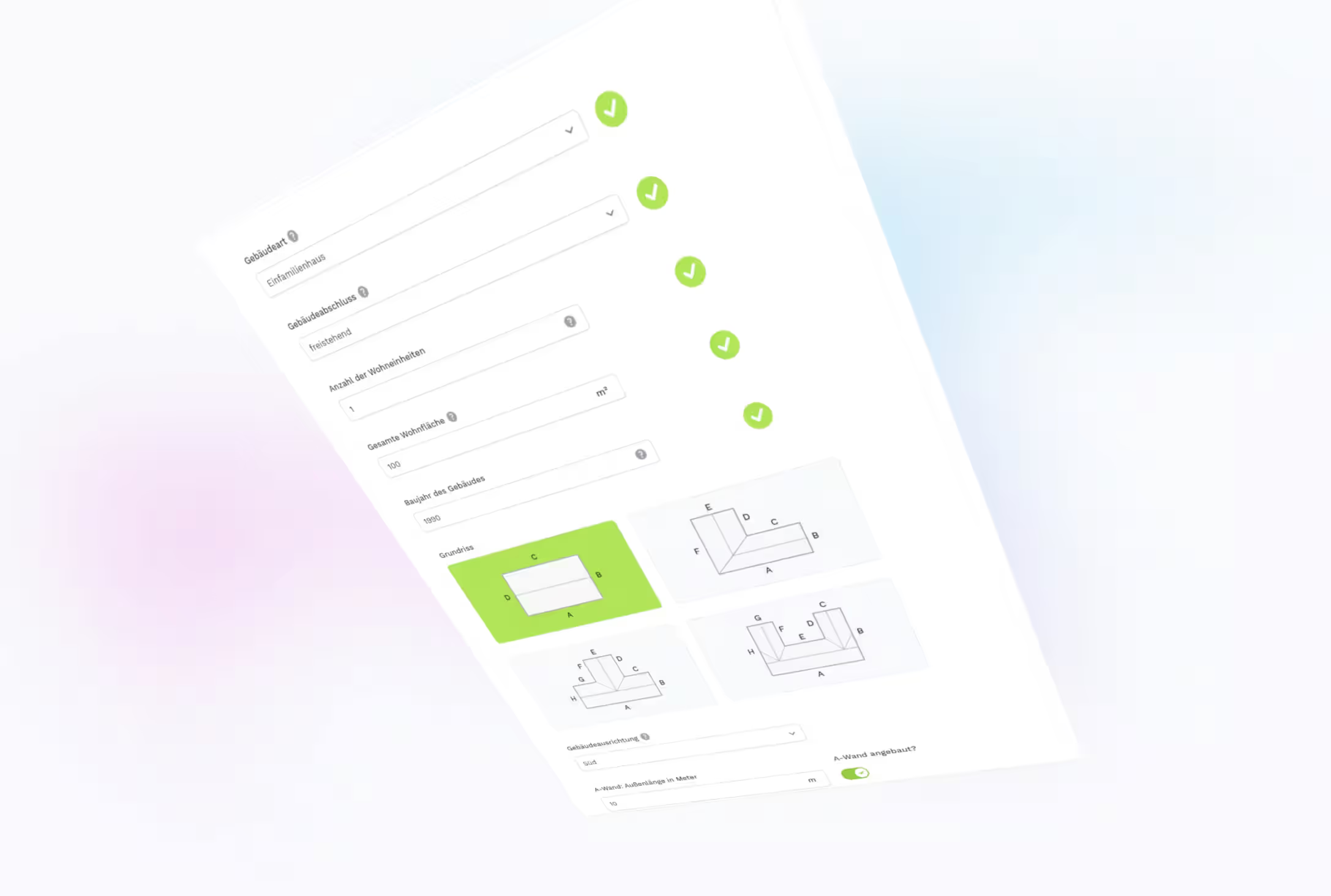
First we clarify what information is needed for both types of energy certificate – demand-based and consumption-based.
Good to know: If you have a certificate prepared at energyausweis.de, all required data is requested step by step. If you do not have a detail to hand, you can continue the form at any time.
What you need to know
- … what documents you need for each type of energy certificate
- … what you need to provide for the consumption-based certificate
- … what you need to provide for the demand-based certificate
- … which details are decisive for the result
- … why the Energyausweis Smart is a smart alternative
- … how renewables positively affect the energy certificate
- … why old and new energy certificates are not always comparable
Consumption-based and demand-based certificate: documents needed for both
The information required for a consumption-based certificate and for a demand-based certificate partly differs. But some details are needed for both types:
- Reason for issue (e.g. sale).
- Building address.
- Year of construction.
- Type of building (e.g. single-family, multi-family).
- Number of units.
- Living area.
- Year of heating system (often in the chimney sweep record).
- Energy source (e.g. gas, oil, renewables).
- Hot water details.
- Type of ventilation and cooling.
- Energy modernisation (e.g. roof refurbishment, facade insulation).
- Building photos (mandatory since 2021).
- Your billing address.
Besides these general details, further information is required depending on the certificate type. Below we cover the specific requirements for consumption-based and demand-based certificates. So first clarify which certificate you need.
Online certificate check
If you are not yet sure which certificate is right for you, use our online check. It helps you find the right energy certificate for your property. In most cases you can choose freely between consumption-based and demand-based; there are exceptions. The check below helps you decide.
Wofür benötigen Sie einen Energieausweis?
Good to know: If the check recommends an Energyausweis Smart™, you can still order only one of the two types. We recommend the Energyausweis Smart™ because it is calculated internally from your data and thus determines the best efficiency class for your building.
Consumption-based certificate: all required documents
For the consumption-based certificate, as the name suggests, consumption data is most important. That includes:
- Heating bills or energy bills for the last three years.
- Details of vacancies (if any).
- Thickness of insulation layers (only affects modernisation recommendations).
For the consumption-based certificate, building details that affect modernisation recommendations are also requested. Even though this is only an initial assessment of possible energy improvements, banks take it into account for financing. If you finance modernisation measures with the loan, you can refer to the consumption-based certificate in discussions. The modernisation recommendations in the certificate also matter for the bank when assessing the building’s creditworthiness and setting interest terms.
For extensive energy refurbishment, an energy certificate alone is not enough to assess the measures needed. We recommend also having an individual refurbishment roadmap (iSFP) prepared. It is drawn up by an energy consultant or architect and contains a detailed plan and cost estimate.
Good to know: The most recent consumption bill must not be older than 18 months and the data must cover 36 consecutive months. If you do not have this data, you must have a demand-based certificate prepared.
Regional climate factors for adjusting consumption are calculated from the building address. Photos of the building and refurbished components and building plans can also help validate the data.
Demand-based certificate: required information
The demand-based certificate is based on a simulation of the building’s energy efficiency, so building geometry and the energy properties of components are decisive. That includes:
- Building size (length, width, room heights, knee wall).
- Energy quality of components (e.g. windows, facade, roof, basement ceiling).
- Thickness and type of insulation.
- Type, age and size of boiler and hot water storage.
Compared with the consumption-based certificate, the information for the demand-based certificate is more extensive and detailed. Obtaining the required data on dimensions and component properties can be a challenge. Building plans or floor plans can help with lengths and heights.
At energyausweis.de we also use satellite images to validate building geometry. Heights can then be estimated from the number of storeys and typical room heights. But details from building plans and floor plans are always better and more accurate. If you have access to the building, measuring with a laser distance meter or tape measure is also possible.
For the energy quality of components, details on insulation and window type are required. You can find these in building plans or in invoices from the trades that did the work. If you know the U-values of components, that is a big advantage and leads to a more accurate result.
Improving energy figures: what matters most
It sometimes happens that owners could have received a certificate with a better efficiency class if they had been more precise. Conversely, being overly precise in some places does not pay off – for example there is no need to measure wall length to the centimetre; metres are enough.
Where does precision pay and where not? Here is an overview of where it is worth being accurate.
Consumption-based certificate
- Accurate consumption data and units.
- Any other energy sources.
- Hot water consumption (if metered separately).
- Vacancies (exact periods and areas).
- District heating: primary energy factor (if provided by the supplier).
Good to know: Building details such as refurbishment and insulation only affect modernisation recommendations in the consumption-based certificate, not the energy figures themselves.
Demand-based certificate
- Building geometry rounded to full metres (lengths, widths, heights, roof pitch).
- Insulation thickness and year installed (even better: exact U-values).
- Heating: type, age and size of boiler and hot water storage.
- Windows: type and glazing U-values are decisive for the energy figures.
- Pipe insulation, if added later.
- Ventilation: if an airtightness test was done, that often has a positive effect.
- Thermal bridges: if a detailed calculation exists, that can also help.
- Heat pump: seasonal performance factor (SPF) for heating and hot water.
Energyausweis Smart: combination of consumption and demand data
For the Energyausweis Smart™ we at energyausweis.de calculate both certificate types internally: consumption-based and demand-based. We need the same data as for both certificates, but data entry is simplified so you only enter everything once.
Holding a certificate with a better efficiency class can be very valuable when selling or financing. The Energyausweis Smart™ lets you obtain the best efficiency class for your building and thus increase your property’s value.
Renewable energy: how it positively affects the certificate
Renewables affect the consumption-based certificate only indirectly. If you cover part of hot water with solar thermal, that will reduce purchased energy and thus improve the efficiency class. In the demand-based certificate, renewables are included in the simulation and thus directly reflected. In both cases renewables have a strong effect on primary energy and CO₂ emissions.
PV only affects the final energy figure when heating or hot water demand is at least partly met by PV – typically with heat pumps or electric flow heaters.
In the consumption-based certificate, double counting is avoided by using actual consumption, which is lower with PV. In the demand-based certificate, electricity input is calculated from location and orientation and included in the balance.
For a full guide to PV, certificate type and efficiency class, see Photovoltaics and the energy certificate: when solar improves the efficiency class — and when it doesn't.
Stating renewables can therefore improve the efficiency class, especially in the demand-based certificate, and thus increase property value.
Updating the certificate: can a new one be calculated from the old?
An energy certificate cannot really be “updated” or “extended”. After the 10-year validity expires, a completely new certificate must always be prepared, which is then valid for another 10 years. Data from the old certificate is not required for the new one and is only rarely helpful.
For the consumption-based certificate, current consumption data for the last 3 years is decisive. So that must always be submitted again; old data cannot be reused. For the demand-based certificate the situation is slightly different, as the input values are not stated – only the result of the simulation. So here too all data must be entered again.
In rare cases, especially after energy modernisation, you may have a document from an architect, energy consultant or engineer describing the building’s energy properties. That can help when preparing a new certificate, mainly to compare current input with the old certificate.
Tip: old and new energy certificates are not always comparable
A new certificate can give different results from the old one because of changed calculation methods and standards. Certificates before 2014 used a colour scale up to 400 kWh/m²a. From 2014 the scale was stricter and only goes up to 250 kWh/m²a. So buildings that were in the yellow range may now appear in the red range even if consumption has not changed.
Since 2014, certificates have also been classified in efficiency classes from A+ to H. These make it easier to compare modern certificates but are not available for older ones.
Good to know: Although the scale and classes changed in 2014, the energy figure in kWh per square metre per year (kWh/m²a) is a good comparison. It is independent of classes and scale. However, it too depends on calculation methods and with the mandatory DIN V 18599 from 2024 is no longer comparable with older certificates.
Especially after energy modernisation, there can be large differences between old and new certificates. So when having a new certificate prepared, always use current data and methods.
Conclusion
Preparing an energy certificate requires a range of information and documents. You can gather these quickly using the checklists above. Then you can order the certificate in no time. Alternatively you can enter the data step by step when creating the certificate online. If a detail is not to hand, you can continue later.
In any case it makes sense to have ready: consumption data, building documents and 4 photos – one of the building, one of the insulation, one of the windows and one of the heating system. Requirements for consumption-based and demand-based certificates partly differ, so first clarify which certificate you need. Then use the checklists above to gather the right documents.
For tips on saving cost, see Free energy certificate: how to avoid the cost.