Introduction to building digitalisation

Building digitalisation is changing how properties are planned, operated and assessed in the future. It makes energy use transparent, improves efficiency and makes it easier to meet legal requirements across the board — from refurbishment obligations to the energy certificate.

What you need to know
- … how digital twins enable simulations and predictive maintenance.
- … how energy certificates benefit from automated data capture and greater transparency.
- … how digital technologies such as IoT, sensors and BIM reduce energy use and operating costs.
- … how digital tools help meet GEG and EU proof requirements faster and more reliably.
- … how owners and agents can increase property value by using digitalisation strategically.
Basics of digitalisation in the building sector
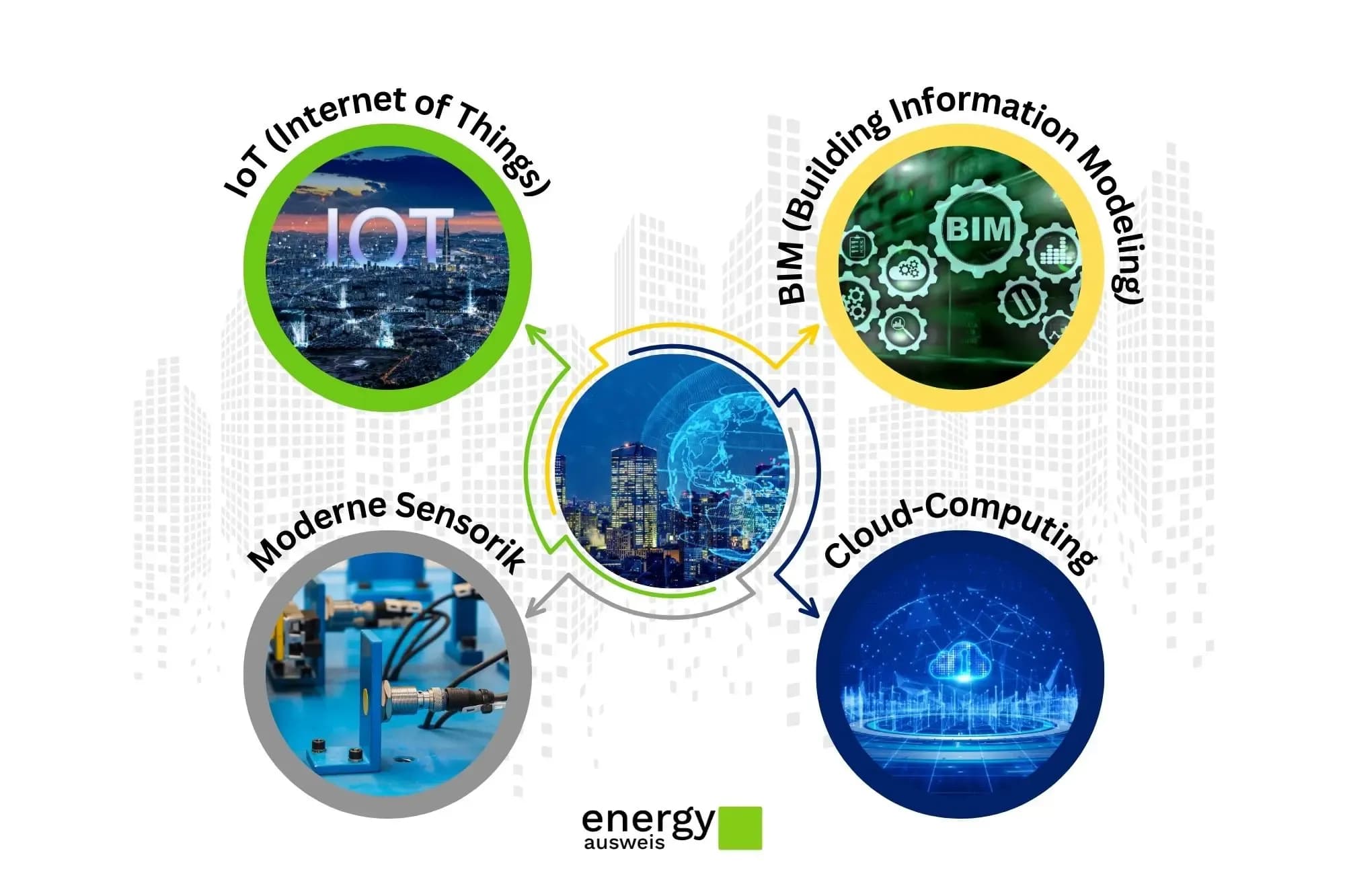
Digitalisation in the building sector means using modern technology to make planning, construction, operation and refurbishment of buildings more efficient and sustainable. It is not only about smart devices but about combining data, connectivity and intelligent control.
Key technologies at a glance
- IoT (Internet of Things): Sensors continuously capture data on energy use, indoor climate or system status.
- BIM (Building Information Modelling): Digital models bring together all building data, from plans to technical equipment.
- Sensors: Measure temperature, humidity or energy flows in real time.
- Cloud platforms: Provide data centrally and enable analysis from anywhere.
Aims of digitalisation
- Efficiency: Less energy use, optimised processes
- Sustainability: Lower CO₂ emissions
- Cost: Lower operating and maintenance costs
- Comfort: Smart building technology improves living and working conditions
The digital building twin
A digital building twin is a virtual copy of a real building. It combines plans, technical data and sensor data in one model that is continuously updated, so processes can be monitored and controlled.
Components of a building twin
- Sensors: provide data on energy use, indoor climate or building services.
- Data structure: collects and organises all information centrally.
- Visualisation: presents the building’s state clearly — often in 3D.
Practical uses
- Monitoring: energy use and indoor climate can be checked in real time.
- Control: heating, ventilation or lighting can be regulated automatically.
- Simulation: before refurbishment, the effect of different measures can be calculated.
- Life-cycle management: from planning through operation to demolition, the twin supports the whole building.
Monitoring and smart building technology
Digital building technology helps control energy use, comfort and operating costs. Six technologies already in use today:
Smart meters
Digital electricity and heat meters capture consumption in real time and enable accurate billing and optimisation.
Smart thermostats
These adjust heating automatically to weather, time of day or occupancy. That can cut heating costs by up to 20%.
Smart lighting
Lighting is controlled by daylight and use. In offices, savings can be large.
Building automation (BMS)
BMS centrally controls heating, ventilation and air conditioning (HVAC) to improve efficiency and transparency.
Sensor-based air quality
Sensors monitor CO₂ and humidity, control ventilation automatically and improve indoor climate and health.
Predictive maintenance (PM) with IoT sensors
Monitoring makes energy flows visible. Owners and managers can see where losses occur and optimise systems and plan maintenance in advance. PM detects deviations early (e.g. pumps, boilers), prevents failures and saves repair costs. Instead of reacting to faults, problems can be fixed early while cutting energy costs and improving comfort.
How do these technologies affect the energy certificate?
The energy certificate is the main document for assessing a building’s energy performance. Under the Building Energy Act (GEG) it is mandatory on sale, letting or leasing and serves as official proof of energy quality.
Digitalisation is changing practice here too. Data from monitoring systems or building twins can represent energy demand more accurately and make it much easier to update the certificate.
Benefits of digitalisation for the certificate
- Automated data capture instead of manually entering bills
- Greater accuracy through sensor-based measurements and digital building models
- Comparability between buildings via standard digital formats
- More transparency for owners, tenants and buyers
The certificate becomes more reliable and easier to use. Owners benefit from fewer errors and faster processes; buyers and tenants get a more realistic view of energy efficiency.
Energy improvements through digitalisation
Digital technologies offer huge potential for energy efficiency in buildings. Savings of around 30–40% are already possible through smart control and automation, especially for heating systems regulated by AI and continuous monitoring. Digital simulation and planning models allow accurate forecasts of energy use and optimised refurbishment strategies.
Energy compliance (GEG and EU)
Energy certificates are the legal proof of a building’s energy quality and are central to German and European climate policy. The GEG and EU rules set clear duties that digitalisation can make easier to meet:
GEG (Germany)
Certificate required on sale, letting, leasing (§ 87). Consumption-based certificates need 36 months of consumption data, weather-adjusted (§ 82). All certificates are registered with DIBt and checked by sample.
EU (EPBD Recast 2024)
Introduction of digital building logbooks, renovation passports, national certificate databases and the Smart Readiness Indicator for better comparability and transparency.
EU Energy Efficiency Directive 2023/1791 (EED)
More transparency on consumption (submetering, monthly information), basis for more accurate certificates.
Digital tools for documentation and proof
- DIBt registration number and data submission (mandatory details in certificate including CO₂; electronic sample checks).
- Digital consumption data from smart/submetering and heating bills (36-month window, weather adjustment per official publication).
- Building logbooks/databases (EPBD 2024): central place for construction, systems and certificate data; basis for renovation passports and future AI analysis.
Outlook
Renovation passports and digital building logbooks are being rolled out across the EU. They support step-by-step refurbishment planning and ongoing certificate updates. SRI ratings make the “digital readiness” of buildings more visible. Transparent data flows (EED) and national registers improve comparability.
In short: To manage energy certificates and proof efficiently today, use digital consumption data, meet GEG deadlines and prepare for EPBD tools such as renovation passports and building logbooks.
Challenges and outlook
Digitalisation in the building sector offers great opportunities but also challenges. Data protection and data sovereignty remain sensitive because building data can reveal information about user behaviour. Uniform regulatory and technical standards are still missing for broad rollout. Trends such as sector coupling, smart grids and the energy transition will put digital technology even more at the centre.
Building digitalisation is the future
Building digitalisation is the future. It is a key lever for climate protection, energy efficiency and cost optimisation. Whether through smart building technology, digital twins or automated certificates: those who use digital solutions today increase the value of their property and make it future-proof.
You can still order a legally valid energy certificate online with us.