Energy certificate for a single flat & mixed-use buildings: GEG requirements explained

Owners of flats often ask whether they can get an energy certificate specifically for their unit. Under the Building Energy Act (GEG) the answer is no — certificates are issued only for the whole building. This article clarifies the rules and what applies to mixed-use buildings with both residential and commercial space.
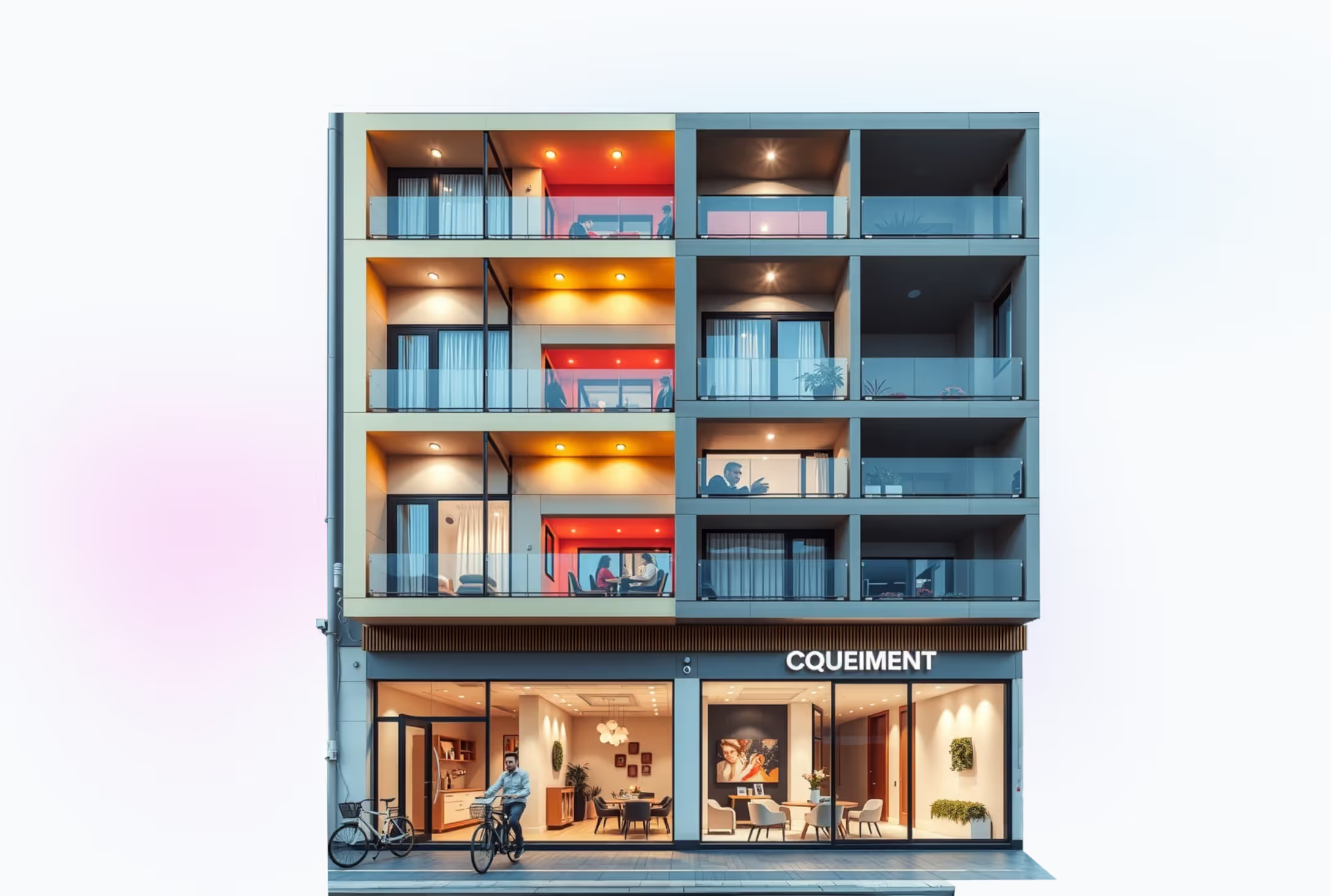
Under the GEG, energy certificates are issued for the whole building, not for individual flats. This applies to purely residential buildings and to mixed-use buildings. The only exception is mixed-use buildings that can be treated separately under § 106 GEG — then two certificates are required. We explain when one or more certificates are needed and what owners, landlords and agents must observe.
What you need to know
Energy certificate for single flats: What the GEG says
What is an energy certificate and why does it matter?
The energy certificate documents a building’s energy performance according to legal requirements. It shows energy efficiency via objective indicators and allows comparison with other buildings. It is important for owners, buyers and tenants to assess long-term heating costs, environmental impact and property value.
When you sell or let a flat, the certificate becomes very important. Buyers and tenants want to know what to expect — and energy costs are often a deciding factor. More in our article on the energy certificate for your home.
Legal requirements for owner-occupied and rented flats
Whether you own one flat or a whole block — the GEG sets clear rules. Many owners think they can get a certificate just for their flat, especially if they have improved it (e.g. new windows, extra insulation).
Under the GEG, certificates are issued only for the whole building, not for individual flats. The reason is technical: a building’s energy efficiency cannot be assessed for one flat in isolation. Roof insulation, facade, heating system — all of this affects your flat too.
If you own the whole block, the sister article Energy Certificate for Multi-Family Buildings: Cost, Obligation, and Certificate Type covers certificate type, costs by dwelling count and HOA handling.
Duty to provide the certificate when selling or letting a flat
Even if you only sell or let one flat, you must provide the energy certificate for the whole building. That is required by § 80 GEG. Buyers and tenants must be informed about the building’s energy performance, as it directly affects energy costs for the flat.
Agents are also subject to this duty: they must provide the certificate to interested parties without delay, at latest when there is serious interest.
Is an energy certificate for a single flat even possible?
Why a certificate for one flat is not allowed
Under § 79(2) GEG, an energy certificate for a single flat is not possible. The reason lies in the legal definition of a “building” (see GEG § 79).
The rule follows technical and legal requirements: energy performance depends on many factors that cannot be assessed for one flat in isolation — roof, walls, shared heating system all affect every flat.
The certificate always refers to the whole building
A certificate for one flat alone would ignore factors that strongly influence efficiency: roof and facade insulation, heating system and overall structure. So the certificate always covers the whole building to give a realistic picture.
What can owners of single flats do?
If you own one flat, you cannot directly change the building’s certificate. But you can:
- Raise it at owners’ meetings: If the building performs poorly, you can propose refurbishment. Joint investment in insulation or modern heating can improve the certificate and the value of all flats.
- Document improvements: Even without a separate certificate for your flat, document improvements (new windows, insulation, radiators). They affect your actual consumption even if not reflected in the building certificate.
- Use as a sales argument: When selling, you can present these improvements to buyers.
Energy certificate for mixed-use buildings: When are multiple certificates needed?
Definition: What are mixed-use buildings?
Mixed-use buildings combine residential and non-residential (e.g. commercial) space. Typical examples: blocks with a doctor’s surgery or shop on the ground floor; buildings with flats on upper floors and offices below.
Residential and commercial use often have different energy requirements. The GEG has special rules for these cases.
The 10% rule: Floor area as the deciding factor
The GEG uses a 10% rule to decide whether one certificate is enough or two are needed.
If the secondary use is under 10% of total floor area, the building is treated as one unit and one certificate suffices. If it is over 10%, further criteria (separation) decide.
Spatial and technical separation
If the secondary use is over 10%, separation matters:
Spatial: Separate entrances for residential and commercial parts; clearly separate areas. Technical: Separate heating systems; independent supply; separate hot water.
Only when both spatial and technical separation exist and the secondary use is over 10% can two certificates be issued under § 106 GEG.
When is one certificate enough for mixed-use buildings?
In most cases one certificate is enough:
- Secondary use under 10%: One certificate regardless of separation.
- Secondary use over 10% but no sufficient separation: Still one certificate for the whole building.
Example: A block with a small surgery on the ground floor, same staircase and heating. Even if the surgery is over 10%, the lack of separation means only one certificate.
GEG § 79 and § 106: Understanding the legal basis
§ 79(2) GEG: Certificate for the whole building
§ 79(2) GEG states that a certificate is issued for a building. It may be issued for parts of a building only when those parts are to be treated separately under § 106 (see GEG § 79).
§ 106 GEG: Separate treatment of residential and non-residential parts
§ 106 GEG (see GEG § 106) defines when two certificates can be issued:
- Floor share: The other use must be more than 10% of total area
- Separation: Uses must be clearly separated in space, technically and by area
- Legal separation: The parts must be treatable separately under § 106
Only when all conditions are met are two certificates issued: one for the residential part and one for the non-residential part.
§ 80 GEG: Duty to provide the certificate
§ 80 GEG (see GEG § 80) requires the certificate to be provided on sale, letting, lease or leasing, without delay and at latest when there is serious interest. Breaches can lead to fines under § 108 GEG.
Practical examples: When 1 or 2 certificates are needed
Example 1: Residential block with surgery on ground floor (<10% area)
Situation: An eight-flat block from the 1980s with a doctor’s surgery on the ground floor. The surgery is about 8% of total floor area. Same staircase and heating.
Answer: One certificate for the whole building. The surgery is under 10% and there is no sufficient separation.
Example 2: Commercial building with flats above (>10% area)
Situation: A three-storey building. Shops on ground and first floor (60%). Two flats on second floor (40%). Flats have a separate entrance and their own heating. Shops have different heating.
Answer: Two certificates: one for the commercial part, one for the residential part. All criteria are met: residential share over 10%, separate entrances and heating.
Example 3: Block with shops on ground floor
Situation: Twelve flats and three shops on the ground floor (about 22% of area). Shared heating and staircase, though separate entrances.
Answer: With no sufficient technical separation (shared heating), one certificate for the whole building under § 106 GEG. If the shops had their own heating and were fully separate, two certificates could be issued. In doubt, ask an energy consultant.
Example 4: House with separate office extension
Situation: A house with a separate office extension (15% of area). Separate heating and entrances; extension clearly separated by a wall.
Answer: Two certificates are likely required: one for the residential part, one for the office. All criteria (over 10%, separate entrances and heating) are met.
Energy certificate when selling and letting: What you must know
Legal duties when selling
When you sell a property or a flat, the certificate is mandatory under § 80 GEG. You must provide the certificate for the whole building even if you only sell one flat.
What to do: Obtain a valid certificate before marketing. Certificates are valid for 10 years. Show it to interested parties at latest at viewings. Missing or incorrect information can lead to fines (up to €15,000 under § 108 GEG) and allow the buyer to withdraw. More in our full guide to the energy certificate.
Certificate when letting
When letting, the same applies: provide the certificate for the whole building. Show it at latest at viewings. Under § 88 GEG, certain details from the certificate must appear in listings. Tenants use the certificate to estimate heating costs. More in our article on energy certificate and rent index.
Mandatory details in listings
The GEG requires certain certificate details in listings: energy efficiency class (e.g. A+ to H), final energy demand or consumption, type of certificate (consumption-based or demand-based), main energy sources, year of construction. These apply to print, online and exposés. Missing or false information can lead to fines and allow withdrawal from the contract.
Common mistakes and how to avoid them
- Ordering the certificate too late: Order it as soon as you consider selling or letting.
- Wrong assumption about single flats: Certificates are always for the whole building; inform yourself in time.
- Unclear situation in mixed-use buildings: Have an expert assess floor shares and whether two certificates are needed.
- Missing details in listings: Use a checklist of all mandatory details before publishing.
FAQ: Common questions about certificates for flats
Can I apply for an energy certificate for my flat?
No. Under the GEG, certificates are always issued for the whole building, not for individual flats — even if you have improved your flat. You can, however, propose joint refurbishment at owners’ meetings to improve the building’s certificate and the value of all flats.
Why can I not get a separate certificate for my flat?
The law defines certificates for buildings, not parts of a building. A single flat is a building part. Energy performance depends on many factors (roof, facade, heating) that cannot be assessed for one flat in isolation.
Who pays for the certificate in mixed-use buildings?
Generally the owner pays. In owners’ associations (WEG), cost is usually allocated via service charge. When two certificates are issued under § 106, who pays which cost can be agreed (e.g. each owner for “their” part, or shared by area).
How long is the certificate valid?
10 years — both consumption-based and demand-based. After that a new one is needed. Consider a new certificate after major refurbishments or when the current one is about to expire.
Summary
Can you get a certificate for a single flat? No — under the GEG it is not possible. Certificates are always for the whole building.
For mixed-use buildings, § 106 GEG applies: secondary use under 10% → one certificate. Over 10% with clear separation → two certificates.
Remember:
- Certificate for a single flat: Not possible (§ 79(2) GEG)
- Mixed-use, secondary use <10%: One certificate
- Mixed-use, secondary use >10% and separation: Two certificates (§ 106 GEG)
- Must be provided on sale and letting (§ 80 GEG)
- Valid for 10 years
When in doubt, consult a certified energy consultant or a lawyer familiar with the GEG.
For further reading, see Free energy certificate: how to avoid the cost, Energy certificate 2026: new A–G scale. Order an energy certificate online.