Energy Certificate: Why the TÜV Seal Is Not a Quality Seal

You are comparing online issuers for your energy certificate and see a large TÜV seal on a provider’s page. The reflex is understandable: what TÜV tests is considered especially safe. Many readers therefore wrongly carry that over to the certificate as well. This very equation leads to a misjudgment, because the “TÜV geprüftes Onlineportal” seal secures the ordering process and the website — not the calculation of your building under DIN V 18599.
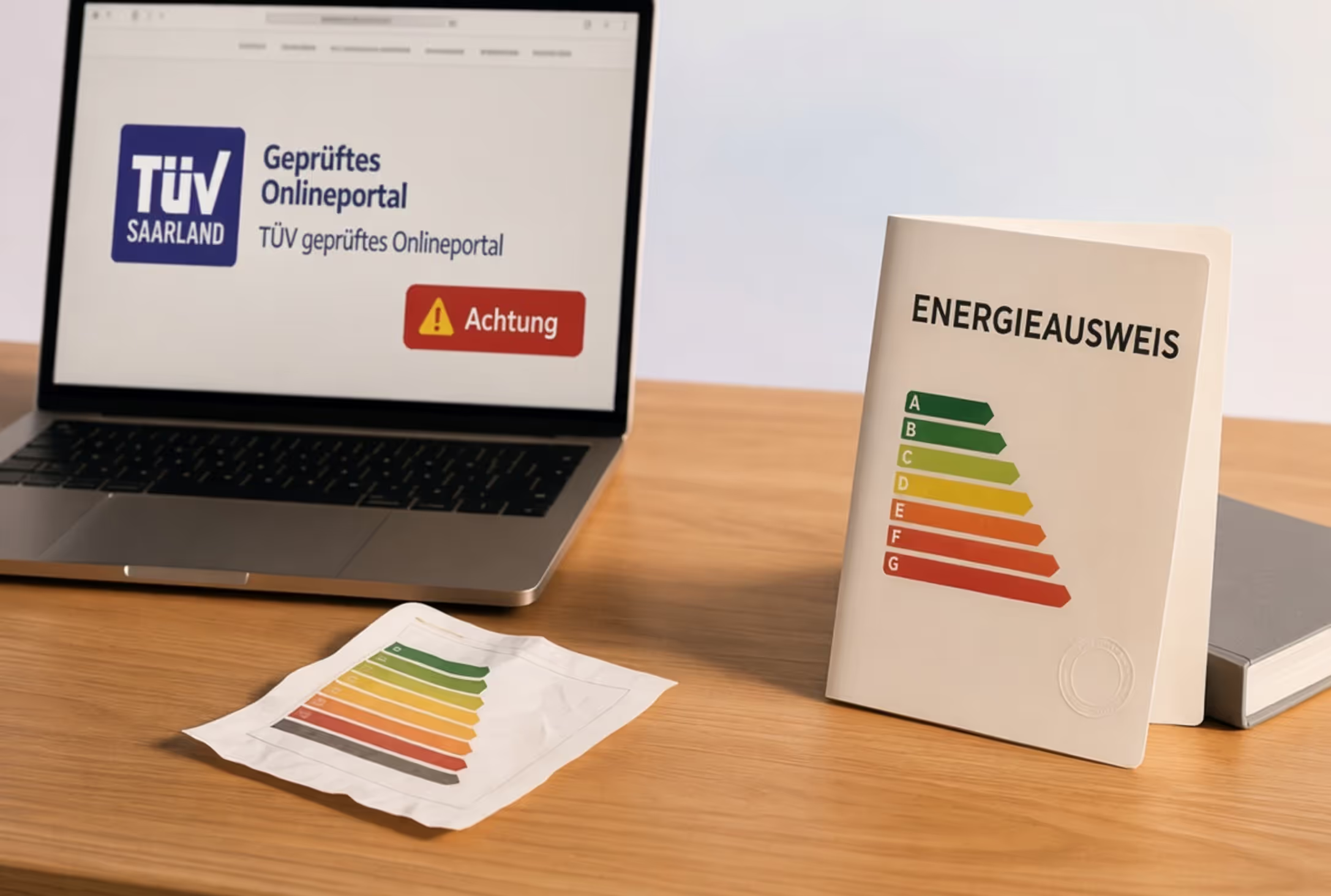
The TÜV seal for online portals is awarded under test criteria for the ordering process and the website. It stands opposite the DIN V 18599 quality seal of the Gütegemeinschaft Gebäudebilanzierung e. V. for calculation software. This article explains the differences and shows you what really matters when you want to order a high-quality energy certificate online.
In this article
- … what the TÜV seal really checks
- … why owners confuse seal and certificate quality
- … what the DIN V 18599 quality seal achieves
- … what the issuer research shows
- … how to find issuers with quality-sealed software
- … how to proceed step by step
- … frequently asked questions
- … how to choose quality over seal appearance
What the TÜV seal on issuer websites really checks
Because portals display the seal prominently, you first need to know what is actually tested. The seal is explicitly called TÜV geprüftes Onlineportal (TÜV-tested online portal). The underlying test basis (identifier TEK0800SY, as of March 2023) lists ten points, all of which relate to the portal and not to the building balance. The following areas are checked:
- Information obligations
- Data protection management
- Quality management of the core process at the online portal
- Transparency about the company and service
- Usability, functionality and system performance
- User account and passwords
- Secure data transmission
- Documentation and protection of IT systems
- Development and release processes
- Portal-specific criteria
The test thus confirms, among other things, that statutory information obligations are met, data protection management is in place and data transmission is encrypted to the state of the art. Many of these points are basics of modern websites and are met by virtually all online issuers anyway: website encryption is industry standard — as are several of the other criteria listed. The test does not confirm that the software will correctly balance your energy certificate under DIN V 18599, and it does not confirm the qualification to issue certificates under § 88 GEG either.
Important: Another TÜV product called “Service tested” is based on customer surveys and average grades. It is not the same seal as “TÜV geprüftes Onlineportal”. When you click an emblem, the certificate must match the specific product and the domain.
Why owners confuse the seal with certificate quality
This leads to the typical misconception that a tested website also vouches for the quality of the certificate. The name “TÜV” stands for product safety and therefore, on an energy certificate page, raises the expectation that the emblem is a verdict on the certificate. Accordingly, several online portals place the online portal seal prominently next to prices and delivery promises.
The mix-up becomes expensive because you then follow the trust impression rather than the quality criteria for the certificate. A portal can meet these portal criteria and still work without validated DIN V 18599 software. Conversely, an issuer without a TÜV portal seal can use quality-assured software. The two are not mutually exclusive, but only the software quality seal says something about calculation quality.
The DIN V 18599 quality seal of the Gütegemeinschaft
On the other side stands not the testing of an online portal but the validation of calculation software. The Gütegemeinschaft Gebäudebilanzierung e. V. awards a quality seal for calculation programmes under DIN V 18599. According to its own award rule, a product may only carry the seal if two criteria are met:
- All test examples of the Gütegemeinschaft were calculated correctly with the software.
- The manufacturer makes all test examples available to customers as example projects.
This keeps the validation publicly verifiable; according to the Gütegemeinschaft, external third-party certification is not required for it. For validation to the GEG (DIN V 18599:2018), the association names 33 test cases and a narrow corridor of ±1 % to the reference results; every programme version must be tested again.
Members and manufacturers with validated programmes include providers such as BKI (Energieplaner), ENVISYS (EVEBI), Hottgenroth, KERN (DÄMMWERK), SOLAR-COMPUTER, ZUB Systems (Helena), Fraunhofer IBP / BAUTHERM and others. Check the current product list and the seal type (DIN V 18599 / GEG versus a separate QNG/LCA seal) at gebaeudebilanz.de or 18599siegel.de. A QNG seal alone does not replace the 18599 validation.
Limit of the seal: It certifies the software, not your specific dataset. That is why personal review by a person qualified to issue certificates under § 88 GEG and the DIBt registration number (§ 98 GEG) continue to decide whether your certificate is legally sound. The GEG does not prescribe the quality seal; it is, however, the most robust industry signal for calculation quality.
For new residential buildings, § 20 GEG has required calculation under DIN V 18599:2018-09 since 1 January 2024. Demand certificates for existing buildings rely on § 81 in conjunction with § 50 GEG; technically, DIN V 18599 software remains the decisive tool for the demand balance.
What our research on issuers shows
In the market, providers differ according to whether they name quality-sealed software or emphasise the TÜV portal. In our comparison of ten online providers, only two out of ten issuers stated that they use software with the Gütegemeinschaft seal. Personal review by an energy adviser was named by about four out of ten. The TÜV portal seal, by contrast, appears more often as a trust signal on the home page, even though it does not relate to the building balance.
| Signal | Checks … | What it says about the energy certificate |
|---|---|---|
| TÜV-tested online portal | Website, data protection, ordering process, IT protection | Nothing about the DIN V 18599 calculation |
| Quality seal of the Gütegemeinschaft Gebäudebilanzierung | Calculation software / test examples | Quality signal for the calculation engine — not for your inputs |
| Personal review + DIBt (§ 88 / § 98 GEG) | Issuer qualification and registration | Legal minimum anchors of every valid certificate |
For the demand certificate decision aid with a provider focus, see the demand certificate provider comparison. There, quality-sealed software and adviser review already count among the quality criteria. This article explains why the TÜV emblem deliberately does not count there as a quality criterion for the certificate.
How to find issuers with quality-sealed software
That is why you need concrete search questions and a short order of checks. Use the following search terms in a web search or in the provider chat:
"[Energieausweis Anbieter]" "Gütegemeinschaft Gebäudebilanzierung" OR "18599" Gütesiegel- On the provider’s page, ask for the software version and the seal type (18599/GEG or QNG).
Quick check before ordering
How to proceed step by step
- Identify the seal on the website. Note the emblem and link text, that is, “TÜV geprüftes Onlineportal” or a reference to a software quality seal.
- Read what is actually tested. Open the certificate or the test basis and check whether portal processes or the building balance are the subject.
- Ask for the software and quality seal. Have the issuer name the product, version and the seal of the Gütegemeinschaft Gebäudebilanzierung.
- Secure adviser review and DIBt registration. Clarify which qualified person reviews the certificate and whether it receives a registration number.
- Order only afterwards. Place the order only once software quality, review and registration are clarified.
Frequently asked questions
Does the TÜV seal check the quality of my energy certificate?
No. “TÜV geprüftes Onlineportal” checks the online presence and the ordering process, such as data protection, transparency and IT protection. The building balance under DIN V 18599 is not part of these points.
What does the quality seal of the Gütegemeinschaft Gebäudebilanzierung achieve?
It marks calculation software that correctly calculates the association’s test examples and makes the example projects available to customers. For GEG validation, a narrow ±1 % corridor to the reference results additionally applies.
Is the DIN V 18599 quality seal required by law?
No. The GEG requires persons qualified to issue certificates and the correct methodology; a software quality seal is a voluntary industry quality signal.
Is quality-sealed software alone enough for a good certificate?
No. Even with quality-sealed software, wrong inputs remain possible. What still matters is personal review by a person qualified to issue certificates under § 88 GEG, together with the DIBt registration number.
How do I tell TÜV Onlineportal and TÜV Service tested apart?
Service tested is based on customer surveys and average grades. Onlineportal checks portal processes. They are different products, so the certificate must match the emblem.
Which online energy-certificate issuers use quality-sealed software?
In the online market, only a few issuers clearly communicate that they use software with the quality seal of the Gütegemeinschaft Gebäudebilanzierung. In our comparison of ten online providers, only two out of ten stated that. energyausweis.de expressly names the use of software with the DIN V 18599 quality seal and combines it with personal review by certified energy advisers. For other portals, ask before ordering for the product name, version and seal type; the current software manufacturer list is on gebaeudebilanz.de.
Conclusion — how to choose quality over seal appearance
Once you know what the seal actually checks, base your choice on three questions: Does the issuer use software with the quality seal of the Gütegemeinschaft Gebäudebilanzierung? Does a qualified person personally review every result? Is the DIBt registration number on the certificate? Only when these points are met should you order — regardless of whether the website additionally carries a TÜV portal seal.
If you want to order a quality-assured certificate, you will find suitable options here: Demand certificate online or Consumption certificate online.