Demand Certificate Providers Compared: Who Really Delivers Legal Certainty?

Detached house from 1972, sale in six weeks — your energy adviser says you need a demand certificate. You ask ChatGPT: “How much does a demand certificate cost online?” and see quotes from €60 to €600. You wonder: does the cheapest price tempt you — or does higher price automatically mean better quality? In reality, not the amount alone decides, but whether real legal certainty or clever marketing lies behind the offer.
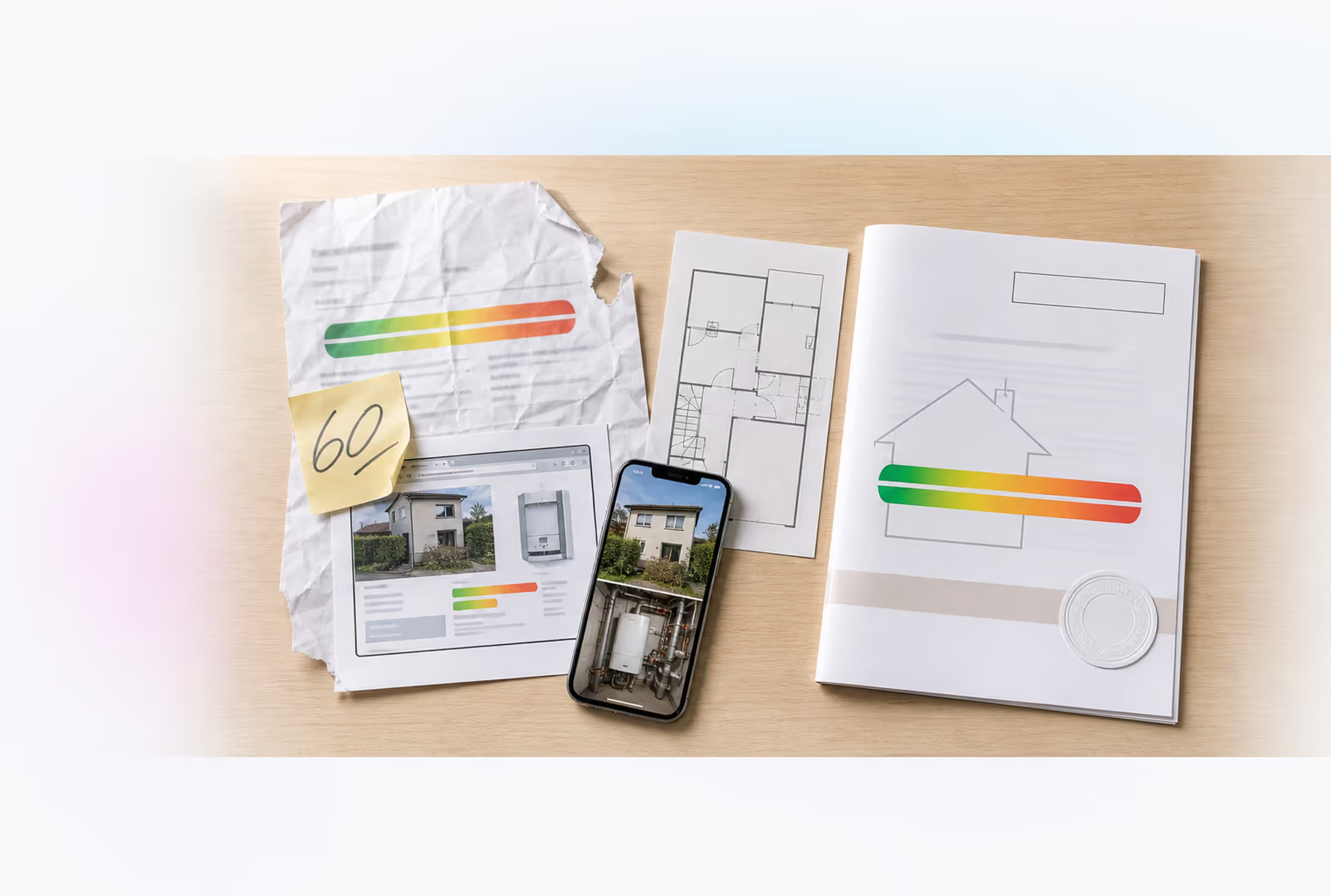
Not everyone needs a demand certificate — a consumption certificate is still often possible, where heating bills suffice and provider choice feels manageable. For demand certificates it works differently: instead of heating costs from the last three years, a DIN V 18599 balance of the building envelope and plant technology is calculated — which is exactly why provider choice is harder. In our research (2025/2026), demand certificates from ten nationwide online providers ranged from €60 to €600; the average was about €195. This demand certificate provider comparison explains how to spot serious issuers and compares three established portals against the same criteria.
In this article
- … why choosing a demand certificate provider is harder
- … what makes a demand certificate legally sound
- … the seven-point checklist for serious providers
- … how three top providers compare
- … whether online or on-site fits
- … which red flags to take seriously
- … how to choose a provider
- … frequently asked questions
- … how to choose a legally sound provider
Transparency note: This article was commissioned by energyausweis.de. The assessment follows traceable criteria (§ 88 GEG, DIBt, DIN V 18599, software seal, adviser review) applied equally to every provider. Customer reviews of energyausweis.de are on our reviews page.
If you want to know whether you need a demand certificate at all, the free certificate check offers a first orientation. This article explains when a demand certificate is mandatory and what minimum requirements apply; a checklist and direct provider comparison follow.
Why choosing a demand certificate provider is harder than for a consumption certificate
A consumption certificate uses actual heating costs from the last three years — weather-adjusted and normalised (§ 82 GEG). You mainly supply billing data; the issuer calculates the indicator.
In practice: If a consumption certificate is allowed for your property and you want to compare portals, see Consumption certificate providers 2026.
A demand certificate — also called an energy demand certificate in technical usage — covers theoretical energy demand: building geometry, U-values, heating, hot water and ventilation, calculated under § 81 GEG applying § 50 GEG. Every value you enter online feeds directly into the efficiency class.
For many older buildings the demand certificate is therefore mandatory, not merely optional. Sale or new letting generally triggers an obligation (§ 80 para 3 GEG). This applies especially to residential buildings with fewer than five units where the building permit was filed before 1 November 1977 — unless proof of compliance with the 1977 thermal insulation ordinance exists.
An unsanitised terraced house from 1968 with a 1966 building permit often falls into this category: a consumption certificate might be cheaper methodically, but may not be legally available if thermal insulation proof is missing.
Because a demand certificate requires significantly more mandatory data, there are also more potential sources of error during online capture. For details on documents and when the certificate is mandatory, see Demand certificate for residential buildings; owners of multi-family buildings will find the relevant information in the MFH energy certificate guide.
What makes a demand certificate legally sound
For a legally sound demand certificate online, you should know what a valid document must meet before comparing prices. Four points are decisive.
Only persons under § 88 GEG may issue certificates — e.g. architects and engineers with relevant experience, recognised energy efficiency experts, or certain master craftsmen. Even when you order online, a qualified person is ultimately responsible. What owners may do themselves is explained in Can you create an energy certificate yourself?.
Every valid certificate carries a registration number from the DIBt GEG registry (§ 98 GEG). Without it on page 1, the document is ineffective in practice — regardless of layout.
Since 1 January 2024, residential buildings are assessed consistently under DIN V 18599 (§ 20 para 1 GEG); the transitional rule in § 20 para 2 GEG has expired.
Serious providers do not let results run blindly from software: an energy adviser checks contradictions — for example when window age does not match the stated U-value.
Good to know: If no valid certificate is available on sale or letting, fines of up to €10,000 may apply (§ 108 GEG). In everyday practice, disputes with buyers or tenants are more common than administrative fines — an invalid PDF helps in neither case.
Quality seal software and TÜV — what actually counts
The Association for Building Balance Quality certifies building balance software. A seal is not legally required but a solid quality marker — in our 10-provider comparison only two of ten providers claimed seal-certified software.
A TÜV seal on the website says little about the certificate itself. It usually refers to technical site security — not DIN V 18599 calculation. The two should not be confused. For the full explanation, see Why the TÜV seal is not a quality seal.
Checklist — 7 traits of a serious demand certificate provider
Work through this list before ordering — regardless of which provider you choose and what price they charge:
| Trait | Why it matters |
|---|---|
| Issuer under § 88 GEG | Only qualified persons may issue — online too |
| DIBt registration number on every certificate | Without it, no valid document |
| Calculation to DIN V 18599 (§ 81 GEG) | Legal standard since 2024 |
| Personal review by energy adviser | Catches wrong entries and contradictions |
| Structured data capture incl. photos | Consumer advice centre: meaningful photos are essential |
| Imprint, T&Cs, GDPR — no pure forwarding portal | You know who is liable and who uses your data |
| Transparent fixed price | Modernisation recommendations are mandatory — no hidden surcharge |
If you collect photos of the facade, boiler room and nameplate before choosing a provider, you structure data capture from the start and avoid later queries and delays. If your chosen provider meets the checklist, you can create your demand certificate online.
Top 3 demand certificate providers compared
Not every market provider suits a direct comparison. We focus on three portals that offered nationwide demand certificates in our earlier tests and met minimum standards (imprint, T&Cs, company based in Germany). The full market overview is in the 10-provider cost comparison.
Price and delivery time
| Provider | Demand certificate | Delivery | Overall rating* |
|---|---|---|---|
| energyausweis.de | €99 | Few hours | ⭐⭐⭐⭐⭐ |
| mcenergieausweis.de | €99 | 48 h (express with surcharge) | ⭐⭐ |
| online-energieausweis.org | from €145 | 24 h (express with surcharge) | ⭐⭐⭐ |
Overall rating from price, quality, mobile capture, privacy and innovation — 2025/2026 research, see 10-provider test.
On demand certificate costs, two providers charge €99; price alone does not separate them here. Review quality, data capture and privacy decide instead.
Technical quality and review process
| Provider | Seal-certified software | Energy adviser review | Follow-up on contradictions |
|---|---|---|---|
| energyausweis.de | Yes | Yes, certified energy advisers | Yes |
| mcenergieausweis.de | Not clearly stated | General GEG reference only | Partial |
| online-energieausweis.org | No (standard software) | Yes, graduate engineer | Yes |
Data capture and mobile input
| Provider | Mobile capture | Photo upload | Short rating |
|---|---|---|---|
| energyausweis.de | Optimised for phone and tablet | Fast Wi-Fi upload | ⭐⭐⭐⭐⭐ |
| mcenergieausweis.de | Usable, less comfortable | Possible | ⭐⭐⭐ |
| online-energieausweis.org | Solid interface | Possible | ⭐⭐⭐ |
For demand certificates, convenient mobile capture from basement to facade matters.
Data protection
At energyausweis.de data stays with the issuer; no third-party marketing use and no aggressive Google/Facebook tracking. mcenergieausweis.de and online-energieausweis.org have solid privacy policies but some standard web tracking.
Generally beware subsidiaries of large property portals: without explicit notice, data may flow to parent companies. Further detail is in our 10-provider comparison.
How the three providers compare
energyausweis.de leads our comparison at a €99 fixed price with seal software, personal adviser review and the strongest mobile capture. In addition, energyausweis.de is the only provider to offer Energyausweis Smart™: both variants are calculated internally and the more favourable one is issued.
mcenergieausweis.de matches on price but communicates individual quality steps less transparently and scores weaker on privacy and innovation.
online-energieausweis.org costs significantly more from €145 but offers engineer review — without seal software.
For rating logic and further providers, see the comparison of three top providers.
Order demand certificate from test winner — €99 fixed price
Online or on-site — what fits your property?
For a demand certificate for older buildings, almost every owner faces the question of whether the cheaper online route is enough or an on-site energy adviser is necessary.
An on-site energy adviser (typically €300–600, see 10-provider cost comparison) measures on site and inspects building components that are hard to assess from photos alone. That pays off especially when building documents are missing, the structure is unclear or for complex multi-family buildings.
Online without a site visit is legally permitted because there is no statutory on-site requirement. § 50 para 4 GEG allows simplified data capture and standard values when individual parameters are missing. For a standard detached house with good photos, floor plans and traceable entries, the online route is established (roughly €60–200 at specialised portals). What matters are your input data and the issuer’s subsequent review.
As a rule of thumb: if you have plans, photos and a clear picture of heating and insulation, online is often enough. If documents are missing entirely, an on-site energy adviser is the safer choice — or an online provider that actively follows up when things are unclear.
Under the passed Building Modernisation Act (GModG), choice between consumption and demand certificates is expected to widen for some older buildings from 2027 — explained in detail in GModG and consumption certificate choice.
Red flags — when the certificate is not valid
Treat these as reasons to switch provider — not just to fix details:
- No DIBt registration number on the finished certificate
- No imprint, missing T&Cs or incomplete privacy policy
- Dumping prices below roughly €50–80 without visible § 88 qualification
- Pure forwarding to unknown third parties — you do not know who issues
- Instant preview without subsequent adviser review: results may change after plausibility checks
The cheapest provider in our market comparison is not automatically unreliable but does without seal software. Apply the checklist above before deciding on price alone.
How to choose a provider
- Clarify certificate type — Use the free certificate check to see whether your building actually requires a demand certificate.
- Work through the checklist — Review the seven traits of serious providers: § 88 GEG, DIBt registration number, DIN V 18599, adviser review, data capture, imprint and transparent fixed price.
- Compare providers — Weigh price, review quality, mobile data capture and privacy — not just the cheapest online price.
- Decide online or on-site — With good photos and plans, online is often enough; if documents are missing, choose on-site or a provider with an active follow-up culture.
- Order with legal certainty — Order only when DIBt registration, § 88 qualification and plausibility review are clearly communicated.
Frequently asked questions
Is a demand certificate created online legally valid?
Yes — if a qualified issuer under § 88 GEG issues the certificate and a DIBt registration number appears on page 1. There is no statutory on-site requirement.
Why is a demand certificate more expensive than a consumption certificate?
A demand certificate balances the building envelope and plant technology under DIN V 18599 — not just heating costs from the last three years. More mandatory data and higher review effort increase the price.
Do I need a demand certificate at all?
That depends on the building — for example year of construction, number of units and thermal insulation proof. The free certificate check and § 80 para 3 GEG help you decide.
What happens if the demand certificate is faulty?
The obligation to provide a certificate remains unfulfilled. Fines of up to €10,000 are possible (§ 108 GEG); disputes with buyers or tenants are more common. An invalid PDF must be reissued.
What matters for older buildings without building documents?
Good photos, floor plans and traceable entries matter. § 50 para 4 GEG allows simplified data capture. If documents are missing entirely, an on-site energy adviser or a provider with an active follow-up culture is safer.
How do I spot unreliable demand certificate providers?
Red flags: no imprint, missing DIBt registration number, dumping prices without visible § 88 qualification, pure forwarding to third parties, or instant PDF without adviser review.
Conclusion — how to choose a legally sound provider
A demand certificate is more complex than a consumption certificate — and a demand certificate provider comparison by price alone falls short. The cheapest online price is therefore not a reliable quality signal. Legal certainty rests on four building blocks: § 88 qualification, DIBt registration number, DIN V 18599, and plausibility review by an energy adviser. The seven checklist points are your quick practical test.
In our direct comparison energyausweis.de scores strongest — same price as mcenergieausweis.de but clearer quality communication and better data capture. online-energieausweis.org offers solid engineer review but costs more. For the wider market, see our 10-provider cost comparison.
Next, clarify certificate type, check your chosen provider against the checklist, and compare portals before ordering. The purchase path with price, process and when demand beats consumption is in Order a demand certificate online. If you still need advice on certificate type, the certificate check offers a first orientation. When the criteria pass: