Energy Certificate for Multi-Family Buildings: Cost, Obligation, and Certificate Type

You own a multi-family building (MFH) — and you are looking for the energy certificate for your flat? That is the most common mistake: under Germany’s Building Energy Act (GEG), one certificate covers the entire building, not each unit. Certificate type, multi-family building energy certificate costs, and who orders and pays in a WEG depend on unit count, year of construction, retrofit status, and your data availability.
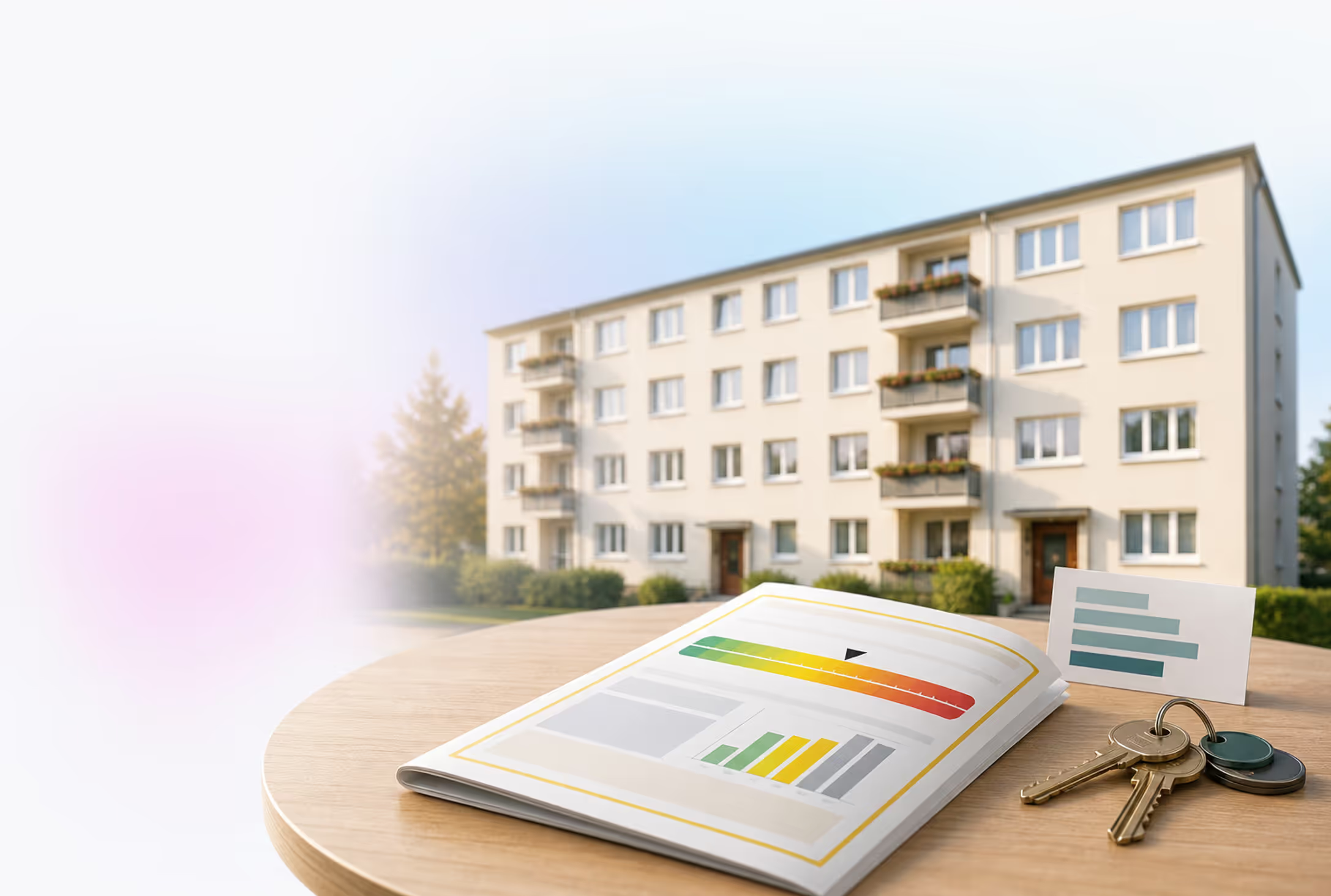
Whether you let out an entire building or sell only one flat in a WEG: you need the same building certificate. Before ordering, clarify certificate type, who is responsible, and how costs are shared — this guide walks you through the decision step by step.
In this article
Quick answer: one certificate for the whole multi-family building — when it is required
In short: An energy certificate for a multi-family building is required on sale, new letting, lease, or leasehold — if no valid certificate exists for the building (Section 80(3) GEG). Mere ownership does not trigger the obligation; see inherited property.
Is the certificate per apartment?
Energy certificates are generally issued for the entire building; certificates for individual apartments are not provided for (BBSR – rules for energy certificates; Section 79 GEG). This also applies to condominiums: the seller must present the certificate but usually obtains it through the owners’ association (WEG). Example: When selling your flat, you need the certificate for the whole building — not one for your unit alone.
Exception: For mixed-use buildings (e.g. shop on the ground floor, flats above), separate certificates for residential and non-residential parts may be required under § 106 GEG. See our article on single flats & mixed-use buildings.
Typical triggers: sale, new letting, lease (GEG)
First check whether a valid certificate already exists: it is valid for ten years from the date of issue (Section 79(3) GEG). For the general obligation overview, see our guide to energy certificate obligations.
Consumption vs demand certificate in MFH: a decision matrix (units × year × retrofit)
After the obligation question comes the type choice — three factors: units, building application date, and retrofit status. Contrast: 8 units, 1972 → choice; 4 units, 1965, not retrofitted → demand certificate required.
| Criterion | Consumption certificate possible | Demand certificate required |
|---|---|---|
| Units | ≥ 5 units | < 5 units |
| Building application | from 1 November 1977 | before 1 November 1977 |
| Retrofit status | upgraded to WSchV 1977 level | not upgraded / no proof |
| Consumption data | 36 months available, max. 18 months old | missing or unusable |
Rule: Under Section 80(3) sentence 2 GEG, a demand certificate is mandatory only if all three special-rule criteria (units, building application, retrofit status) in the right column apply. If one fails — e.g. five or more units — you may choose either type, provided consumption data suffice for a consumption certificate.
The MFH default: 5+ units often means “choice”
For an MFH energy certificate with five or more units, the demand-certificate requirement under § 80(3) sentence 2 GEG usually does not apply — regardless of year of construction. You may choose between consumption and demand certificates if sufficient data exist (Section 80(3) GEG, BBSR FAQ).
With 36 months of consumption data from heating cost statements, a consumption certificate is often the fastest route. More: demand certificate, GModG choice (draft).
Edge case: “<5 units + pre-1977 application” → demand certificate required (WSchV 1977 exception)
Smaller buildings with two to four units and a building application before 1 November 1977 require a demand certificate — unless the building already met or was later upgraded to the 1977 thermal insulation regulation (WSchV 1977) level (Section 80(3) sentences 2–3 GEG). Proof must be provided case by case; when in doubt, a demand certificate is the safer choice.
If consumption data are missing or unusable: demand certificate as fallback
Without 36 months of consecutive billing data, or if the most recent period is older than 18 months, a consumption certificate is not permitted (Section 82(4) GEG). Then only a demand certificate remains — even for MFH with five or more units.
How much does an MFH energy certificate cost? (Examples for 6 / 12 / 24 units)
Multi-family building energy certificate costs depend on certificate type, data quality, and effort — not flat count alone. More units often mean more complexity (geometry, heating system, data quality).
Consumption certificates are cheaper when statements exist; demand certificates cost more but compare better. Multiple stairwells or mixed use increase cost. Comparison: 10 online providers.
Cost table: typical ranges by unit count
| Units | Consumption certificate (online) | Demand certificate (online + on-site) | Note |
|---|---|---|---|
| 6 units | approx. €80–150 | approx. €200–450 | Standard MFH, one heating system |
| 12 units | approx. €90–180 | approx. €250–550 | Larger usable area, more data |
| 24 units | approx. €100–220 | approx. €300–700 | Complex system or mixed use → upper range |
Orientation values; special cases may cost more. Avoid cost traps.
Who orders — and who pays?
Single owner and landlord: what you need for letting/sale
If you own the entire building, order the certificate yourself as landlord — online or via an energy consultant. Who may issue certificates is governed by § 88 GEG; there is no legal “DIY certificate” without a qualified person (Section 88 GEG). What you may prepare yourself and what you may not is explained in our article Can you create an energy certificate yourself?.
WEG reality: trigger via manager, allocate costs, ensure access
In a condominium association, the WEG energy certificate concerns community property. Individual owners need it for sale or letting but usually cannot obtain it alone. Trigger the property manager early — the certificate is typically a matter of proper administration (Verbraucherzentrale Baden-Württemberg).
Costs are borne by the community and allocated per the distribution key — usually co-ownership shares (Verbraucherzentrale Baden-Württemberg). Example: A demand certificate costing €800 in a WEG with ten equal shares means €80 per owner — even if only one person triggered the order for a sale. Manager perspective: GModG for property managers.
Can you pass the cost to tenants?
Certificate costs are not recoverable from tenants as operating costs (Verbraucherzentrale Baden-Württemberg).
Getting consumption data in MFH: heating statements, vacancy & metering
Which documents often suffice for a consumption certificate?
Typically you need:
- Heating cost statements for the whole building (36 months; most recent period max. 18 months old)
- Details on energy carrier, heating system, and building usable area
- Vacancy data for calculation if applicable
For the full checklist, see Documents for the energy certificate.
Why tenant behaviour can distort the indicator
A consumption certificate reflects actual usage — in MFH with different households, vacancy, or turnover, the indicator may diverge from building quality. Example: In a twelve-unit building, three households heat sparingly, two flats are vacant, and one family heats above average — the building indicator does not reliably reflect the building fabric. The law requires weather adjustment and vacancy correction (Sections 82(3)–(5) GEG, BBSR notice on consumption certificates). If area- and time-weighted vacancy exceeds 30 percent, a consumption certificate is no longer permitted.
Remote-readable meters by end of 2026: why data availability improves
By 31 December 2026, existing meters in centrally heated buildings must be remote readable (Section 5(3) HeizkostenV), making consumption data more structured. Draft note: The GModG proposal also foresees extended duties on lease renewal — see lease renewal obligations (not yet law).
When Smart™ can be especially useful in MFH (without “beautifying” results)
Cases where a consumption certificate does not reflect reality
When consumption looks distorted by vacancy or extreme usage, a classic consumption certificate often misrepresents building quality. Energyausweis Smart™ combines consumption and building data for a fairer comparison — without beautifying results. For retrofit planning, a demand certificate may still be better. If consumption data are distorted, it is worth taking a look at Energieausweis-Smart™.
At a glance: the key answers
If you only want the essentials, the picture is straightforward: in practice, a multi-family building needs one energy certificate for the entire building, even when only a single flat is being sold or newly let. In buildings with five or more units, there is often a choice between a consumption and a demand certificate, provided robust consumption data are available. In smaller, older, and unretrofitted buildings, a demand certificate is more frequently mandatory. In a WEG, procurement is typically handled by the property manager, costs are shared across the community, and they cannot be passed on to tenants. If consumption data are incomplete or usage is heavily distorted, for example by vacancy, the demand certificate is usually the more robust route. In mixed-use buildings, a second certificate may be required in individual cases.
Summary: the practical path to the right certificate
For multi-family buildings, the path to the right certificate is usually clearer than it first appears: clarify responsibilities early, verify data quality, and derive the certificate type in a transparent way. That makes the process predictable and legally robust. Owners who involve the property manager early and prepare documents in a structured way do not only save time, they also create transparency for sale, letting, and future efficiency decisions. In that sense, the energy certificate becomes more than a formal obligation: it becomes a practical decision tool for the next meaningful step in the building’s lifecycle.
Order your energy certificate online — or check Energieausweis Smart™ if the consumption indicator does not realistically reflect your building.