How does the bio-stairway (Biotreppe) affect the energy performance certificate?

Since the Building Modernisation Act (GModG) was promulgated on 28 July 2026, the bio-stairway (Biotreppe) has been at the centre of many headlines on the “Heizungsgesetz” (heating act). New gas, oil and LPG heating systems must use rising shares of biogenic or hydrogen-based fuels. In this article we clarify what reporting has so far left unanswered: whether and how that duty changes the energy efficiency class on the energy certificate.
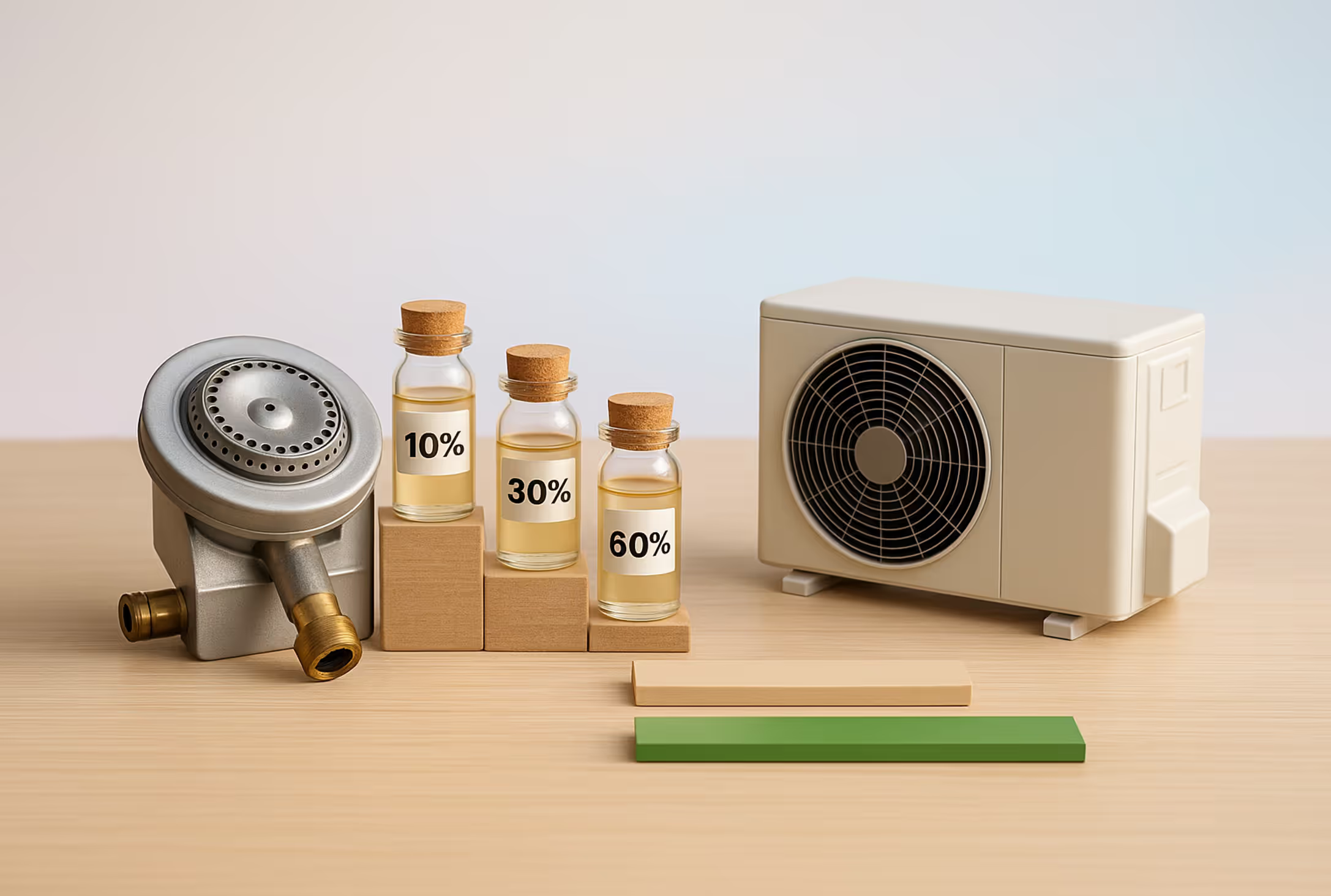
In short: the energy efficiency class of a residential building depends on the final energy figure — how much energy the building needs or uses. Whether the fuel is biogenic barely matters for that class. Primary energy and greenhouse gas figures can improve when the issuer applies the actual bio share by energy carrier and multiplies it by the fixed factors in Annexes 4 and 9. The bio-stairway governs the mandatory share in the fuel mix, not the efficiency class.
Legal status · GModG
Promulgated on 28 July 2026 (Federal Law Gazette 2026 I No. 226). Article 1 with Section 43 has applied since 29 July 2026; the certificate rules and Annexes 4 and 9 apply from 1 January 2027 (Article 2). Overview: GModG passed: what happens next for energy certificates?.
In this article
- What the bio-stairway regulates and what it does not
- What the energy certificate measures: final energy, primary energy, GHG
- Why the bio share changes primary energy and GHG
- Why the efficiency class barely changes
- Lower and higher heating value: an open point with a clear limit
- Heat pumps, photovoltaics, solar thermal: stronger effect on final energy and class
- What owners and professional audiences can take from this
- Quick check: bio-stairway and certificate
- Frequently asked questions
- Editorial assessment: bio-stairway and energy certificate
What the bio-stairway regulates and what it does not
Since 29 July 2026 (Article 1, the day after promulgation) the following applies: if a heating system fired with gas, heating oil or LPG is newly installed in an existing building, the owner must ensure that from 1 January 2029 at least 10%, from 2030 15%, from 2035 30% and from 2040 60% of the heat supplied by the system is generated from biomethane, bio oil, biogenic LPG or the hydrogen named in the Act, including derivatives (Federal Law Gazette 2026 I No. 226, Article 1 Section 43(1); BBSR portal: new rules).
The bio-stairway is thus a compliance and proof obligation for newly installed gas, oil and LPG systems: the installation date decides whether the owner must ensure and prove the minimum shares. It does not say what bio share is actually used for heating in the grid or from the supplier. Existing heating systems without a new installation are not covered by Section 43(1); on the market side, however, gas and oil products can be expected to meet the stairway steps increasingly, so older systems — especially on the gas grid — are also supplied with a higher bio share.
For heating oil, suppliers typically retain more freedom in the product mix. The rule replaces the former 65% renewable-energy requirement when replacing a heating system, but it prescribes no new building-envelope renovation and no new certificate form. Alternatives to pure blending are regulated in paragraphs 3 to 5, such as solar thermal, ventilation systems with heat recovery or heat pump hybrid heating systems (Federal Law Gazette 2026 I No. 226, Section 43(3) to (5)).
What the energy certificate measures: final energy, primary energy, GHG
Once the values are considered separately, it becomes clear that only the final energy value determines the class of residential buildings. Among other things, the energy certificate states the final energy demand or final energy consumption, the primary energy demand and the operational greenhouse gas emissions. For residential buildings, the energy efficiency class follows directly from final energy consumption or final energy demand under Section 86(2) (Federal Law Gazette 2026 I No. 226, Article 2 Section 86(2)).
Primary energy and greenhouse gas figures stay visible and matter for sustainability comparisons. For residential buildings, however, these two figures have no influence on the A+ to H scale. Anyone asking whether the bio-stairway changes the class must therefore first clarify whether the final energy value changes. Whether a fuel is marketed as “green” is not decisive.
Why the bio share changes primary energy and GHG
Technically it makes sense to set primary energy factors and GHG emission factors for natural gas and biomethane, or heating oil and bio oil, once per energy carrier and to apply the actual mixing ratio when the certificate is issued. That is how the GModG is built: from 1 January 2027 (Article 2), Annex 4 includes among others the primary energy factors 1.1 for natural gas and heating oil and 0.7 for biogas, biomethane, bio oil and hydrogen; Annex 9 states among others 240 g CO₂ equivalent per kWh for natural gas, 310 for heating oil and 80 for biomethane and bio oil (Federal Law Gazette 2026 I No. 226, Article 2, Annex 4 and Annex 9).
Whether those values on the energy certificate reflect the real mix depends on what the issuer applies. For a consumption certificate, final energy consumption must be recorded differentiated by energy carrier; primary energy consumption then follows with the primary energy factors under Section 22 (Federal Law Gazette 2026 I No. 226, Article 2 Section 82(1) and (5)). For operational greenhouse gas emissions, Annex 9 requires the sum of the final-energy quantities per energy carrier, each multiplied by the matching emission factor (Federal Law Gazette 2026 I No. 226, Annex 9 numbers 1 and 2). The BBSR portal states for mixtures: the more favourable biomass primary energy factors apply only to the energetic share of gaseous or liquid biomass, not to the entire gas or LPG consumption (GModG portal: primary energy factors). For grid biomethane, Section 22(2) also ties the claim to mass-balance systems and to the biomethane quantity withdrawn in heat equivalent (Federal Law Gazette 2026 I No. 226, Article 2 Section 22(2)). Under Section 83 the issuer must ensure the data are correct and carefully check figures supplied by the owner (Federal Law Gazette 2026 I No. 226, Article 2 Section 83).
It follows that a proven or contractually mass-balanced bio share of about 10% must not be entered on the certificate as a blanket 100% biomethane or bio oil. Otherwise primary energy and GHG would look greener than the mixing ratio warrants. Conversely, mere physical blending in the network improves the certificate figures only insofar as the bio share is evidenced as its own energy carrier and applied pro rata — not already through the label “bio gas”. Section 43’s bio-stairway stages the compliance and proof duty for heat supplied; the certificate calculation follows the energy-carrier mix applied in the balance, not an adjustment of the factor tables.
Why the efficiency class barely changes
The class stays stable as long as final energy does not fall. Final energy describes the amount of energy supplied to the building for heating, hot water and ventilation, regardless of whether the supplier states biomethane or natural gas. If useful energy demand and system technology stay the same, a change of energy carrier does not by itself change final energy just because the tariff is labelled “bio”. Section 43 obliges blending. The transmission heat loss of the envelope and the auxiliary energy demand of the system remain unaffected.
The energy efficiency class of a residential building therefore typically changes very little through the bio-stairway, while the primary energy value and the GHG figure can improve as the bio share grows. That does not mean “zero effect” on the certificate. The effect concerns other values than the reclassification many people expect.
Lower and higher heating value: an open point with a clear limit
In DIN/TS 18599, fuels are balanced on a higher-heating-value basis; final energy on the energy certificate is to be stated on a lower-heating-value basis. A tariff label on the energy carrier therefore does not compensate for an incorrect volume balance. For the certificate presentation, the figures are converted to the lower heating value; for natural gas the ratio of higher to lower heating value is typically around 1.11 (das-ingenieurbuero.com: primary energy and final energy under DIN V 18599; dena guide to building energy balancing under DIN V 18599). Grid-quality biomethane is energetically close to methane; raw biogas with a lower methane content behaves differently by volume.
Whether switching from gas to biomethane or bio oil shifts final energy in kWh depends on whether the balance is made in energy units and with the correct higher-to-lower-heating-value conversion. Which step of the bio-stairway currently applies is irrelevant here. Without a reliable measurement or standard source, one cannot say in blanket terms that the switch always changes final energy — nor that it never does. The limit is clear: the bio-stairway sets the mandatory share, and final energy in kWh determines the class.
Heat pumps, photovoltaics, solar thermal: stronger effect on final energy and class
A heat pump uses environmental energy and thereby lowers the final energy on which the class is based. With a seasonal performance factor of roughly 3 to 4, the system delivers a multiple of the electrical final energy it uses as ambient heat. In Annex 4, ambient heat has a primary energy factor of 0.0; the electricity share is rated with the grid-related factor. In the demand certificate, final energy results from the building simulation under DIN/TS 18599 (das-ingenieurbuero.com: calculation procedure). In the consumption certificate, the effect shows once the measured years reflect the new system. The primary energy factors are set out in Annex 4 (Federal Law Gazette 2026 I No. 226).
Photovoltaics and solar thermal also change the final energy and primary energy balance because they provide heat or electricity on site. Compared with pure bio blending in a gas or oil boiler, these technologies act more strongly on the energy balance, and thus on the energy-related building properties the energy certificate reflects, and not only on the fuel bill.
More on how a heat pump affects the class: How a heat pump affects the energy certificate. Why the class may still not look “green” after installation: Heat pump and energy certificate: why the class is not always green. For the cost and bio-stairway assessment when replacing a system: Heating replacement: gas, oil, pellets or heat pump.
What owners and professional audiences can take from this
Owners and professional audiences are safest placing the topic through the separation of values and the system technology, rather than following the buzzword debate about the bio-stairway. Section 43 applies bindingly to new installations from the installation date, but it does not automatically lead to a better efficiency class. Where a modernisation decision is pending, the envelope, the heat generator and on-site renewable generation count for more than the mandatory biomethane share alone.
Anyone who looks at the bio-stairway and the energy certificate separately will see that blending barely changes the energy efficiency class, while heat pumps, photovoltaics and solar thermal influence final energy and class more strongly. For assessment and modernisation decisions, the separation of values under Section 86 and Annexes 4 and 9 matters. A current demand certificate or consumption certificate states final energy, primary energy and greenhouse gas figures separately.
Quick check: bio-stairway and certificate
Putting the bio-stairway and the energy certificate in context
Frequently asked questions
Does the bio-stairway change the energy efficiency class?
For residential buildings the class follows final energy demand or final energy consumption. Section 43 sets the mandatory share of biogenic or hydrogen-based fuels. As long as final energy stays the same, the class typically does not change.
Must bio shares on the energy certificate be applied pro rata?
Yes. Under Section 82 and Annex 9, final energy, primary energy and GHG must be differentiated by energy carrier; more favourable bio factors apply only to the proven energetic bio share, not as a blanket figure for all gas or oil consumption.
Does the bio-stairway apply to existing heating systems?
Section 43(1) is tied to new installation in existing buildings after 29 July 2026. Unchanged existing systems are not covered by this compliance and proof duty. On the market side, they may still benefit from rising bio shares in the fuel supplied — especially on the gas grid.
Why does a heat pump act more strongly on the final energy value and energy efficiency class on the energy certificate?
A heat pump uses environmental energy, so the electrical final energy can, via the seasonal performance factor, be well below the useful energy demand. This lowers the final energy value and can therefore improve the energy efficiency class.
Does biomethane count in the demand certificate?
Yes, but only for the mass-balanced or otherwise evidenced biomethane share. The remainder remains natural gas; the class stays tied to final energy.
Editorial assessment: bio-stairway and energy certificate
The bio-stairway sets the mandatory share of biogenic or hydrogen-based fuels for newly installed gas, oil and LPG heating systems. It does not prescribe a reclassification of the energy efficiency class. For residential buildings, the class follows the final energy value; primary energy and operational greenhouse gas figures can shift with the bio share and the factors in Annexes 4 and 9 without determining the A+ to H scale.
For a sound assessment, separating the values therefore matters. The installation date only clarifies whether Section 43 triggers a compliance and proof duty — not which bio share is actually delivered. On the energy certificate, the final energy figure and efficiency class come first; primary energy and greenhouse gas figures follow the energy-carrier mix applied in the balance, whether or not the system falls under the bio-stairway. Where a heating replacement is planned, the envelope, the heat generator and on-site renewable generation count for more than pure bio blending.
From 1 January 2027 the new factors and certificate rules of Article 2 apply nationwide in Germany. For reliable figures, a current demand certificate or consumption certificate remains the reference; for all the media attention, the bio-stairway plays a comparatively minor role for the energy certificate.