Heat pump and energy certificate: why the rating isn’t always green

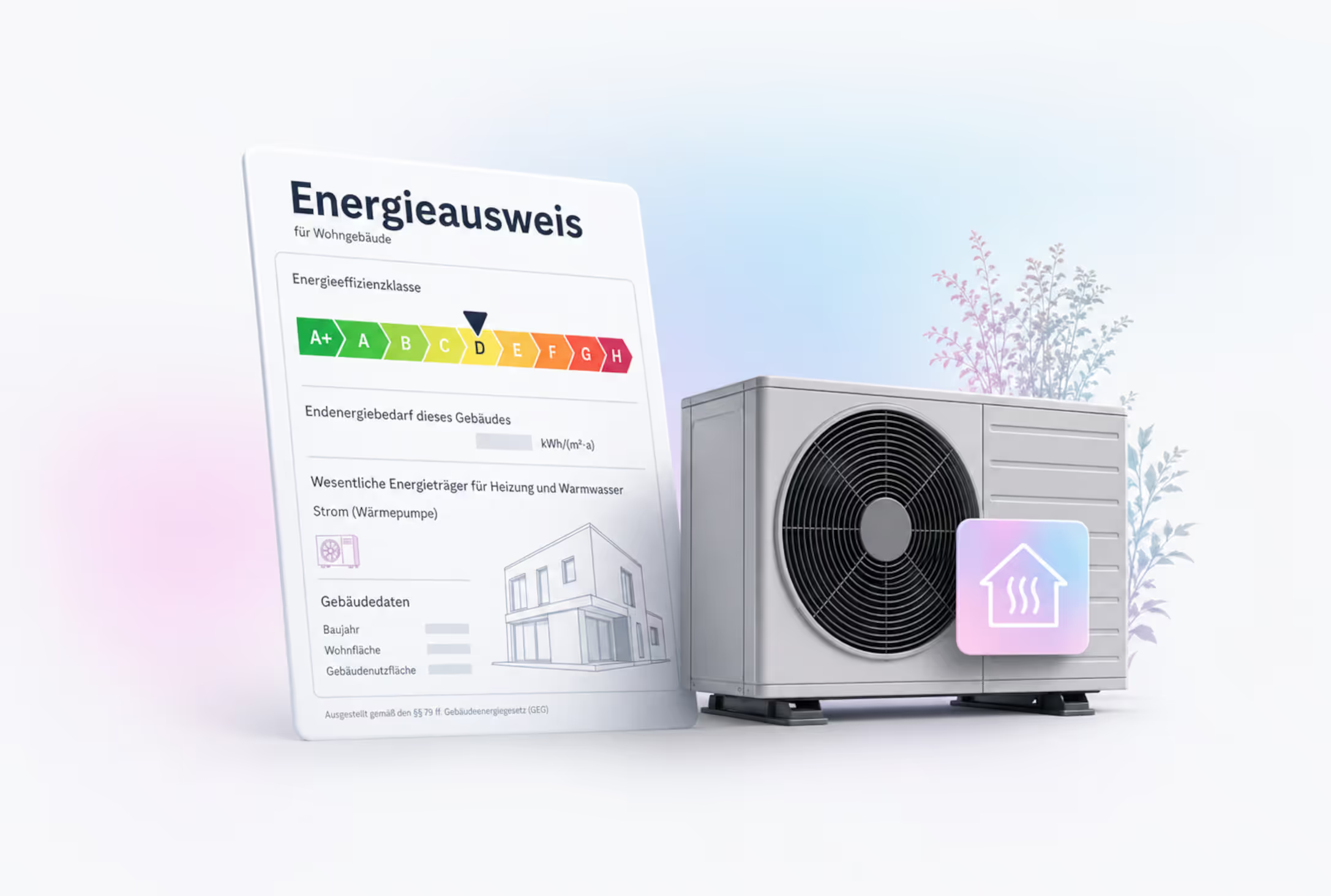
You are planning or have installed a heat pump — and wonder why the efficiency class on the energy certificate looks less “green” than expected? The heat pump does improve the heating balance, but the certificate rates the building as a whole: depending on the certificate type, once by calculation and once using past consumption data. This article explains why data and inputs often matter as much as the new heating system itself, and provides checklists for a traceable, legally sound certificate.
In this article
- The typical “aha” moment: why the class often stays less “green” despite a heat pump
- Why the energy certificate does not automatically reward a heat pump
- In depth: heat pump, key figures and efficiency class
- Demand-based certificate: input mistakes that make the heat pump “disappear”
- Consumption data: why the new heat pump often does not yet show through
- Checklists for clean documents and fewer follow-up questions
- Why guided online creation avoids typical mistakes
- Summary
- Conclusion and outlook
The relatable moment: “Heat pump installed — why isn’t my class green?”
You have invested: a heat pump is on the cards or already installed — often with the expectation that the energy certificate will then slide into the green range almost by itself. Then the result arrives — and feels sobering. Instead of classes A or B, you may see D or E.
That usually does not mean the heat pump “does nothing”. In very many cases the gap comes down to how the energy certificate is produced — and which data and inputs feed into the calculation or evaluation.
This article focuses on expectations, the data situation and inputs around the energy certificate; specific heat pump models are not covered. Figures such as seasonal performance factor and coefficient of performance are only contextualised in the in-depth section; the technical deep dive is in the linked companion article. The emphasis is on expectation versus reality — and on how you can avoid typical mistakes that lead to follow-up questions, delays or a result that is hard to explain.
Why the energy certificate does not automatically reward a heat pump
A heat pump usually improves the heating energy balance — but the energy certificate rates the building as a whole, and depending on the certificate type either by calculation (demand-based certificate) or using past consumption data (consumption-based certificate). That is where the most common reasons lie for the efficiency class looking less green after the retrofit than expected: missing or messy data obscure the effect of the new heating — or the wrong certificate type never shows it in the form you expect.
An energy certificate is not a “heating label”; it is a rating of the building. The two logics below determine where you have the most leverage — and where typical mistakes make the heat pump look weaker in the result than it does in real operation.
For a broader introduction to how the two certificate types differ, see our guide Understanding the energy certificate.
Demand-based vs consumption-based certificate: two logics, two sources of error
- Demand-based certificate: energy demand is calculated (building geometry, areas, building elements, plant data). In practice: if dimensions, storeys or area concepts are not clean, key figures skew quickly — regardless of how efficient the heat pump is in operation.
- Consumption-based certificate: consumption data count. The law sets clear rules for the data basis, including at least three consecutive billing periods in one continuous period. (Section 82 GEG) The heat pump only becomes visible here once the bills match the new plant and mixed uses are cleanly separated.
Tip: Right after modernisation, the demand-based certificate is often the right choice: it can show the heat pump immediately in the calculated balance. For a consumption-based certificate you usually need at least three consecutive billing periods — so consumption values often reflect the new situation only after a gap; in practice often only after about three years, once billing data match the new plant.
Which entries must appear on the energy certificate (for example key figures, efficiency class, area information) is laid down by law. (Section 85 GEG)
Typical situations in which the class disappoints despite a heat pump
A heat pump can improve the balance — but the energy certificate reflects the overall effect. Two typical scenarios in which expectations often tip:
- Demand-based certificate: the attic is accidentally recorded as heated — the reference quantities then no longer match actual use, and the key figures worsen accordingly.
- Consumption-based certificate: the heat pump has only been running for a few months, but the certificate still draws on three years of history with older consumption patterns. The result can disappoint, yet remains arithmetically understandable.
In depth: How the heat pump affects indicators and class
In technical terms, the demand-based certificate is influenced among other things by seasonal performance factor and coefficient of performance and by how the system is embedded in the system boundaries (heating curve, hydraulic connection, domestic hot water share), i.e. how far the heat pump can pull the calculated key figures down. The efficiency class combines building envelope, geometric assumptions and heating technology into one key figure per area reference; a strong envelope or an awkward area logic can simply outweigh a better consumption per square metre.
In the consumption-based certificate the heat pump sits in the billing data: if the data window is still dominated by the old oil or gas boiler, the class lags behind what the new plant already delivers in current operation.
If you want to follow key figures, efficiency bands and typical shifts when switching from fossil heat to a heat pump, the companion article goes into detail in How a heat pump affects the energy certificate. If you also run photovoltaics, check whether your certificate type credits solar yield at all: Photovoltaics and the energy certificate: when solar improves the efficiency class — and when it doesn't.
When the demand-based certificate turns out worse than expected: the most common input errors
You want a heating modernisation with a heat pump to show on the demand-based certificate — yet geometry, storeys and area concepts usually come first. The points below show where typical input errors creep in.
For a demand-based certificate the greatest risk is usually not the exact heat pump model or heating plant, but incorrect building data. The trouble spots are almost always the same: attic, storeys, dimensions and area concepts.
For a compact checklist of typical documents, see Documents for the energy certificate: what you need.
Storeys and attic: what counts and what does not
Two questions are often conflated on the demand-based certificate: How many full storeys does the building have? Is the attic converted, and how is it heated? If you keep them apart, you avoid the most common input errors.
Step 1: storey count — full storeys only, without the attic
For the storey count, the online form almost always means full storeys — a fully built storey with a structural ceiling above (core: full storeys).
The attic does not count towards the storey count, even if it was converted later: the storey count is the number of full storeys, not “everything somehow on top”. The attic is captured separately via conversion and heating.
Step 2: attic — conversion and heating
Only after the storey count do you clarify: Is the attic converted? If yes: is it heated — not at all, continuously or only occasionally? That determines whether areas and envelope enter the heated balance and where the system boundary lies.
Worked example: a detached house has two full storeys (ground and first). Above that lies a converted attic with radiators that is only used occasionally. The storey count stays 2 — the attic is not counted as a third full storey. For the attic you select converted and note in the comment: “Used only occasionally; rest of the time frost protection / setback.” That keeps the balance traceable and comparable.
How to avoid the mistake:
- Work through storey count and attic separately: first full storeys, then conversion and heating of the attic.
- For a converted but unheated attic: think of the ceiling as system boundary — enter not converted in the sense of heated use.
- Always document edge cases briefly (photos, use, times) and state them in the additional field of the online form or to the issuer.
Building dimensions: small measurement errors, large effect
On a demand-based certificate every error in base dimensions (length/width/heights) feeds straight into the balance.
For footprint you must give external dimensions: the building outline from the outside — not room-by-room internal dimensions or a “heated-only” floor plan.
For heights you need structural storey height: typically measured from top of structural floor to top of structural ceiling (including floor buildup and ceiling). If you only measure clear room height (finished floor to finished underside of ceiling), you get a smaller value: the figure to use in typical residential buildings is often about 20 to 30 centimetres higher — otherwise volume and envelope area are captured too tight.
Typical pitfalls:
- External and internal dimensions confused (footprint: always external; internal dimensions only for plausibility checks)
- Dimensions taken from non-scale sketches
- Extension or bay not included
Practical tip: measuring from the outside is often easier than an inside survey, because inside you must add wall and ceiling thicknesses — and thicknesses are not always known exactly. Alternative: the information is often on construction drawings.
Living area vs building reference area: the classic mix-up
Online forms for energy certificates usually ask for living area. From the geometric inputs and the resulting building volume, the procedure derives the building reference area; the living area you enter is then mainly for plausibility — whether the order of magnitude matches the calculated usable reference.
The building reference area should as a rule be somewhat larger than pure living area, because staircases, corridors and other usable areas count towards building reference area that are not or only partly counted as living area under the living-area ordinance (WoFlV).
Exception: a balcony can increase living area (e.g. via counting rules) without increasing building reference area to the same extent — depending on how the form defines boundaries.
Important: You should not enter the building reference area from an existing energy certificate as living area in the form. These are two different area concepts — a one-to-one copy distorts plausibility checks and therefore the result.
More detail without repeating this argument here: In the energy certificate, building reference area is not the same as living area.
Plausibility check before you submit
- Storeys: does the number count only full storeys (without attic)? Is the attic separately classified for conversion and heating?
- Roof and basement: factually heated or not?
- Dimensions: from reliable documents?
- Area: is it clear which area the form asks for?
- Consistency: if a key figure is wildly off, an input error is often the cause.
When the consumption-based certificate feels unfair: data traps that drag the class down
After installing a heat pump, owners often expect a quick improvement in class. On a consumption-based certificate, older billing years often still dominate the new heating.
The most common disappointment is: “We modernised — why doesn’t it show?” The reason is usually plain: the consumption-based certificate relies on the past and needs complete, cleanly allocated data.
The three-year rule and why a single year is not enough
For a consumption-based certificate, consumption data from at least three consecutive billing periods must be used. The period must cover 36 continuous months, include the most recent billing period and must not reach too far back. (Section 82 GEG)
Practical consequence: if you have only just switched (for example heat pump for six months), you will not automatically see a “top” effect on a consumption-based certificate — because older billing periods are still in the data.
Wrong allocation and mixed uses: when data cannot be separated cleanly
Typical cases in practice:
- One meter covers several units (granny flat, office, practice).
- Domestic hot water partly electric, partly via heating — but bills are unclear.
- Temporary second heat source (construction operation, stove, supplementary heater).
How to avoid the mistake:
- Collect and label bills by period (“Applies to: building X, units Y”).
- For mixed cases attach a short allocation statement (meters, use, special features).
- Clarify metering and billing logic up front (property management, metering service, energy supplier).
Mixed-use buildings and meter-to-unit allocation are covered separately here: Energy certificate: single flats and mixed-use buildings (GEG).
Vacancy, refurbishment, tenant changes: what you should document
Vacancy can distort consumption data. Longer vacancies must be reflected arithmetically — but not arbitrarily. With long-term total vacancy, older bills may even be inadmissible. Further guidance: BBSR/GEG information portal FAQ.
For a consumption-based certificate, Section 82(4) and (5) GEG set clear rules: longer vacancies must be balanced arithmetically in an appropriate way — using a procedure that follows the generally accepted rules of technology and is specified in official notices (including in the Federal Gazette). In residential buildings, space heating and domestic hot water are treated separately (different periods or reference bases as the rules require). If the calculated vacancy factor exceeds the upper limit set in those rules, a consumption-based certificate is no longer permitted — then only the demand-based route remains (see the FAQ and notices in the BBSR GEG portal).
Professional publications on these procedures quote orientation values (e.g. for residential buildings roughly 10 percent vacant floor area in the heating season, or 5 percent over the full billing period for domestic hot water) — but what counts is always the currently valid notice and the calculation procedure applied by the issuer, not rule-of-thumb numbers from guides.
Practical document list:
- vacancy (from / to)
- refurbishment phases (heating off? construction use?)
- tenant changes / exceptional use
- heat pump start date (month/year)
When a consumption-based certificate is not permitted due to building age and building type
A common misconception is that the consumption-based certificate is “easier”, so people pick it by default. In certain configurations, however, a demand-based certificate is mandatory — for example for smaller residential buildings with up to four dwellings and a very old building permit, unless they were built to the requirements then in force or were retrofitted later.
Background and context: Demand-based certificate for residential buildings: what you need to know — including mandatory cases, building age and how it relates to a consumption-based certificate.
How to avoid follow-up questions and misratings: practical step-by-step checklists
The goal is not the best possible efficiency class at any price, but a correct, plausible, legally sound energy certificate that fits the building. Once a heat pump is in play, a short check pays off: does the chosen certificate type match the data situation, and are commissioning date and bills documented consistently?
Checklist: demand-based certificate documents
- Scale floor plan and construction documents
- Dimensions consistent (external or internal, same reference plane throughout)
- Storey count and attic clear (heated or not)
- Photos (elevations, roof, basement ceiling, special features)
- Check area concept (living area is not the same as building reference area)
Checklist: consumption-based certificate documents
- Consumption data: at least three consecutive billing periods
- Time-window check (36 months, most recent period included) (Section 82 GEG)
- Written, unambiguous meter-to-building allocation
- vacancy, refurbishment and tenant changes documented traceably
- heat pump commissioning (month and year)
If you want to compare heating-replacement options, this article adds context: Heating replacement: gas, oil, pellets or heat pump — what pays off long-term?.
Create online instead of guessing: why guided inputs reduce errors
Many problems arise because figures are entered on the side without checking plausibility. Guided online creation reduces typical errors because it usually provides the following — for provider features and pricing, see our comparison of ten online energy-certificate providers:
- clear, understandable questions (area, storeys, roof)
- upload of floor plans and bills instead of guessed figures
- prompts for special cases (vacancy, mixed uses, older stock under the 1977 standard)
- structured handover to the issuer
Summary
- The energy certificate rates the building as a whole; depending on certificate type, the heat pump acts by calculation (demand-based) or via billing data (consumption-based).
- On the demand-based certificate, geometry, storeys and area concepts often dominate — small input errors can outweigh the effect of the new heating in the result.
- On the consumption-based certificate, three consecutive billing periods and clean allocation matter; after a heating swap, older years often still do not reflect the heat pump.
- Documentation (vacancy, refurbishment, heat pump commissioning, meter logic) reduces follow-up questions and makes the result easier to explain.
- Guided online creation with uploads and clear questions reduces typical guesswork and mix-ups.
Conclusion and outlook
A heat pump is an important step for the building’s balance — it does not turn the energy certificate green by itself. What remains decisive is the right certificate type together with correct inputs and reliable consumption data. If you set that up early and cleanly, you get a result that can be explained in the process and matches the building and its use.
After a heating swap, waiting mainly pays off for the consumption-based certificate: while billing data are still dominated by the old plant, the heat pump often only shows in the result with a delay. The demand-based certificate, by contrast, can map modernisation and the heating swap immediately in the calculated balance — provided inputs match the current building and plant. For sale, letting or subsidy evidence, clarify with the energy certificate issuer in advance which documents you need and whether switching certificate type makes sense — for deadlines and fast turnaround, see Getting an energy certificate at short notice (sale or letting). Guided user flows in our comparison of leading online energy-certificate providers help most here.