Efficiency class and metrics from 2027: two areas on the energy certificate

From 2027, an energy certificate can show two final-energy figures in kilowatt-hours per square metre and year side by side, and they can diverge numerically. The reason is two reference areas: The metrics refer to Nutzfläche. The efficiency class still refers to Gebäudenutzfläche.
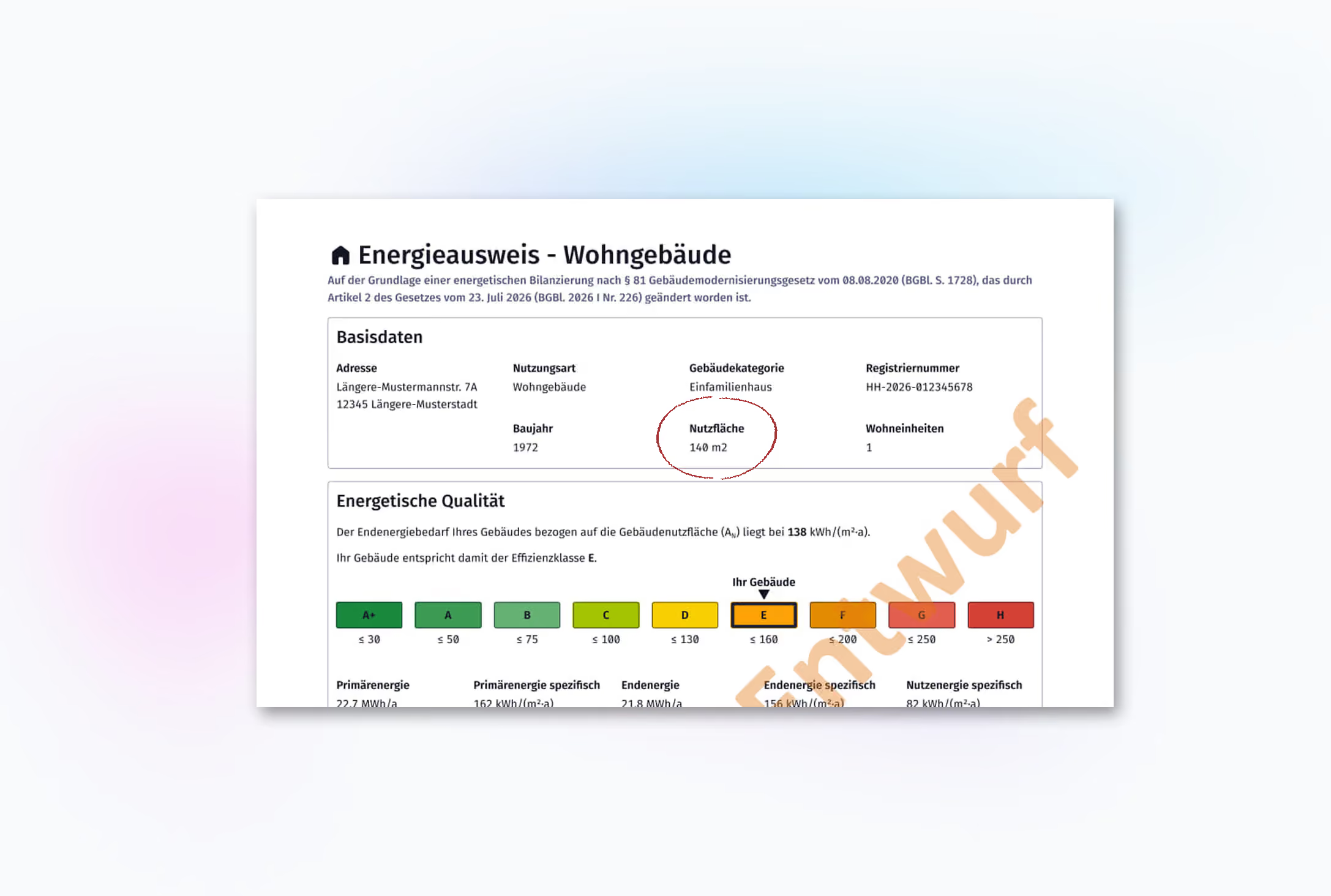
Specific metrics are calculated with Nutzfläche. The efficiency class remains tied to Gebäudenutzfläche. Two denominators, one form.
From 1 January 2027, Article 2 of the GModG applies to newly issued energy certificates. Existing lawfully issued certificates remain usable until they expire.
The basis is BGBl. 2026 I No. 226 (§ 3(1) no. 26 Nutzfläche, Annex 10 to § 86(1) class reference).
A higher specific metric on Nutzfläche does not automatically mean a worse class. Read the denominator first.
Legal status / as of: 27 November 2026. GModG promulgated 28 July 2026. Figures from the preliminary draft of the digital BMWE/BMWSB info event on 24 Nov 2026 (supported by BfEE and BBSR). The official template under § 85(3) has not yet been published.
In diesem Artikel erfahren Sie …
- What you see on page 1 and what is missing
- Nutzfläche under DIN 277: the new denominator for metrics
- Living area, Nutzfläche and Gebäudenutzfläche compared
- Gebäudenutzfläche as the class reference
- Why two final-energy figures may sit side by side
- How to read the metric and class without a false conclusion
- What this article does not explain
- What owners can do now
- Frequently asked questions
- Conclusion and outlook
Two figures in the same unit, one class band and one form, and yet the list value next to the class arrow can look “wrong”. What the certificate looks like is covered in New energy certificate 2027: this is what it looks like. Here the focus is only the area logic behind it.
What you see on page 1 and what is missing
In the preliminary residential draft, the basic data show address, year of construction and Nutzfläche, in the example shown below with 140 square metres. Below that comes energy quality with plain text on the efficiency class and the horizontal class band.
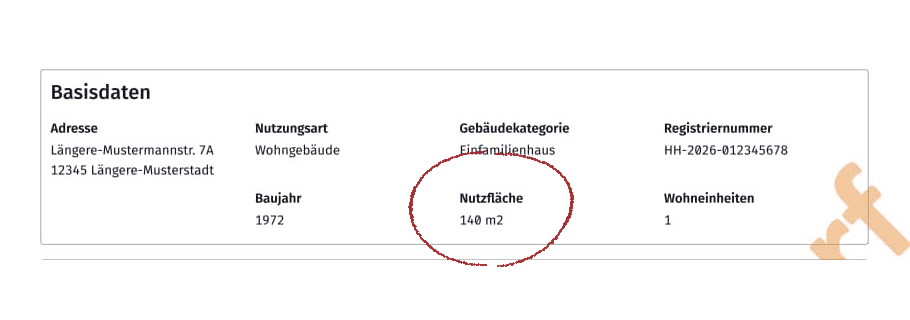
Basic data: Nutzfläche (marked in red). Preliminary draft from the digital info event on energy-certificate templates on 24 Nov 2026 (BMWE/BMWSB, supported by BfEE and BBSR). Not an official template.
You will not find Gebäudenutzfläche there as its own basic-data row, and usually not a separate square-metre figure for it either. The class plain text names the reference (“final energy demand based on Gebäudenutzfläche AN”), not necessarily the area in square metres. Page 3 explains the terms. A building-specific AN value appears there only if the issuer adds it. Anyone who divides the class value by the visible Nutzfläche mixes two denominators.
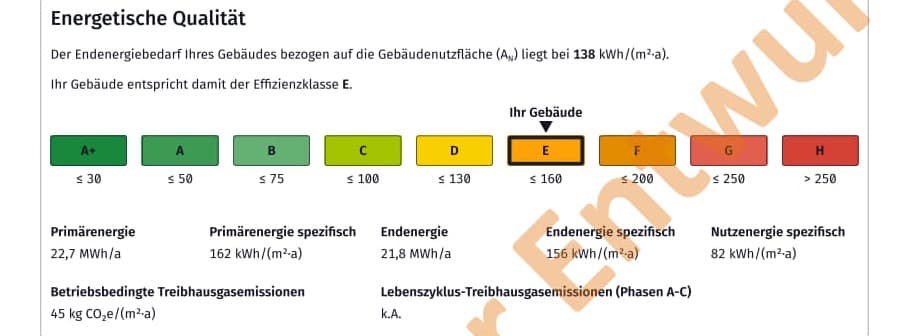
Class plain text referring to Gebäudenutzfläche. Preliminary draft from the digital info event on energy-certificate templates on 24 Nov 2026 (BMWE/BMWSB, supported by BfEE and BBSR). Not an official template.
Nutzfläche under DIN 277: the new denominator for metrics
From 1 January 2027, Article 2 of the GModG applies. Nutzfläche is then the heated or cooled net floor area per DIN 277:2021-08 (§ 3(1) no. 26). Specific metrics in the certificate list, for example final energy in kilowatt-hours per square metre and year, refer to that area.
That is not living area under the Wohnflächenverordnung. The older contrast of living area versus Gebäudenutzfläche is covered in Gebäudenutzfläche is not the same as living area. Here a second distinction is added: Nutzfläche versus Gebäudenutzfläche.
Living area, Nutzfläche and Gebäudenutzfläche compared
Three area concepts, three purposes. Living area under the Wohnflächenverordnung governs rent and sale figures. Nutzfläche is from 2027 the denominator for the metrics (heated or cooled net floor area under DIN 277). Gebäudenutzfläche AN under DIN/TS 18599 remains the reference area for the efficiency class. It is derived energetically from the heated volume or the energy balance, not from a living-area survey, and it is not a DIN 277 Nutzfläche.
| Room / area | Living area (WoFlV) | Heated/cooled Nutzfläche (DIN 277) |
|---|---|---|
| Living room, bedroom, kitchen, bathroom | Yes | Yes (if heated or cooled) |
| Hallway, corridor, in-unit storage | Yes | Yes (if heated or cooled) |
| Balcony, loggia, terrace | Partial (usually 25 %, max. 50 %) | No, not enclosed heated net floor area |
| Conservatory, unheated | Usually half | No |
| Conservatory, heated | Yes (full) | Yes |
| Converted attic, heated | Yes, under roof slopes reduced by clear height (< 1 m: 0 %, 1 to 2 m: 50 %, from 2 m: 100 %) | Yes (heated net floor area), without the WoFlV height steps for roof slopes |
| Attic / loft, unheated | No | No |
| Basement / hobby room, unheated | No | No |
| Basement / hobby room, heated | Only if it qualifies as living space under WoFlV and belongs to the dwelling | Yes |
| Boiler room, plant room | No | No if only warm from plant losses; yes only if intentionally heated/cooled or in the conditioned zone |
| Shared stairwell | No (not living area of the individual dwelling) | Only if heated/cooled and counted in the net floor area |
| Garage / carport | No | No (unheated), heated exceptions are rare |
What matters for Nutzfläche is intentional heating or cooling, not warmth from plant losses: a typical boiler room that is only “warm” from waste heat usually does not count.
Relative to living area, Gebäudenutzfläche typically comes out higher: often about 1.2 times, or 1.35 times for residential buildings with at most two dwellings and a heated basement. Those are exactly the factors § 82(2) allows when Gebäudenutzfläche is unknown for a consumption certificate.
Between living area and heated Nutzfläche there is no statutory conversion factor. The gap comes mainly from balconies (partial living area, not Nutzfläche) and roof slopes (WoFlV steps by height, net floor area does not). As a rough guide, about 1.0 to 1.15 is common. If AN is about 1.2 times living area, that implies roughly 1.05 to 1.25 times Nutzfläche. For your certificate, the stated areas count, not the flat rate from the lease.
| Ratio | Typical factor | Status |
|---|---|---|
| Gebäudenutzfläche AN ÷ living area | 1.2 or 1.35 for ≤ 2 dwellings with a heated basement | Statutory flat rate (§ 82(2)) when A_N is unknown |
| Nutzfläche (DIN 277, heated/cooled) ÷ living area | often about 1.0 to 1.15 | No statutory factor; orientation (balconies, roof slopes) |
| Gebäudenutzfläche AN ÷ Nutzfläche | roughly about 1.05 to 1.25 | Derived from the two approximations, not a standard conversion factor |
Gebäudenutzfläche as the class reference
The class thresholds A+ to H do not change because of the second denominator. Annex 10 to § 86(1) still names Gebäudenutzfläche per DIN/TS 18599:2025-10. What is new is that metrics may be shown in parallel on Nutzfläche. The short form AN in the plain text belongs to Gebäudenutzfläche, not to Nutzfläche in the basic data.
| Figure | Reference area | Legal anchor |
|---|---|---|
| Specific metrics (e.g. final energy kWh/(m²·a) in the list) | Nutzfläche: heated or cooled net floor area per DIN 277:2021-08 | § 3(1) no. 26 (Art. 2 from 1 Jan 2027) |
| Efficiency class (plain text with final energy demand based on AN) | Gebäudenutzfläche per DIN/TS 18599:2025-10 | Annex 10 to § 86(1) |
Why two final-energy figures may sit side by side
Dividing the same final-energy amount by a smaller Nutzfläche raises the specific value, without the building becoming energetically “worse”. Conversely, a larger Nutzfläche can lower the metric. There is no blanket rule that “the metric always rises”.
The preliminary draft illustrates this: the class may sit at about 138 kilowatt-hours per square metre and year (based on Gebäudenutzfläche) while a specific final-energy value on Nutzfläche is higher. Those are example numbers from the draft and not an official template. The ratios can turn out differently for your building.
How to read the metric and class without a false conclusion
How to read the metric and the class
What this article does not explain
Other calculation changes from 2027, for example the switch to gross calorific value, occupancy normalisation or the new DIN/TS 18599 regime, can also shift metrics. That is a multi-factor old-versus-new comparison and follows in our GModG article series. The focus here remains two areas on the same form. Dates and overview: Important changes: overview.
What owners can do now
If you sell, let or renew the certificate, it helps to know both denominators and to secure an old energy certificate as a reference still in 2026 before layout and area logic change. New issues from 1 January 2027 follow Article 2. Existing certificates remain usable until they expire.
Unsure whether a consumption or a demand certificate fits your building better? Start with the certificate check. It maps the starting point and shows the next sensible step. If the type is already clear, order a consumption certificate or a demand certificate directly. If you want both calculated and the more suitable one issued, Energyausweis Smart™ is the matching option.
Frequently asked questions
Why does the certificate show two different final-energy figures?
Because metrics and the efficiency class use different reference areas: Nutzfläche (DIN 277) versus Gebäudenutzfläche (Annex 10 / DIN/TS 18599).
How do living area, Nutzfläche and Gebäudenutzfläche differ?
Living area governs rent and sale. Nutzfläche is from 2027 the metric denominator under DIN 277. Gebäudenutzfläche AN remains the class reference, typically about 1.2 times (sometimes 1.35 times) living area. There is no fixed conversion to Nutzfläche.
Is the efficiency class wrong if the metric looks higher?
No. Check the denominator in the class plain text.
Where is Gebäudenutzfläche shown on the draft?
Usually not as a basic-data row with square metres, but as a reference in the class plain text (AN). You will find a concrete m² value on page 3 only if the issuer adds it.
Do the class thresholds A+ to H change?
No. Annex 10 keeps the thresholds and the Gebäudenutzfläche reference. What is new is the parallel Nutzfläche for metrics.
Does this already apply to my 2025 certificate?
No. Article 2 applies from 1 January 2027 to newly issued certificates.
Does this article replace an old-vs-new certificate comparison?
No. Calorific value, normalisation and standards shifts follow in our GModG article series.
Conclusion and outlook
From 1 January 2027, residential energy certificates carry two reference areas side by side. Nutzfläche under DIN 277 is used to calculate the specific metrics. The efficiency class remains tied to Gebäudenutzfläche AN. Two figures in kilowatt-hours per square metre and year can therefore diverge numerically without the building becoming energetically “worse”. Reading the denominator first, then the number, avoids the usual false conclusion.
Living area under the Wohnflächenverordnung remains a third concept for rent and sale, not the denominator on the certificate. Balconies and roof slopes explain why Nutzfläche and living area can diverge. Gebäudenutzfläche typically comes out higher than living area, often about 1.2 times, sometimes 1.35 times. The tables above place rooms and rough factors. For your form, the stated areas count.
What is left open follows in our GModG article series: gross-calorific-value switching, occupancy normalisation and the new DIN/TS 18599 regime can also shift metrics. That is a multi-factor comparison of old versus new certificates, not a pure area topic. For dates and overview, see Important changes: overview. For the draft layout, see New energy certificate 2027: this is what it looks like.
In practice: check remaining validity and the next sale or letting occasions. Anyone who still secures a consumption, demand or Smart certificate as a 2026 reference can place layout and area logic more clearly in 2027 and read metric and class with the right denominator.