New energy certificate 2027: this is what it looks like

You knew the energy certificate as a five-page document — the preliminary residential draft for 2027 is digital and presents all information compactly on three pages. It is still only a preliminary draft, but it is already readable enough to place format, metrics and recommendations.
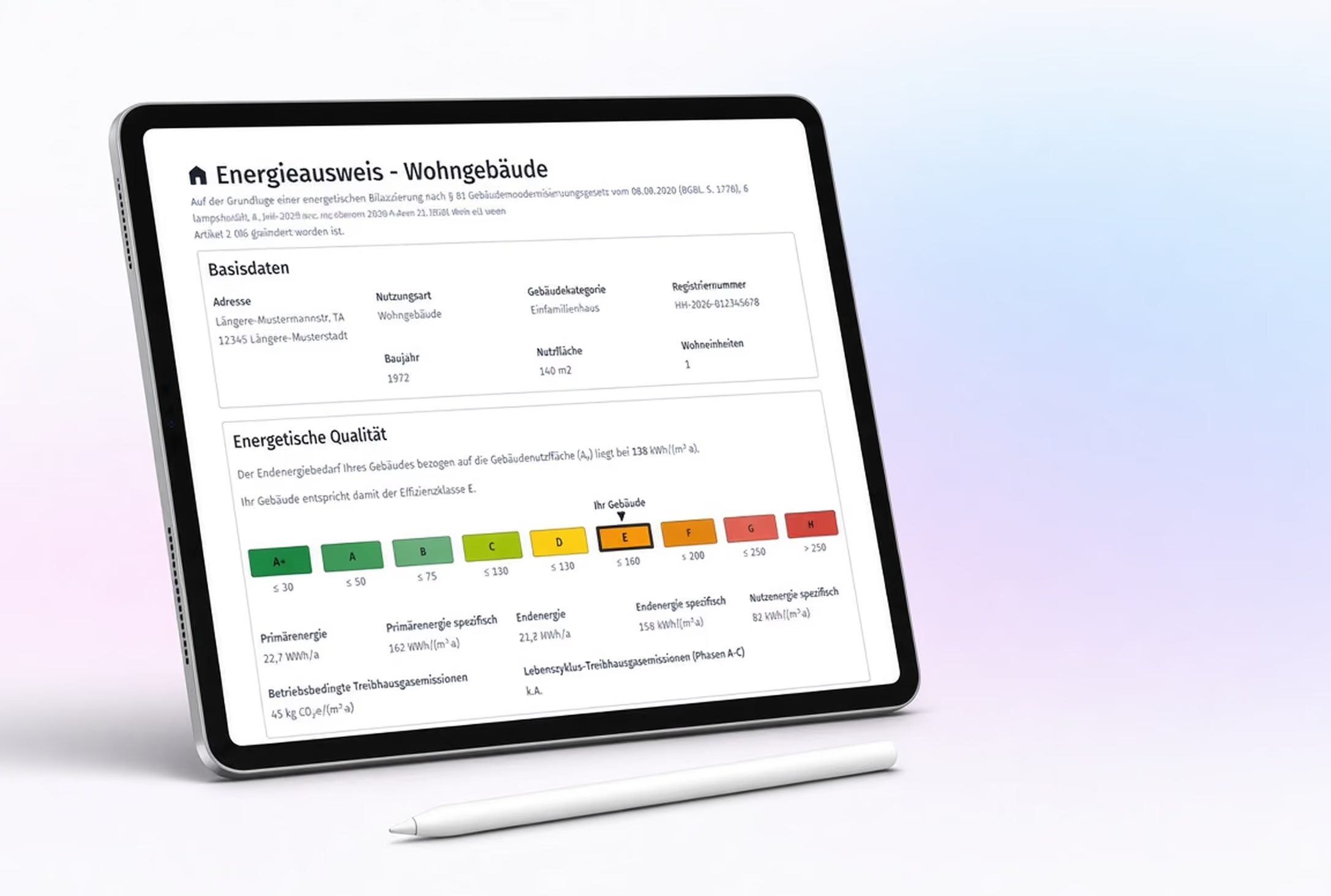
Under the title New energy certificate 2027: this is what it looks like, the preliminary residential draft shows the certificate on three pages: energy quality, recommendations and explanations. The images and PDF in this article are not an official template.
From 1 January 2027, Article 2 of the GModG applies to newly issued energy certificates. The binding layout follows via the Federal Gazette (§ 85(3)).
The legal basis is BGBl. 2026 I No. 226; Article 2 of the GModG applies from 1 January 2027.
The class and metrics change from 2027 cannot be estimated seriously for your building in advance — so we recommend securing a consumption, demand or Smart certificate as a reference still in 2026 and reissuing and comparing in 2027 if needed.
Legal status / as of: 26 November 2026. The GModG was promulgated on 28 July 2026. The visuals come from the preliminary draft shown at the digital info event hosted by BMWE and BMWSB on 24 November 2026 (supported by BfEE and BBSR). The official template has not yet been published.
In diesem Artikel erfahren Sie …
- Five pages, three pages — what changes in the format
- Demand or consumption — where the difference shows
- Two reference areas: Nutzfläche and Gebäudenutzfläche
- Sample PDF for download
- What applies for owners now
- Is ordering a 2026 certificate still worthwhile?
- Frequently asked questions
- Conclusion and outlook
Anyone who sells, lets or orders a certificate first wants to know: What does the certificate look like? This overview answers that — with full draft pages, close-ups of important fields and a sample PDF. What changes in the mandatory disclosures is covered under mandatory disclosures from 2027. We describe the digital process under digital energy certificate.
Five pages, three pages — what changes in the format
Previously the certificate was a multi-page document and, for non-residential buildings, included one page for display (Aushang). The preliminary residential draft compresses that to three pages. The main gain is readability: page one covers energy quality, page two the recommendations and page three the explanations.
| Previous (GEG template) | 2027 draft (info event) | |
|---|---|---|
| Pages | Typically 5 pages (+ one display page for non-residential) | 3 pages |
| Page 1 | Master data and metrics spread out | Basic data + energy quality + generation + indoor climate |
| Page 2 | Further metrics / notes | Modernisation recommendations with savings potential |
| Page 3 | Recommendations / explanations | Numbered explanations (incl. reference areas) |
| Status | Official GEG template | Preliminary draft — Federal Gazette template follows |
The orange stamp on the figures is intentional. It marks the status of the 24 November 2026 info event hosted by BMWE and BMWSB and makes the preliminary character visible until the Federal Gazette template is published.
Page 1: basic data, metrics and class band
Page 1 holds the details you need first: address and building type, Nutzfläche, metrics in MWh and kWh/(m²·a), the class band, energy generation including the renewables share, plus indoor climate and the issuer.
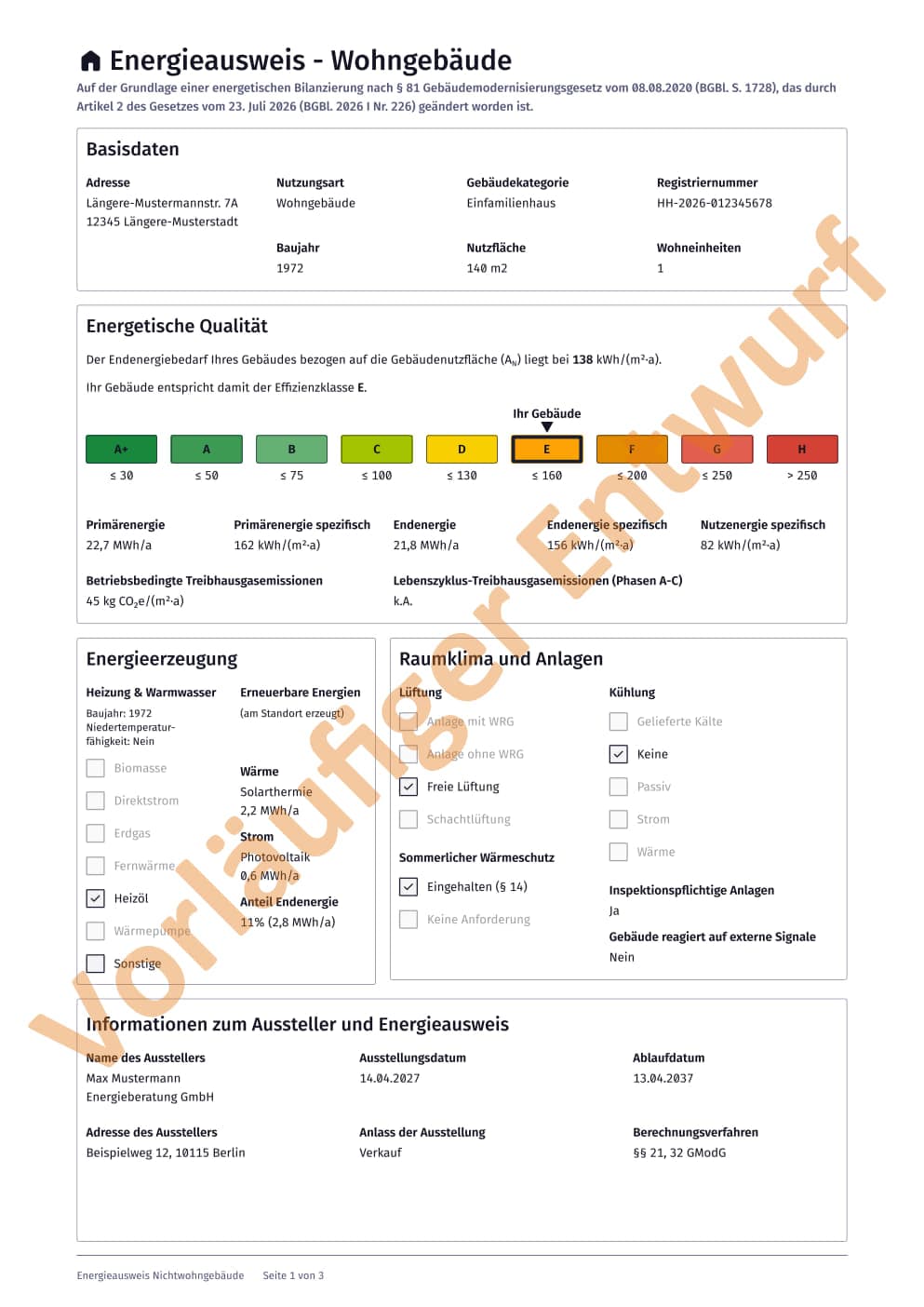
Page 1 of 3 — residential draft. Preliminary draft of the energy-certificate templates, provided in the context of the digital info event on energy-certificate templates on 24 November 2026 (BMWE/BMWSB, supported by BfEE and BBSR). Not an official template; binding publication in the Federal Gazette will follow.
Two close-ups follow the order on the form: first the basic data with Nutzfläche, then below that the energy quality block with the class band and the reference to building floor area AN.
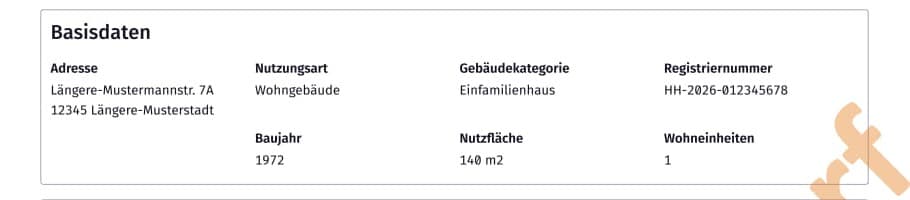
Top of page 1: basic data with Nutzfläche (example 140 m²).
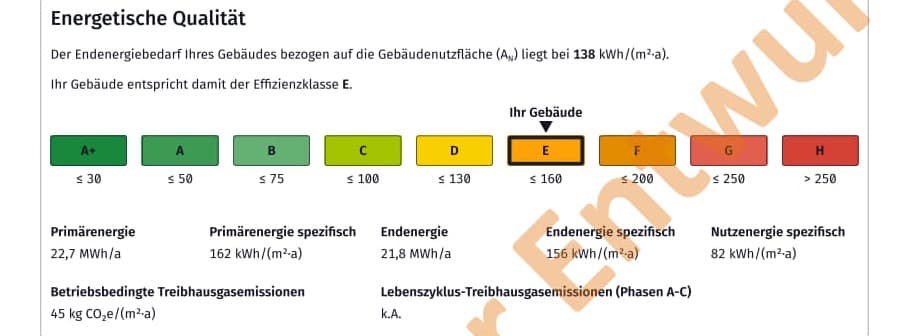
Below: energy quality — final energy demand related to AN, class band with example class E.
Demand or consumption — where the difference shows
At first glance, demand-based and consumption-based certificates look the same in the draft: the same three pages, the same blocks, the same class band. From 2027 the statute names the certificate by its basis: an energy certificate based on an energy balance (§ 81) or based on recorded final energy consumption (§ 82). In everyday language, Bedarfsausweis and Verbrauchsausweis remain the usual names — on the form itself the distinction now sits only in the header line under the title.

Demand-certificate example: “Auf der Grundlage einer energetischen Bilanzierung …”. For a consumption certificate the line refers to recorded final energy consumption (§ 82).
On a consumption certificate the draft shows metrics and the class — the consumption data themselves (billing periods and raw figures) are not on the form for your own cross-check. That makes it all the more important to choose an issuer you trust and providers that follow the quality criteria of the Gütegemeinschaft Gebäudebilanzierung and open validation standards. You will find more context under why the TÜV seal is not a quality seal and energy-certificate preview: why it helps little.
Two reference areas: Nutzfläche and Gebäudenutzfläche
This is where the details are most often confused. The basic data show Nutzfläche. The efficiency class in the draft hangs on final energy demand related to building floor area (AN). Specific metrics (related to Nutzfläche) can therefore look numerically different from the class arrow — and both figures can be technically correct side by side.
Anyone who wants to dig deeper into this change will find more in the planned follow-on article on the metrics logic and in the existing piece building floor area is not living space.
Page 2: modernisation recommendations
Page 2 is the action page. It contains a table of component, measure and savings potential, plus free-text fields and a pointer to the national contact point.
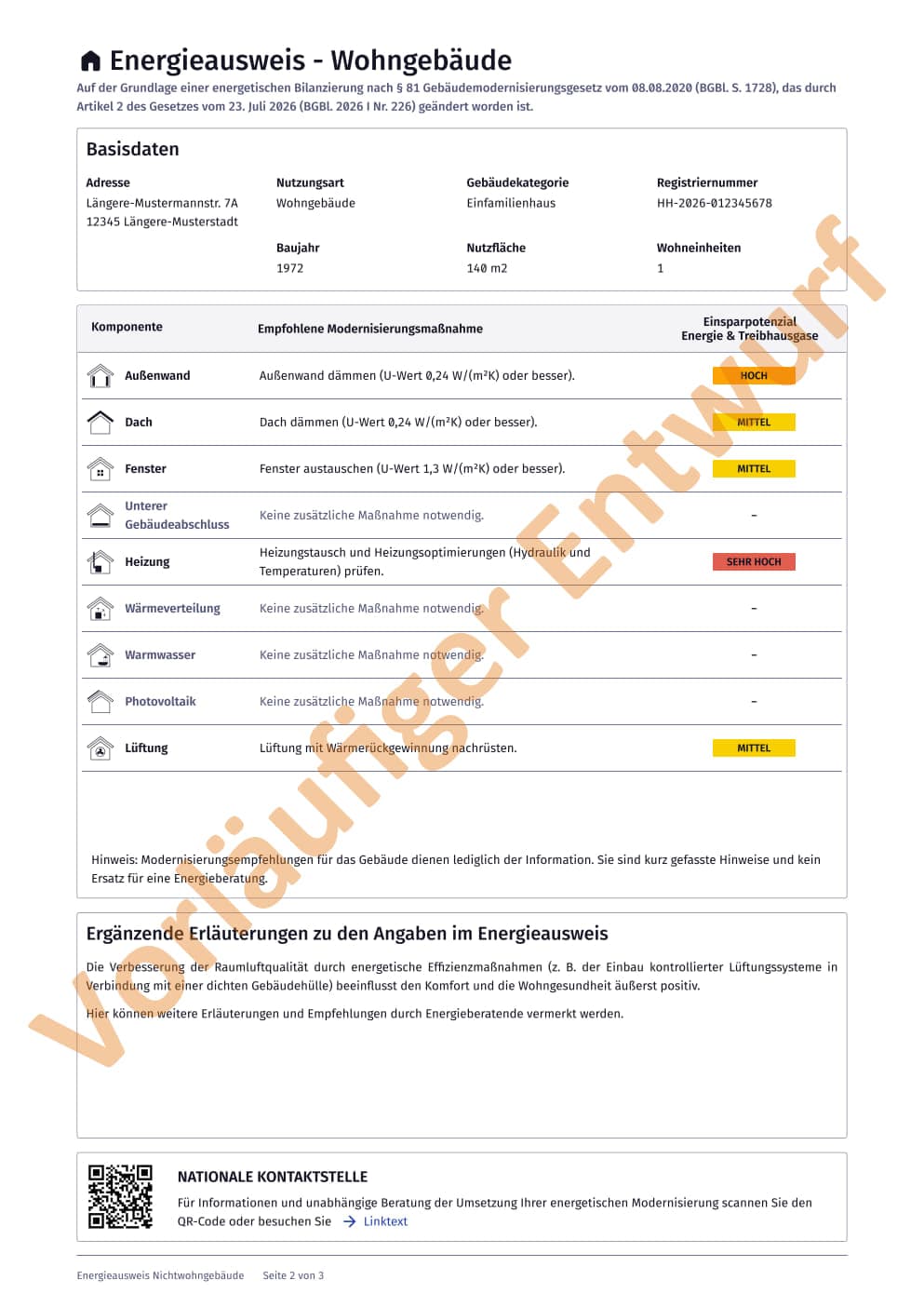
Page 2 of 3 — recommendations. Preliminary draft of the energy-certificate templates, provided in the context of the digital info event on energy-certificate templates on 24 November 2026 (BMWE/BMWSB, supported by BfEE and BBSR). Not an official template; binding publication in the Federal Gazette will follow.
In the close-up below you see the recommendations table more clearly: each component has a short measure, and the right-hand column shows the savings potential (for example medium, high or very high) where the draft sees the biggest lever. That helps you see at a glance what to look at first — and you can follow up with energy advice when needed.
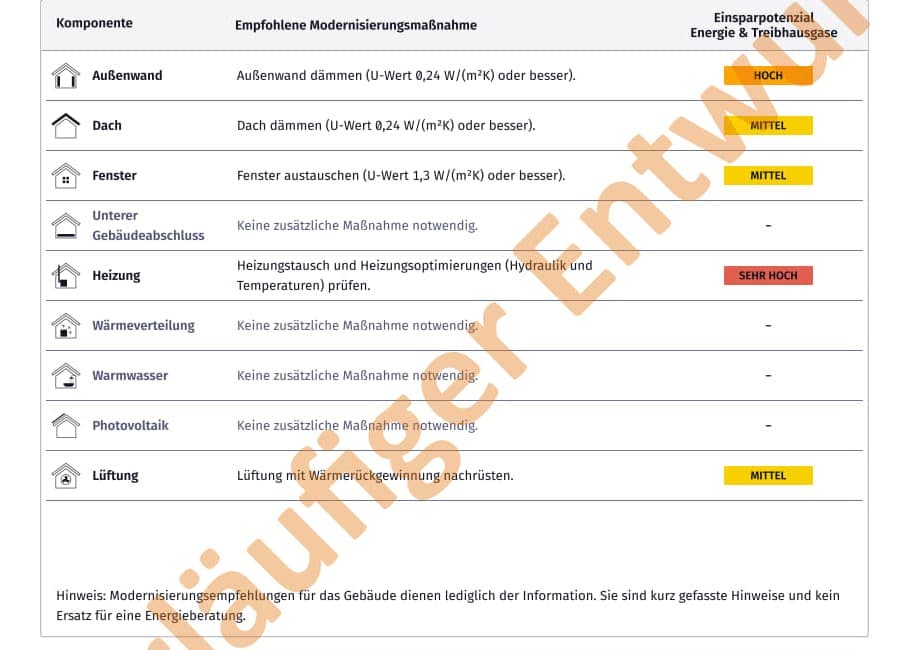
Close-up: modernisation recommendations with savings potential.
Page 3: explanations for readers
Page 3 explains purpose, reference areas, efficiency class, greenhouse-gas figures, recommendations and validity. That makes it the reading aid that finally makes pages 1 and 2 understandable.
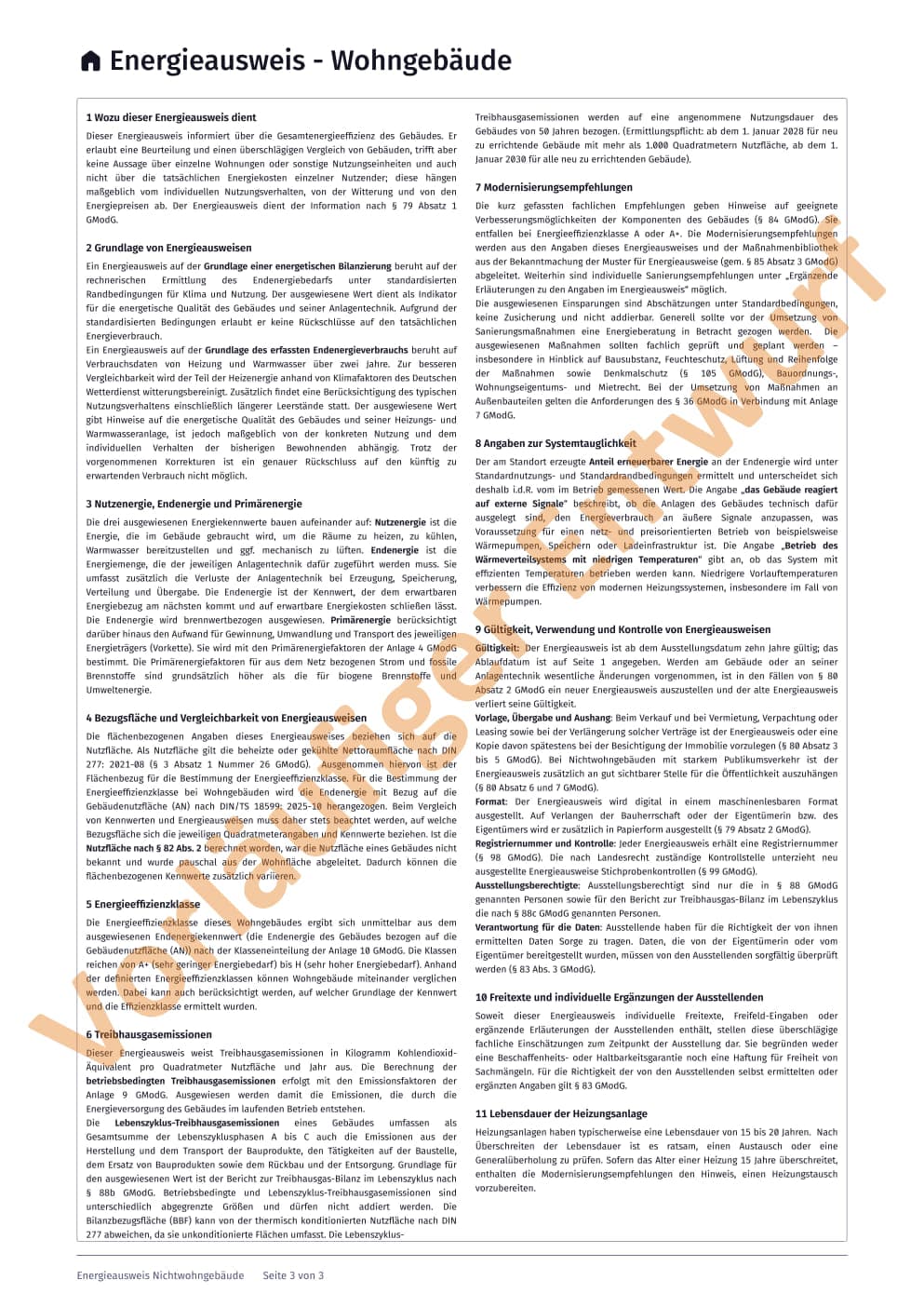
Page 3 of 3 — explanations. Preliminary draft of the energy-certificate templates, provided in the context of the digital info event on energy-certificate templates on 24 November 2026 (BMWE/BMWSB, supported by BfEE and BBSR). Not an official template; binding publication in the Federal Gazette will follow.
New mandatory fields at a glance
The draft makes several disclosures more visible that owners will see more often from 2027. Other knowledge articles on energyausweis.de describe them in more detail. Here we show an overview for initial orientation:
| Field / block | What owners see |
|---|---|
| Nutzfläche (useful floor area) | Reference area in the basic data (example: 140 m²) |
| Efficiency class | Final energy demand related to building floor area AN |
| Renewable share | On-site renewable share of final energy |
| Low-temperature capability | Heating-system readiness disclosure |
| External signals | Whether the system can react to external signals |
| Operational GHG | Operational greenhouse gas emissions; life-cycle often “n/a” |
For estate agents and owners interested in listing changes, there is a dedicated article: old or new certificate in the listing. It covers mandatory disclosures in adverts, old and new certificates side by side, and what practically changes in listing text from 2027 — separate from the layout draft here.
Sample PDF for download
The same three residential pages are available as a sample PDF — to read along, forward or file. The PDF does not replace an official template and carries the same draft character.
What applies for owners now
Article 2 of the GModG applies from 1 January 2027 to newly issued certificates. An existing, lawfully issued certificate remains valid — even when the layout changes. You only need to reissue when sale, letting or expiry requires it. Plan the switch to the new layout with that concrete occasion, not because of the template change alone.
What you can do now depends on your situation. If it is unclear whether consumption or demand fits, start with the certificate check. If the type is clear, order a consumption certificate or a demand certificate directly. Unsure between the two routes? Then the Energy Certificate Smart™ calculates both and issues the more suitable one. You will find an overview of the article series and of the key dates under important changes — overview.
Is ordering a 2026 certificate still worthwhile?
Yes — mainly for comparability of class and metrics. Order a consumption, demand or Smart certificate still in 2026. The effect of Article 2 on your building cannot be estimated seriously in advance; without today’s reference you later will not know whether differences come from the new calculation logic, from measures or from consumption data. You can deliberately order a comparison certificate under the new rules in 2027 — whether or not sale or letting already requires it.
For a few hundred euros you secure a certificate that usually remains valid for ten years and stays usable as a solid reference. More under Order a consumption certificate now and The Energy Certificate Smart™.
Frequently asked questions
Is the template shown already the official energy-certificate template from 2027?
No. The figures come from the preliminary draft presented at the digital energy-certificate template info event on 24 November 2026, hosted by the Federal Ministry for Economic Affairs and Energy (BMWE) and the Federal Ministry for Housing, Urban Development and Building (BMWSB), supported by the Federal Agency for Energy Efficiency (BfEE) and the Federal Institute for Research on Building, Urban Affairs and Spatial Development (BBSR). The official template under § 85(3) GModG will be published in the Federal Gazette.
How many pages will the new energy certificate have from 2027?
The preliminary residential draft shows three pages. Until Federal Gazette publication the binding layout remains open.
Why are Nutzfläche and the efficiency class not on the same reference area?
The basic data show Nutzfläche. In the draft the efficiency class relates to final energy demand based on building floor area AN. Specific metrics can therefore look different from the class value. That is how the legislator set it in the GModG; a different logic would also have been conceivable.
Do existing energy certificates become invalid on 1 January 2027?
Lawfully issued certificates remain usable until they expire. A layout change alone does not end validity; a new occasion such as sale, letting or expiry can require a new certificate.
Where can I find a sample PDF of the draft?
You will find it in the “Sample PDF for download” section above and can load it here: sample residential draft PDF (three pages, with attribution; not an official template).
How do I tell demand and consumption certificates apart on the new form?
Both types use the same three-page draft. You now read the difference only in the header line: energy balance under § 81 or recorded final energy consumption under § 82. Previously the difference sat on separate pages: page 2 showed calculated energy demand (demand certificate), page 3 recorded energy consumption (consumption certificate); the other page often stayed blank.
Can I recheck a consumption certificate against my bills?
On the draft you see metrics and the class; the raw figures for your own cross-check are not there. Recalculating from bills was already difficult before: between the invoice and the metric sit conversions from net to gross calorific value, weather normalisation and further normalisation steps. Rely on issuer choice and recognised quality criteria.
Is ordering a certificate under today’s rules in 2026 still worthwhile?
Yes. Because class and metrics from 2027 cannot be estimated seriously for your building in advance, we recommend securing a consumption, demand or Smart certificate still in 2026 (typically valid for ten years) and reissuing and comparing in 2027 if needed.
How to read the draft
- Separate draft and legal status. Remember the date of Article 2 of the GModG (1 January 2027), and treat the pages shown as preliminary until Federal Gazette publication.
- Read page 1. Consider Nutzfläche and the efficiency class on AN separately from each other.
- Use recommendations and explanations. Use page 2 for measures and page 3 for definitions and rationale.
- Clarify PDF and timing. File the sample PDF. Check whether you want a 2026 reference — and whether sale, letting or expiry requires a new certificate.
Conclusion and outlook
The preliminary residential draft shows what the energy certificate will look like from 2027: three pages instead of a longer form, with energy quality, recommendations and explanations. Demand and consumption certificates share the same layout; you recognise the type only from the header line (§ 81 or § 82). On page 1 the key points are Nutzfläche and the efficiency class on building floor area (AN), which are easy to mix up, plus issuer quality: metrics appear without input data such as consumption figures or building construction. Images and sample PDF serve as initial orientation; they are not official templates.
The binding certificate template under § 85(3) will be published in the Federal Gazette. Until then the draft remains preliminary. In the series “The new energy certificate from 2027” we will next deepen the metrics logic (Nutzfläche and efficiency class) and place mandatory disclosures, listings and the digital issuance process. For dates and Article 2 of the GModG see GModG promulgated and the overview of important changes.
In practice: check remaining validity and the next sale or letting occasions, and familiarise yourself with the draft. Also decide whether you want to secure a consumption, demand or Smart certificate still in 2026 as a reference, then reissue and compare in 2027 if needed.