Key changes to energy certificates – overview and perspective

The Bundestag and Bundesrat passed the GModG on 10 July 2026 — promulgation in the Federal Law Gazette is still pending. EU scale A–G only for non-residential; residential keeps A+–H. What happens next for energy certificates? · Cabinet draft fact check.
From 2026, new rules apply to energy certificates: an EU-wide scale A to G, more duties for lease renewal and renovation, and a new legal framework under the Building Modernisation Act. If you are an owner, manager, agent or bank adviser, knowing the main lines helps you plan in time – and here you find the entry point and links to the deeper-dive articles in this blog.
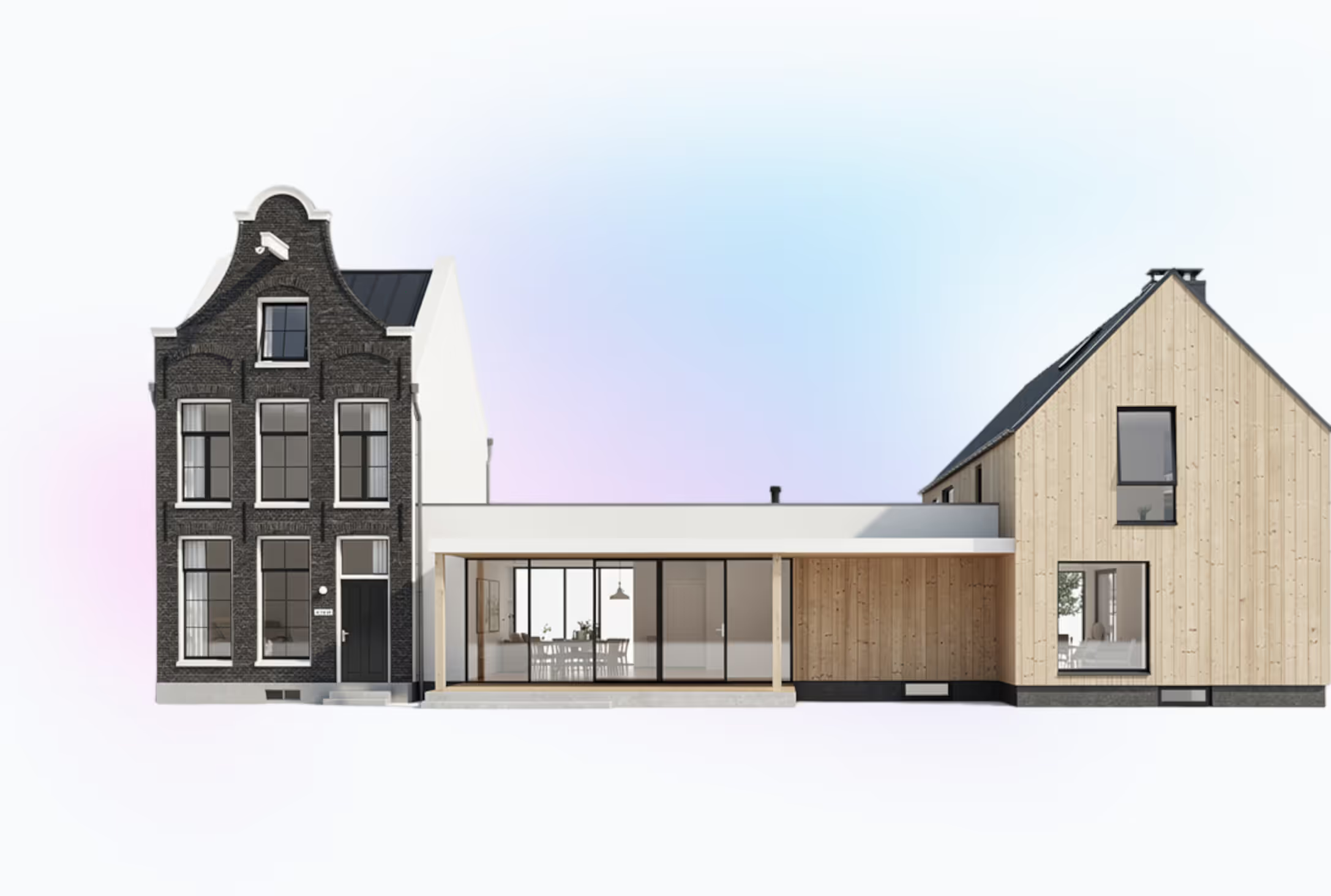
The article moves from the EU directive via German implementation to a look at other EU countries and a possible shared European perspective. Concrete details on scale, validity and duties are in the linked posts.
In this article
- Why so much is changing for energy certificates now
- The EU Buildings Directive: Framework for all member states
- New A–G scale and harmonised energy certificates
- Minimum standards, zero-emission buildings and deadlines
- Germany: The Building Modernisation Act and key changes
- New scale, extended presentation duties and digital database
- Heating choice and current political debate
- Looking beyond borders: How other EU countries handle energy certificates
- Front-runners: The Netherlands and Denmark
- France, Belgium and Austria compared
- Outlook: A shared European goal
- Harmonisation of measurement and regulation
- Learning from each other – climate, environment and resilient buildings
Why so much is changing for energy certificates now
The energy certificate is the main information tool for the energy quality of buildings – for sale, letting and increasingly for financing and valuation. Since 2024 the revised Buildings Directive (EPBD) has applied at EU level; by May 2026 all member states must transpose it into national law EU Commission – EPBD. In Germany this is done by the planned Building Modernisation Act (GModG), which replaces the previous Building Energy Act (GEG) and, among other things, reorganises energy certificates.
In practice that means: new efficiency classes (EU A–G for non-residential; residential keeps A+ to H in the cabinet draft), more situations in which a certificate must be presented – e.g. on lease renewal or after major refurbishment. That will create better comparability in Europe in the long run. Anyone who understands the main lines can plan in time and, when needed, go to the deeper-dive articles: on the new A–G scale and extended duties, on whether old certificates become invalid from May 2026, and on energy certificate duty on lease renewal and renovation.
The EU Buildings Directive: Framework for all member states
Directive (EU) 2024/1275 on the energy performance of buildings (EPBD) entered into force on 28 May 2024 and must be transposed into national law by member states by 29 May 2026 EU Commission – EPBD, Directive (EU) 2024/1275. It is the framework that German changes also follow: harmonised energy certificates, minimum standards for the building stock, zero-emission buildings as the target for new builds, and more transparency through digital tools.
New A–G scale and harmonised energy certificates
The EPBD introduces a single energy efficiency scale A to G. Class A is reserved only for zero-emission buildings; Class G represents the worst 15% of the national building stock by energy performance. Classes B to F are distributed roughly evenly across the rest. The rating thus follows the familiar label used for appliances and is intended to improve comparability in the EU EU Commission – EPBD, Annex V. A numeric indicator for primary energy use (kWh/m²·a) and, where provided for, lifecycle greenhouse potential complete the classification.
Important: The new scale is based on different calculation methods and criteria from the previous German scale (A+ to H). Old certificates cannot be simply “converted”; a new certificate under the new rules is needed for the new classification. Whether existing certificates become invalid from a cut-off date or remain valid for a transition period is set in national transposition – more in the Germany section and in Are energy certificates invalid from May 2026?. On EU-wide comparability: Are energy certificates more comparable with the new A to G scale from May 2026?.
Minimum standards, zero-emission buildings and deadlines
As well as the harmonised scale, the directive requires member states to do the following, among other things:
- Minimum energy performance standards (MEPS) for non-residential buildings: By 2030 the worst 16% of the stock by energy performance must be renovated, by 2033 the 26% worst EPBD Art. 9, WorldGBC MEPS.
- New builds: New public buildings must meet the zero-emission building (ZEB) standard from 2028, all new builds from 2030 EU Commission – EPBD.
- Residential building stock: Each member state sets a national renovation trajectory so that average primary energy use of the residential stock falls by at least 16% by 2030 and 20–22% by 2035 compared with 2020; a significant share of the reduction must come from renovating the worst buildings EPBD, WorldGBC.
- National building renovation plans (NBRP) with targets, funding and measures; drafts by end of 2025, final plans by end of 2026 EU Commission – EPBD.
- Fossil heating: Financial support for installing new purely fossil-fired boilers must end by 1 January 2025 at the latest EPBD Art. 17.
The EPBD also provides for energy certificates to become digital and for data to be made available in national databases on the energy performance of buildings. Renovation passports (building renovation passports) are to support owners in step-by-step renovation. How Germany fills this framework is directly relevant for owners, managers and agents – so the German transposition follows here.
Germany: The Building Modernisation Act and key changes
In Germany the EPBD is transposed by the Building Modernisation Act (GModG). On 13 May 2026 the federal government adopted the cabinet draft; the Bundestag and Bundesrat passed the Act on 10 July 2026 — promulgation in the Federal Law Gazette is still pending (staggered under Art. 9). What promulgation, the Art. 9 timeline and energy-certificate rules mean now is explained in the news article GModG passed: What happens next for energy certificates?. The key points of 24 February 2026 remain relevant background (Energie-Experten – Building Modernisation Act). The GModG replaces the previous Building Energy Act (GEG) and bundles requirements for energy certificates, heating and building modernisation.
New scale, extended presentation duties and digital database
- Scale A–G (non-residential) / A+ to H (residential): In the cabinet draft the EU A–G scale applies only to non-residential buildings (Annex 10a); residential keeps A+ to H (Annex 10 unchanged). The article Energy certificate 2026: New A–G scale and extended duties describes details and practical impact.
- Extended presentation duty: An energy certificate is required not only for sale and new lettings but also when renewing tenancy agreements and after major renovations (e.g. where more than 25% of the building envelope or building value is affected) EPBD, Energie-Experten – Duties from May 2026. The exact definition of “major renovation” is set in national transposition. Example: A landlord who renews several tenancy agreements in 2026 must present an energy certificate each time – usually one under the new rules with the A–G scale. Read more on this in New energy certificate duty on lease renewal and renovation.
- Digital building database: The directive requires a national database for data on the energy performance of buildings; the GModG will set the concrete design in Germany.
- Greenhouse potential (GWP): For new builds, reporting of lifecycle greenhouse potential in the energy certificate will be required in phases (from 2028 for large new builds, from 2030 for all new builds) EPBD, energie-m.de – GModG 2026.
- Renovation passport: A renovation passport building on the individual renovation roadmap (iSFP) is to help owners plan renovation steps energie-m.de – GModG 2026.
For banks and lending, the energy certificate is playing an increasing role – see the articles How the energy certificate affects your credit terms and What do banks do with the energy certificate?.
Heating choice and current political debate
The GModG follows the controversially discussed GEG amendment (“Heating Act”). In its key points the federal government has opted for a more flexible approach without a binding requirement for a specific heating technology: The previous 65% rule (new heating must use at least 65% renewable energy) is to be removed and replaced by a green gas quota – gas suppliers are to provide gradually increasing shares of biomethane or green hydrogen; new gas and oil heating would in principle be permitted again under this model Energie-Experten – GModG, Cleanthinking – GModG key points. The government cites greater planning certainty, simplification and social cushioning.
In public debate, critics say this shifts control from the building level to the energy market, that renewable gases are scarce and expensive, and that climate targets in the building sector could be put at risk Cleanthinking, Correctiv – Heating reform fact-check. Some associations and researchers warn of a slowdown in the heat transition and of social inequity if tenants remain tied to fossil heating and rising costs for longer. How things develop – whether and how tightening or extra support is added – will shape the practice of building modernisation and energy certificates. The article Heating replacement: gas, oil, pellets or heat pump can help put heating choice and building efficiency in context.
Looking beyond borders: How other EU countries handle energy certificates
The EPBD sets the framework; the concrete design is up to member states. A short look at countries with ambitious standards shows that energy certificates and building efficiency are organised differently – and offer ideas for what a shared European level could look like.
Front-runners: The Netherlands and Denmark
The Netherlands and Denmark are widely seen in comparative studies as front-runners on requirements for the energy efficiency of new builds: very strict U-values, high demands on the building envelope and on technical systems IWU – Comparison of European requirements, BPIE – Building stock. The Dutch energy label has been in place for years and is mandatory for sale and letting; the methodology has been tightened over time. Denmark adopted zero-emission and nearly zero-energy standards early and integrated lifecycle assessment into the rating. Both countries must also transpose the 2024 EPBD by May 2026; their existing systems provide a good basis for the harmonised A–G scale and the other EPBD requirements.
France, Belgium and Austria compared
France uses the DPE (Diagnostic de Performance Énergétique) for a single assessment on sale and letting; the DPE includes renovation recommendations and is linked to requirements for energy renovation IWU. Belgium (especially Flanders with the EPB system) and Austria are in the middle range in comparative assessments of new-build requirements; there are also regional specifics and voluntary certification schemes that go beyond minimum requirements IWU, Interreg Central Europe – Comparative analysis. Differences in calculation methods and thresholds still make direct numeric comparison between countries difficult; the new EU A–G scale and common framework criteria are intended to improve comparability over time. For agents and investors, one example is relevant: anyone comparing properties in several EU countries will be able to classify energy efficiency better via the single A–G scale – even if national calculation details still differ for now.
Outlook: A shared European goal
Across national transpositions, the EPBD pursues a clear goal: decarbonised building stock by 2050 and more consistency in measurement, certificates and renovation steering in the EU. Whether and how quickly a largely common “language” for building efficiency takes hold depends on transposition in member states and on further political developments.
Harmonisation of measurement and regulation
In the long run it is conceivable that the same basic principles apply in all major EU countries: a single scale (A–G), comparable indicators (primary energy, greenhouse potential), digital certificates and databases, and clear minimum standards for new builds and the stock EU Commission – EPBD, WorldGBC MEPS. The directive sets the framework; comparability will depend on how closely national calculation methods and thresholds align. For owners, investors and banks that would make it easier to assess properties across borders.
Learning from each other – climate, environment and resilient buildings
The EPBD’s aims – lower greenhouse gas emissions, lower resource use, better adaptation to climate change and healthier indoor air – matter in all member states. Differences lie in the pace, the instruments (e.g. renovation obligations, support, one-stop shops) and how the energy certificate is linked to renovation roadmaps. Learning from each other – e.g. on quality assurance of certificates, data infrastructure or integrating lifecycle and climate resilience – can help buildings burden climate and environment less while becoming more resilient and livable. The vision of a shared goal remains the direction: reduced carbon footprint, careful use of natural resources and buildings that are better aligned with climate change and natural cycles. The EU with the EPBD and member states with their national plans are working towards this EU Commission – EPBD, BUILD UP.
Summary: The main changes to energy certificates in 2026 come from the EU – new A–G scale, extended presentation duties (including lease renewal, major renovation), MEPS, ZEB and digital tools – and are implemented in Germany by the Building Modernisation Act. For homeowners, bank advisers, property managers and agents it pays to know these lines and to use the deeper-dive articles when needed: validity of old certificates, lease renewal and renovation, credit terms and heating choice. The look at other EU countries and the outlook towards a shared European perspective make clear: the energy certificate remains the central tool for transparency and steering – in an evolved form and with greater importance for planning, financing and comparability.