Renovation Obligations and the Energy Certificate: What Modernization Recommendations Actually Mean — and What’s Legally Required

“Renovation obligation” sounds like a deadline, a mandate, and expensive measures. In practice, it is often a misunderstanding: recommendations in the energy certificate get mixed up with real retrofit duties under Germany’s Building Energy Act (GEG) and headlines about the EU’s Energy Performance of Buildings Directive (EPBD).
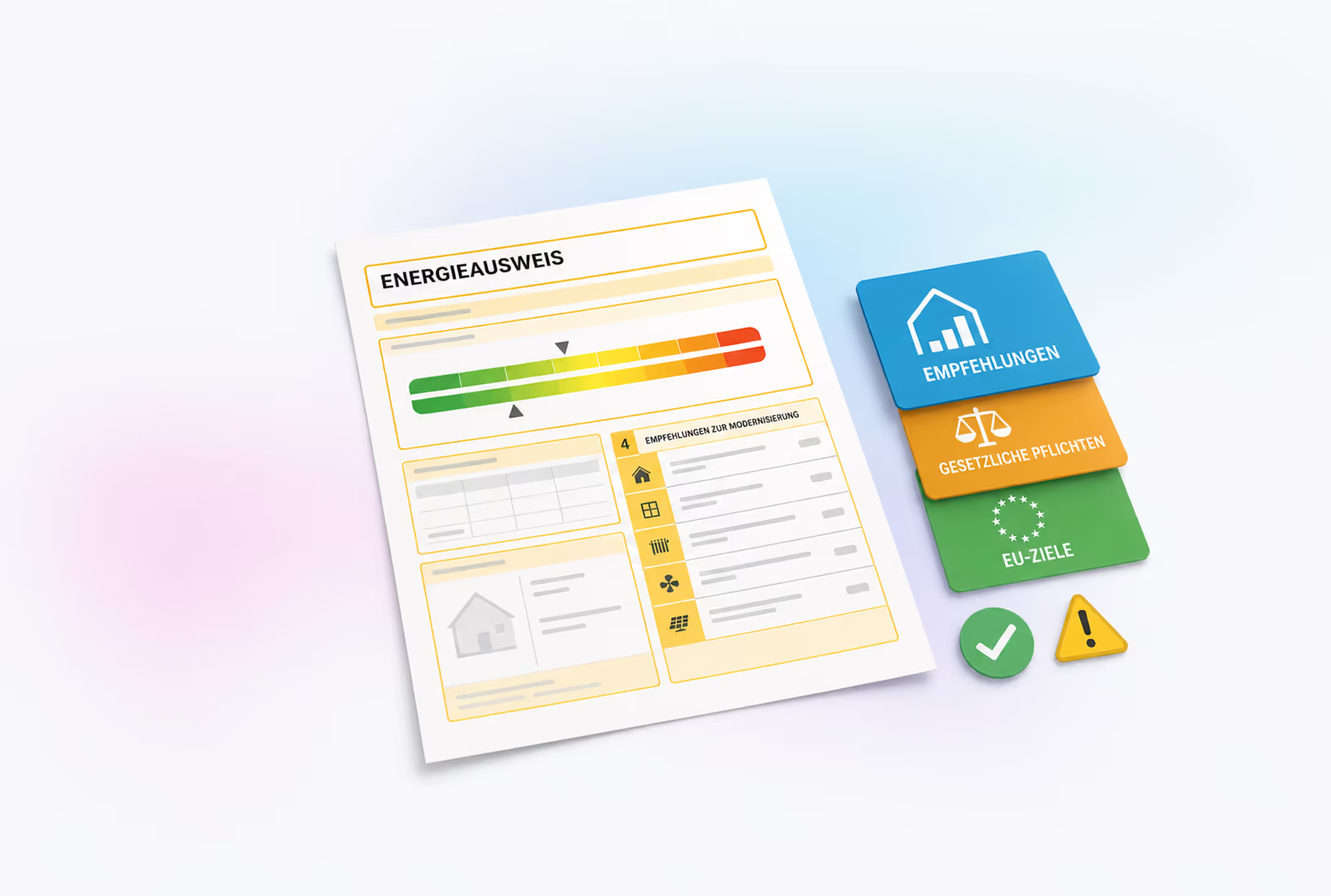
A widespread misunderstanding follows: page 4 with its “modernization recommendations” is read like an official notice. And you wonder whether you can afford the renovation costs at all.
To classify things cleanly, we therefore separate three layers: what the energy certificate recommends (hints, not duties), what can actually be mandatory in certain cases (and how to spot that) — and what the GModG cabinet draft of 13 May 2026 proposes: transposing the EPBD without a new blanket renovation obligation for residential buildings.
In this article
- Short answer: Does the energy certificate force renovations?
- Page 4 in the energy certificate: What modernization recommendations are (and aren’t)
- Mandatory, recommended, voluntary renovation: The 1‑minute table
- What duties really exist: typical retrofit cases in everyday life
- “Renovation obligation 2026” and GModG draft: What applies to residential buildings — and what doesn’t
- When recommendations are still worth it (sale, comfort, funding)
- Ownership transfer, listed buildings, renting and owner associations
- Summary and outlook
The Bundestag and Bundesrat passed the GModG on 10 July 2026 — promulgation is still pending; until then the GEG remains unchanged. What happens next for energy certificates?
Short answer: Does the energy certificate force renovations?
Definitely not. The energy certificate is an informational document. It can point to measures that may improve energy performance — but it is not a “renovation notice”.
What is still worth doing: use recommendations to set priorities. And separately check whether individual retrofit duties apply independently of the certificate (the table below helps).
A quick example to get a feel for it:
- Case A: “Insulate pipes” is listed, and you see bare pipes in the basement. That is often quick to fix and can even be mandatory in some setups.
- Case B: “Insulate façade” is listed. In most cases that is not a blanket retrofit duty — rather a modernization you can plan (or postpone) consciously.
Page 4 in the energy certificate: What modernization recommendations are (and aren’t)
Page 4 commonly lists measures like:
- insulating the roof / top floor ceiling
- insulating heating or hot‑water pipes in a basement
- upgrading old heating equipment
- sealing or replacing windows
- sometimes PV or solar thermal as optional measures
These recommendations are briefly worded hints. They point in a direction — nothing more.
What you should not treat them as:
- a binding duty programme (“if it’s listed, I must do it”)
- a reliable profitability calculation (“this will definitely pay off”)
- a fixed renovation roadmap (“this must be the order of work”)
In practical terms: page 4 is more like a note after a doctor’s appointment. It can be useful — but it does not replace a case-by-case assessment.
If you want it confirmed in writing: modernization recommendations are provided for information and do not have to be implemented (see the BBSR/GEG portal on modernization recommendations and GEG § 84). That is the only place in this article where we pin it down legally — from here on, we stay practical.
If you also want the bigger picture (demand vs. consumption, key metrics, validity): see Understanding the energy certificate.
Mandatory, recommended, voluntary renovation: The 1‑minute table
The same measure can be purely optional in one building and mandatory in another. The difference lies in the conditions: building type, current state, owner status, and technical setup.
| What may appear in the certificate | When it can be mandatory | When it is more likely optional |
|---|---|---|
| “Insulate top floor ceiling” | If the ceiling does not meet minimum thermal protection and the legal criteria apply | If already insulated sufficiently, or if roof/ceiling needs a different technical/economic assessment |
| “Insulate heating/hot‑water pipes” | For accessible, previously uninsulated pipes in unheated rooms | If pipes are not accessible or already insulated |
| “Replace old boiler” | For certain oil/gas boilers that may not be operated after a defined age threshold (with major exceptions) | If it is a condensing/low‑temperature boiler or otherwise outside the rule |
| “Replace windows / insulate façade” | Typically not a blanket retrofit duty — often only relevant in the context of specific renovation works | Often: comfort, operating costs, value retention, funding logic |
| “Install PV” | Typically not mandatory for residential buildings because of the energy certificate itself | Often sensible as a voluntary measure (details in the PV guide) |
If you take away one thing: page 4 is a starting point. Whether something is mandatory is not decided by a line in the certificate, but by the legal framework and your concrete situation.
If you are under time pressure (agent calls, viewing scheduled): this table is often more useful than a long detail discussion. It gets you quickly to the question that really matters: “Do I have to do something — or can I choose freely?”
What duties really exist: typical retrofit cases in everyday life
Instead of reciting provisions, a practical logic helps: which parts of a building are typical candidates for retrofit duties? Three show up again and again — and can be sorted with a few questions.
Top floor ceiling insulation: when it becomes mandatory
Typical scenario: an unheated attic above living space, with an accessible ceiling. If that ceiling does not meet minimum thermal protection, insulation can be required. Important: it does not always have to be the ceiling — insulating the roof can also satisfy the requirement.
A common mistake: “I received a certificate, so I must insulate now.” The certificate may recommend the measure; whether a duty applies depends on criteria — not on the paper.
Quick self-check:
- Is there actually an unheated attic?
- Is the ceiling accessible and obviously not insulated?
- Has the roof perhaps already been insulated (which can also satisfy the requirement)?
Pipes in the basement: often a small duty with a big effect
If uninsulated heating or hot‑water pipes run visibly through a basement, that is energetically almost always one of the easiest levers. There can also be a binding duty — but only when the pipes are accessible and in unheated rooms.
In practice: walk through the basement once, take photos, check the pipes. That is often simpler than major envelope work — and reduces losses noticeably.
Concrete image: if you can touch a warm pipe in winter, you are currently heating the basement as well — exactly what you want to avoid.
Old oil/gas boilers: when age becomes an issue
Many know the headline “replace heating after 30 years”. That is not universally true. What matters is boiler type. For certain boilers there are operating bans after defined deadlines, but there are major exceptions (e.g. condensing and low‑temperature boilers).
For owners, a sensible order is usually:
If you are still undecided: for a start, photographing the nameplate and noting the installation year is often enough. That helps with classification before you commit to a measure.
Ownership transfer as a multiplier (the two‑year deadline)
Many duties become especially relevant when ownership changes — for example after a purchase or inheritance. That is one reason “renovation obligation” is so often searched together with “inherited” or “bought”.
Important: the two‑year deadline does not apply blanket rules. In the law it is tied to a specific constellation: a residential building with no more than two apartments that was owner‑occupied on 1 February 2002. If ownership changes after that, retrofit duties can apply with a two‑year deadline. If you are in that situation, careful classification pays off — especially after inheritance.
If you inherited and want to know what is really relevant now (and what only matters on sale/letting): see our guide Energy certificate for inherited property.
“Renovation obligation 2026” and GModG draft: What applies to residential buildings — and what doesn’t
Many search for “renovation obligation 2026”. The background is the EU Energy Performance of Buildings Directive (EPBD), which Germany must transpose by 29 May 2026. The Bundestag and Bundesrat passed the Building Modernisation Act (GModG) on 10 July 2026 — promulgation is still pending. The full fact check is in The A–G scale is coming — just not for your home: GModG fact check (originally cabinet draft); promulgation and timeline in the news article.
Decisive for classification: the draft contains no new blanket renovation obligation for residential buildings. Minimum energy performance standards (MEPS) under EU rules apply only to non-residential buildings — residential buildings are exempt. Modernization recommendations under § 84 remain non-binding. They will only become more detailed, with estimated energy and CO₂ savings plus remaining heating service life (GModG for property managers: modernization recommendations).
What the draft means in practice for existing owners:
- 65% rule dropped: the previous duty to use 65% renewable energy when replacing heating (GEG §§ 71 ff.) is removed. Heating systems may continue to be operated or replaced in a more technology-neutral way — details in Heating replacement: gas, oil, pellets or heat pump?.
- Consumption certificate for all residential buildings: the previous demand-certificate requirement for small older buildings without WSchV-1977 proof ends. From entry into force, the consumption certificate is available for all residential buildings when 24 months of data exist (Consumption certificate: new freedom of choice).
- Solar duty only for new builds: from 1 January 2030, a solar duty applies to new residential buildings. Existing renovations do not trigger a solar duty for homes — unlike non-residential buildings, which can be affected from 2028 in comprehensive renovations.
- Tighter certificate duties, not renovation: on sale, new letting and in future also lease renewal, presentation duties become stricter. After major renovations, a new certificate may be required. That is a documentation duty, not an automatic measure duty (Energy certificate 2026: new A–G scale and extended duties).
Germany implements EPBD targets for the overall housing stock (reducing average primary energy use) through state-level goals — not an individual duty per house. For the official framing: BBSR/GEG portal on the EPBD.
That is why “renovation obligation 2026” is misleading: the GModG draft brings many changes to energy certificates and heating rules, but no new general renovation obligation for every single-family home. If you are still undecided, distinguish documentation duties (present or reissue a certificate) from renovation duties (implement a measure) — and check today’s GEG retrofit duties separately from the planned GModG.
When recommendations are still worth it (sale, comfort, funding)
Non‑binding does not mean useless. Recommendations are often a good starting point for weighing sensible measures and getting started.
Typical situations where page 4 helps:
- Sale/renting: if you are prepared, you answer follow‑up questions faster and can classify measures cleanly (“mandatory? voluntary? already done?”).
- Comfort & operating costs: some measures (e.g. pipe insulation) are quick, affordable and noticeable.
- Funding & planning: for bigger projects, structured advice (e.g. energy consultancy or an individual renovation roadmap) is often a better next step than ticking off certificate lines blindly.
Scope note: PV sometimes appears as a recommendation. How and when PV affects the energy certificate is a separate topic. See our guide Photovoltaics and the energy certificate: when solar improves the efficiency class — and when it doesn’t.
If you need a certificate anyway (e.g. for sale or letting): see EPC obligations in Germany.
If you want to use page 4 without acting too quickly, a simple classification helps:
Ownership transfer, listed buildings, renting and owner associations
The same questions keep coming up around modernization recommendations in these special cases.
Do I have to renovate immediately after receiving an energy certificate? No. The certificate itself does not trigger an immediate duty. It documents the building’s current state and contains suggestions for possible measures.
What happens if I ignore recommendations? Usually nothing happens on its own. Recommendations are hints without legal effect. Whether statutory duties apply depends on specific retrofit requirements — and those apply independently of whether the same measure is also recommended in the certificate.
I bought or inherited a property — what is sensible now? A pragmatic start: read the certificate (building type, year, heating system, page 4), walk through basement and attic once, clarify boiler type and age — then decide whether to check retrofit duties or prioritise voluntary measures. For inheritance and deadlines, see the guide Energy certificate for inherited property.
Does all of this also apply to listed buildings? That cannot be answered in blanket terms. For listed buildings, additional rules and reasonableness play a role. Recommendations in the energy certificate are not automatically mandatory. Whether concrete duties apply should be checked case by case.
Renting or owner association: who is responsible? For common property — for example pipes in shared areas — responsibility may lie with the owner association or property management. For details, see the multi-family and property-management articles. This article is not meant to be a legal guide to owner associations.
Summary and outlook
The energy certificate is not the trigger of a renovation obligation. It helps with classification and prioritisation — any duties arise (if at all) from clearly limited legal rules and always only under specific conditions.
Before you consider a renovation, start with three simple guiding questions:
- Which recommendations are listed on page 4?
- Which of them are even realistic for your building?
- Do any of the typical retrofit candidates (ceiling, pipes, boiler) clearly apply?
That is what page 4 is useful for in the end: as a starting point for an informed assessment — and then, together with an energy advisor, reaching a cost-effective and effective renovation decision.