Will energy certificates become more comparable with the new A to G scale from May 2026?

From May 2026 the uniform A to G scale applies across the EU – at first glance a big step towards comparable energy certificates. But the same letter does not mean the same thing everywhere. Comparability hits limits in several dimensions: between countries, over time, and between consumption-based and demand-based certificates. This article shows where you can compare and where not – and how to get the most out of the energy certificate anyway. For brokers, managers and owners.
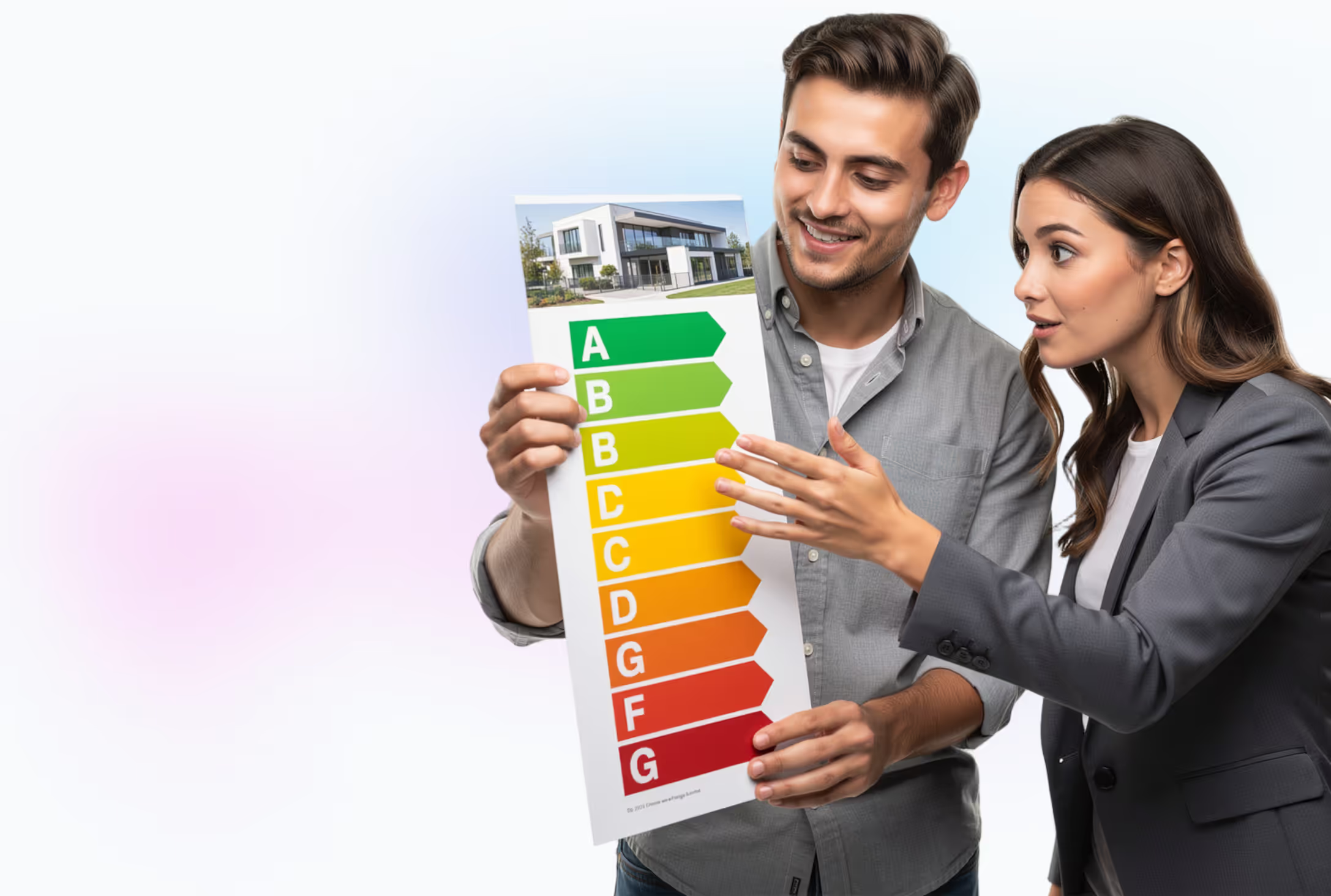
The energy certificate is a key factor in sale and rental decisions for buyers and tenants and helps estimate energy costs and refurbishment needs. Whether and where comparisons are valid depends on the scale, the legal framework and the calculation method used.
In this article
- Why the question of comparability matters
- The new A to G scale: Harmonisation without unified thresholds
- Comparability over time: GEG and standards in flux
- Consumption vs. demand certificate: Two methods, no direct comparability
- Energy certificate and valuations: Multiple methods as normal
- Where the energy certificate still adds value
- Conclusion: Comparability has limits – value remains
Why the question of comparability matters
The energy certificate is a key factor in sale and rental decisions for buyers and tenants and helps estimate energy costs and refurbishment needs. Practitioners therefore want to compare properties and certificates – over time (“how does the certificate’s year of issue affect the result?”), between countries (“how does it compare across the EU?”) and between certificate types (“consumption or demand?”). Whether and where such comparisons are valid depends on the scale, the legal framework and the calculation method used.
The new A to G scale: Harmonisation without unified thresholds
What the EU specifies for the A–G scale
The revised EU Energy Performance of Buildings Directive (EPBD, Directive (EU) 2024/1275) has been in force since May 2024 and must be transposed into national law by member states by 29 May 2026. It requires a harmonised energy efficiency scale A to G: Class A is only for zero-emission buildings, Class G for the worst 15% of the national building stock in each member state. Classes B to F are distributed in roughly equal shares in between. The colour logic (green for very good, red for poor) is the same across the EU.
New EU scale A to G (colour logic)
Green = very good, red = poor energy efficiency. Thresholds (kWh/m²·a) are set by each member state.
Why cross-country comparability remains limited
The concrete thresholds in kWh/(m²·a) for classes A to G are set by each member state under the EU framework (European Commission: Energy Performance of Buildings Directive). A multi-family building in class C in Germany can therefore have different energy performance values than a comparable class C building in France or Spain. The letter scale is harmonised, not the underlying figures – a like-for-like comparison across borders is not possible.
Not only across borders but also over time caution is needed: the year of issue of the certificate determines which legal and normative framework was applied. Comparing a certificate from 2018 with one from 2025 means comparing different calculation bases and therefore different results.
Comparability over time: GEG and standards in flux
Changes in recent years (EnEV, GEG, DIN)
Requirements for energy certificates have changed several times: from the Energy Saving Ordinance (EnEV 2007/2009/2014) to the Building Energy Act (GEG) from November 2020 and with the GEG amendment 2024 (e.g. stricter mandatory information, CO₂). Since 1 January 2024 demand-based energy certificates must be produced exclusively according to DIN V 18599 (§ 81 GEG – demand-based certificate). Which version applies depends on the certificate’s year of issue. Each change in law or norm changes calculation and presentation – older and newer certificates are therefore not directly comparable.
Key changes in legislation and standards
- 2014
EnEV 2014
Energy Saving Ordinance – now superseded; new certificate must be ordered
- Nov 2020
GEG
Building Energy Act replaces EnEV
- 1.1.2024
GEG amendment 2024
Demand-based certificate only DIN V 18599; CO₂, mandatory information
- May 2024
EPBD (EU) 2024/1275
EU directive in force (A–G scale)
- 29.5.2026planned
EU implementation deadline
New A–G scale into national law
Old scale A+ to H vs. new scale A to G
The previous German scale (A+ to H) and the new EU scale (A to G) follow different logics: in the new scale G is defined relative to the national stock (worst 15%), not as a fixed kWh value. There is no simple “conversion” of old certificates to the new scale.
Cabinet draft (13 May 2026): Residential buildings keep scale A+ to H (Annex 10 unchanged). Scale A to G applies in the draft only to non-residential buildings (new Annex 10a). Existing certificates remain valid until expiry.
The Bundestag and Bundesrat passed the GModG on 10 July 2026 — residential keeps A+–H; A–G for non-residential only. What happens next? · Fact check
For details see our articles Will energy certificates be invalid from May 2026? and Energy certificate 2026: New A–G scale and extended duties.
Consumption vs. demand certificate: Two methods, no direct comparability
How consumption-based and demand-based certificates are produced
Consumption-based certificates (§ 82 GEG) are based on actual energy consumption over the last 36 months (heating and hot water), weather-corrected. They are strongly influenced by user behaviour. Demand-based certificates (§ 81 GEG) are based on calculated demand according to DIN V 18599 with standardised boundary conditions and are independent of actual heating behaviour. Both types are legally equivalent; whether consumption-based or demand-based is allowed or required depends on building type, year of construction and number of units.
Strengths and weaknesses at a glance
| Consumption-based certificate | Demand-based certificate | |
|---|---|---|
| Basis | Measured consumption (36 months) | Calculated demand (DIN V 18599) |
| Cost | Cheaper | More expensive, analysis more involved |
| Interpretation | Practical, but user-dependent | Objective building condition |
| Comparability | Limited by differing user behaviour | Limited by norm and scale changes 2014, 2024, 2026 |
Why values cannot be compared directly
For the same building, values in the demand-based certificate are often noticeably higher (typically around 20–30%) than in the consumption-based certificate (Verbraucherzentrale: Energy certificate – demand and consumption). The reason: different data bases (measured consumption vs. calculated demand) and different methodology. Practical example: An unrefurbished older single-family home can still achieve class D in the consumption-based certificate if heating was frugal – the same house often drops to E or F in the demand-based certificate. Direct comparison between the two certificate types is not methodologically valid; when comparing properties, always note the certificate type (consumption or demand).
Energyausweis Smart: The better certificate for the customer
With Energyausweis Smart™ (see our blog post Energyausweis Smart™: How to increase your property’s value) we turn the comparability limits between consumption and demand certificates into an advantage: because results can differ significantly and only a detailed calculation by an energy expert shows which certificate gives the better result, at energyausweis.de you can always receive the certificate that is more favourable for you – without having to decide in advance whether consumption-based or demand-based is the better choice for your property.
Energy certificate and valuations: Multiple methods as normal
For property valuations, different methods (comparative, income, cost approach) are common – and produce different results. That is accepted as normal in practice and is made acceptable by transparency about the method used. The same principle applies to energy certificates: Different calculation methods (consumption vs. demand), legal frameworks (EnEV, GEG, future GModG) and national thresholds produce different “results”. Use and comparability always depend on context (method, purpose, year of issue). Taking this into account makes proper use of the energy certificate and avoids misunderstandings – e.g. in pricing or when communicating with buyers and tenants.
Despite these limits, the energy certificate offers practical value – especially when it is read and interpreted correctly.
Where the energy certificate still adds value
Final energy value instead of just the colour scale
The concrete value in kWh/(m²·a) (final energy demand or consumption) is often more useful than the letter class alone. Within the same certificate type and within one country it allows better comparability and a rough estimate of energy costs. In comparisons, practitioners should always look at this figure as well, not only the colour scale.
Modernisation recommendations as a starting point
Energy certificates must include modernisation recommendations. They give concrete starting points for energy refurbishment (e.g. insulation, windows, heating) and can be linked to an individual renovation roadmap (iSFP) or the future renovation passport. That makes the certificate a planning tool for step-by-step improvement of energy efficiency – regardless of the limits of comparability between different certificates.
Transparency for buyers and tenants
Buyers and tenants have a right to information about the building’s energy performance. The energy certificate fulfils this with a standardised presentation (band gauge, efficiency class, key values) and provides a common basis for purchase and rental decisions – even if comparability between countries, over time and between certificate types remains limited.
Conclusion: Comparability has limits – value remains
Will energy certificates become more comparable with the new A to G scale from May 2026? In several dimensions no: Cross-country comparability remains limited (national thresholds), comparability over time – the year of issue determines the legal framework applied – is restricted by EnEV, GEG and DIN changes and the new scale, and comparability between consumption-based and demand-based certificates is not given due to different methods. That does not devalue the energy certificate. It remains a central information and planning tool: the final energy value allows proper assessment, modernisation recommendations a clear starting point for refurbishment, and transparency for buyers and tenants is strengthened.
In short – what you can take away: When comparing properties, always note the certificate type (consumption or demand) and the certificate’s year of issue, and use the value in kWh/(m²·a). For planning energy refurbishment, a demand-based certificate with modernisation recommendations or an individual renovation roadmap (iSFP) is worthwhile. Read more on the 2026 changes and validity of existing certificates in Energy certificate 2026: New A–G scale and extended duties and Will energy certificates be invalid from May 2026?.