Energy certificate in Berlin: apply quickly and legally online

Berlin, Germany’s capital and seat of government, is known as an attractive location for property investment, for owner-occupiers and investors alike. The city has continuous population growth, which keeps demand for housing high. High purchasing power, low vacancy and rising rents make Berlin a lucrative property market.
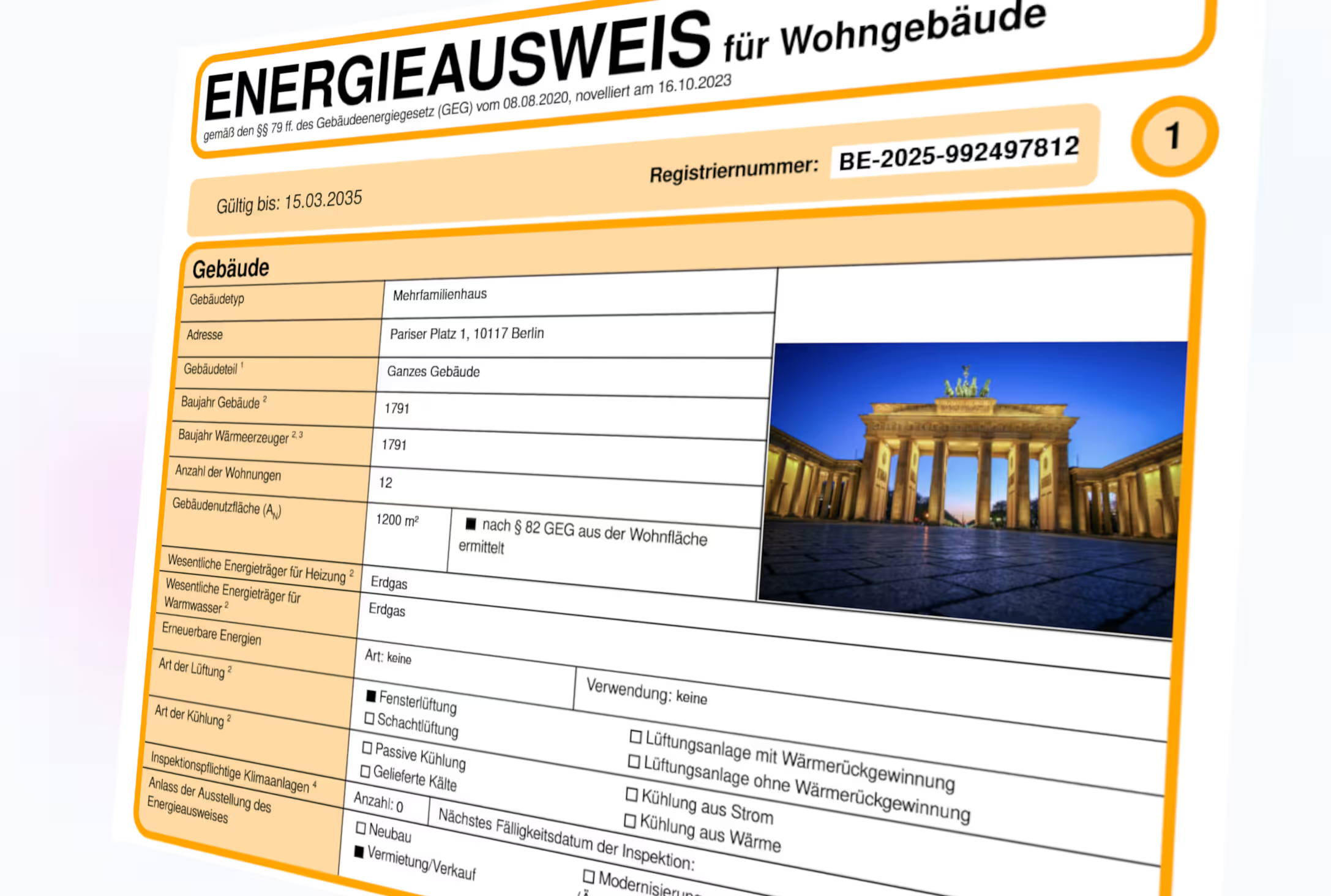
As everywhere in Germany, you need an energy certificate in Berlin when selling or letting a property. It is mandatory in Berlin and Brandenburg and must be presented at the viewing.
What you need to know
- … how refurbishment status in Berlin affects the energy certificate
- … where to apply for a legally compliant energy certificate for your Berlin property online
- … which energy sources and heating systems dominate in Berlin
- … which energy refurbishment measures pay off in Berlin
- … what funding you can get in Berlin for energy refurbishment
This article explains how local conditions in Berlin and Brandenburg affect energy certificates for residential buildings and how you can apply for a certificate quickly and in line with legal requirements online.
Energy efficiency in Berlin: building age and energy certificates
For a first assessment of a building’s energy efficiency in Berlin, the building age class can be a useful indicator. Berlin has many older buildings that often need energy refurbishment. Inner-city areas in particular have a high share of buildings from the late 19th century that have often not been refurbished. Based on current data, the chart below shows the distribution of building age classes (older, post-war, new build) for inner Berlin, outer districts and the surrounding area.
Baualtersklassen in Berlin und Umgebung
Baualtersklassen in Berlin und Umgebung
This data is from the 2021 census and shows a clear spatial difference between inner city and outer districts that strongly affects energy efficiency. In the inner city with its high share of older stock, up to 70% of buildings need refurbishment, while the outer districts are already dominated by new and post-war builds, which are usually more energy-efficient but still have modernisation potential. In the surrounding area many new homes for families and commuters have been built in recent years, already meeting high efficiency standards.
The table below links building age classes with refurbishment rate and typical efficiency classes (according to the energy certificate) for inner city, outer districts and surrounding area:
| Category | Building age classes | Typical energy efficiency class | Refurbishment rate (2025) |
|---|---|---|---|
| Inner city |
|
| 25 % |
| Outer districts |
|
| 40 % |
| Surrounding area |
|
| 60 % |
This shows which efficiency classes to expect for each age class and how refurbishment status affects the energy efficiency of residential buildings.
Refurbishment status and energy certificates in Berlin
The refurbishment rate in Berlin must increase significantly to meet climate targets by 2045. It is currently around 40% but is to rise to over 90% by 2035. So the investment needed for energy modernisation of Berlin’s stock is huge and requires coordinated action by policy, funding banks and owners.
Due to the high share of older stock in Berlin, many buildings have poor energy efficiency in the F–H range. Energy certificates with these classes can be a starting point for comprehensive refurbishment. Energy refurbishment directly affects the efficiency class in the certificate, property value and eligibility for funding in Berlin. Through targeted measures such as insulation, heating replacement or full refurbishment, owners can not only cut energy costs but also benefit from public funding.
To support owners with energy refurbishment, the state provides substantial funding. The federal funding for efficient buildings (BEG) offers grants or low-interest loans for measures such as insulation, window replacement or heating renewal. The so-called “Worst Performing Building Bonus” (WPB bonus) is especially interesting: buildings with the worst efficiency class H receive an extra 10% grant when refurbished.
Energy certificates for residential buildings in Berlin: figures and trends 2025
Energy certificates are a central tool for assessing and making transparent the energy quality of residential buildings. In Berlin, with its diverse stock, they play an important role in meeting climate targets and modernising the housing market. In 2025 there are many developments and trends affecting both owners and tenants.
In Berlin an estimated 40,000 to 50,000 energy certificates for residential buildings are issued each year. This is because certificates are legally required in certain situations – for example on sale, letting or comprehensive refurbishment. As certificates are valid for 10 years, many issued in 2015 need to be renewed now.
With the 2024 GEG amendment, requirements for energy certificates were tightened. Since 2024, newly issued certificates must also include greenhouse gas emissions (CO₂) per square metre. This is intended to make the climate impact of buildings more transparent and encourage owners to modernise. Initial calculations show that many existing buildings may receive worse figures under the new criteria – often 20–25% compared to previous certificates.
Good to know: The efficiency class in energy certificates depends not only on building age and refurbishment status but also on the type of certificate. So we especially recommend applying for an Energyausweis Smart™ for multi-family buildings. It determines the class from both consumption-based and demand-based certificates and then issues the certificate with the better class.
Energy certificate in Berlin online
In Berlin and Brandenburg it is especially easy to create an energy certificate online. Via energyausweis.de you can apply for a legally compliant certificate for your residential building in a few steps. The certificate is prepared by a certified energy consultant, meets legal requirements and is valid for 10 years.
The energy certificate is available in two types: consumption-based and demand-based. Which is right for your building depends on several factors. The consumption-based certificate is based on actual consumption over the last three years; the demand-based certificate on an energy assessment of the building.
A third option is the Energyausweis Smart™, which combines the benefits of both. When you order an energy certificate online, the right type for your building is selected automatically.
Tip: Make sure the certificate is prepared by a certified energy consultant using software that carries the DIN V 18500 quality mark. Only then can you be sure of a high-quality certificate that meets legal requirements.
Energy sources in Berlin: which dominate the market 2025?
The energy sources and heating technologies used in Berlin depend strongly on location. In the inner city district heating dominates, operated with innovative technologies such as power-to-heat and large heat pumps. In the outer districts heat pumps and solar thermal are widespread; in the surrounding area renewables such as photovoltaics and biomass are increasingly used.
As fossil fuels such as coal and gas are increasingly phased out, renewables are gaining importance. Berlin is relying on innovative solutions such as wastewater heat and hydrogen to meet its climate targets. Nevertheless, modernising the older stock remains a central challenge.
Besides energy refurbishment and insulating the building envelope, which are decisive for a good efficiency class, the type of heating also matters. The table below shows the main energy sources (gas, district heating, heat pump, solar thermal) in and around Berlin, with primary energy factor, typical efficiency class and optimisation potential.
| Energy source | Share of buildings | Primary energy factor | Optimisation potential |
|---|---|---|---|
| Gas heating | 45 % | 1.10 | Replace with heat pumps or connect to district heating |
| District heating | 34 % | 0.45 (Berlin network) | Use waste heat and renewables in the network |
| Heat pump | 4.3 % | 0.43 | Improve efficiency with PV for self-consumption |
| Solar thermal | 2 % | 0.00 | Combine with other systems such as heat pumps or gas |
Using sources with a low primary energy factor reduces CO₂ emissions and thus environmental impact. This figure is calculated and shown in both consumption-based and demand-based certificates.
Top energy measures for Berlin properties: maximum efficiency, minimum cost
Energy refurbishment of buildings is a central topic in Berlin. Given rising energy costs and ambitious climate targets, it pays for owners to make their properties more efficient. Targeted measures can not only reduce energy costs but also tap funding and increase property value. Here are six of the best measures offering maximum efficiency at minimum cost.
| Measure | Efficiency gain | Funding | Cost–benefit ratio |
|---|---|---|---|
| Insulating the building envelope | Significantly reduces heat loss, especially in older buildings. | Up to €500,000 per project (IBB) and 15–20% of cost (BEG). | High savings on heating costs, especially effective in unrefurbished buildings. |
| Replacing/optimising the heating system | Modern heat pumps or gas heating reduce energy use and CO₂ emissions. | Up to €60,000 per unit (IBB and BEG). | Long-term reduction in running costs and better efficiency class. |
| Installing photovoltaics (PV) | Own generation reduces primary energy demand and energy costs. | Grants via BEG, especially combined with heat pumps or batteries. | Very effective with high self-consumption, pays back in a few years. |
| Integrating solar thermal | Supports hot water and heating, reduces fossil fuel need. | Up to 20% of cost (BEG), ideal with other systems. | Cost-effective addition to existing heating, especially in refurbished buildings. |
| Connecting to district heating/building networks | Reduces primary energy demand through renewables and waste heat. | Up to €500,000 per project (IBB Effiziente GebäudePLUS). | Especially effective in urban areas like Berlin, good climate balance. |
| Digital controls | Optimises energy use through smart heating and ventilation control. | Grants via “Effiziente GebäudePLUS” for building automation. | Long-term savings through precise control of energy use. |
Every energy certificate also contains information on possible modernisation measures. These are only recommendations but give a first indication for energy refurbishment. The measures above are especially effective and allow owners to improve their properties sustainably.
Solar energy in Berlin: potential, sunshine hours and impact on the energy certificate
According to the Masterplan Solarcity, solar could meet up to 25% of Berlin’s electricity demand. Studies show maximum solar potential of 6 to 10 GW, half of it on residential buildings. Despite obstacles such as listed buildings and ownership structures, growth potential is huge.
With an average of 2,005 hours of sunshine per year, Berlin is one of the sunniest cities in Germany. The summer months in particular offer ideal conditions for PV and solar thermal.
Solar energy significantly improves a building’s efficiency class in the energy certificate by reducing primary energy demand. PV and solar thermal are often listed as modernisation recommendations to cut energy costs and CO₂ emissions.
Based on available data on Berlin’s solar potential, roof areas in the inner city, outer districts and surrounding area and their potential generation can be estimated as follows:
| Region | Suitable roof area | Installable capacity | Annual generation |
|---|---|---|---|
| Inner city | 🏙️ 12.8 km² | ⚡ 2,492 MW | 🔋 2,405 GWh/year |
| Outer districts | 🌳 25.1 km² | ⚡ 4,884 MW | 🔋 4,705 GWh/year |
| Surrounding area | 🏡 7.8 km² | ⚡ 1,518 MW | 🔋 1,463 GWh/year |
| Total | 🌍 45.7 km² | ⚡ 8,894 MW | 🔋 7,929 GWh/year |
Berlin has enormous solar potential: full use of suitable roof area could generate almost 7,929 GWh per year, about a quarter of Berlin’s total electricity demand. The outer districts in particular, with their larger roof areas, offer the best conditions for expanding PV.
These figures underline the importance of further solar expansion in Berlin – for the energy transition and for cutting CO₂ emissions and increasing the capital’s energy independence.
Energy refurbishment in Berlin: funding and loans overview
Berlin offers numerous funding options for energy refurbishment to reduce energy consumption and CO₂ emissions. The Investitionsbank Berlin (IBB) supports owners with programmes such as “Modernise housing” and “Energy building refurbishment”. Low-interest loans of up to €150,000 per unit can be applied for, for example for insulation, heating modernisation or modern building services.
At federal level, the funding for efficient buildings (BEG) offers attractive grants and loans. Individual measures such as insulation, window replacement or heat pump installation are funded with up to 20% of cost. For full refurbishment to efficiency-house standard, KfW loans with repayment grants of up to €67,500 are available. Replacing old heating is also generously supported – for example with grants of up to 70% of cost for heat pumps.
Energy advice is often a prerequisite for funding and is itself funded. BAFA covers up to 50% of advice costs, max. €650 for single-family and €850 for larger residential buildings. An individual refurbishment roadmap helps plan measures strategically and use funding optimally.
| Programme | What is funded | Amount | Notes |
|---|---|---|---|
| Effiziente GebäudePLUS (IBB) | Thermal insulation, plant technology, digital systems, efficiency-house standards | Up to 40% of cost, max. €500,000 per project | Can be combined with federal funding, application to IBB required |
| Federal funding for efficient buildings (BEG) | Individual measures (insulation, heating replacement, ventilation), full refurbishment | Grants of 15–70% of cost, repayment grants up to €67,500 per unit | Application via KfW or BAFA, energy advice often required |
| BAFA energy advice | Individual refurbishment roadmap (iSFP) | 50% of advice cost, max. €650 (single-family), €850 (multi-family) | Extra €250 for presentation at owners’ meetings |
| ENEO advice Berlin | Reports and advice on energy refurbishment | Grants for energy reports and advice costs | Supports planning and implementation of measures |
| KfW loan 261 (residential) | Full refurbishment to KfW efficiency-house standard | Low-interest loans with repayment grants up to €30,000 per unit | Expert planning and site supervision required |
| Solar thermal and PV funding | Installation of PV or solar thermal | Grants up to 20% of cost depending on system size | Combination with other measures (e.g. heat pumps) preferred |
| Heating replacement (BEG) | Replacing old heating with heat pumps, biomass or district heating | Grants up to 70% of cost, max. eligible cost €30,000 per unit | High funding for renewables |
There is also funding for renewables such as solar thermal, biomass heating or connection to district heating. Owners in Berlin can draw on a wide range of grants and low-interest loans to make their buildings more energy-efficient – an investment that pays off financially and ecologically. All these measures improve the efficiency class in the energy certificate.
Conclusion
This article highlights the importance of the energy certificate for residential buildings in Berlin and how it creates transparency about the energy quality of properties. Especially in a city with diverse stock, from unrefurbished older buildings to modern new builds, the energy certificate is a central tool for owners and tenants. It is not only a legal requirement on sale or letting but also a basis for modernisation decisions that can increase property value.
Besides an analysis of building age classes and their typical efficiency classes, the article looks at the main energy measures, funding options and the use of renewables such as solar. With targeted refurbishment and state support, owners can cut energy costs, reduce CO₂ emissions and support Berlin’s climate targets. The energy certificate is not just a legal document but a valuable tool for sustainable and economic property development.
For other locations, see: Energy certificate in Hamburg: apply online and save, Energy certificate in Frankfurt: faster online in the Main metropolis and Energy certificate in Munich: order from the online test winner. To order your energy certificate, go to Create energy certificate online.